
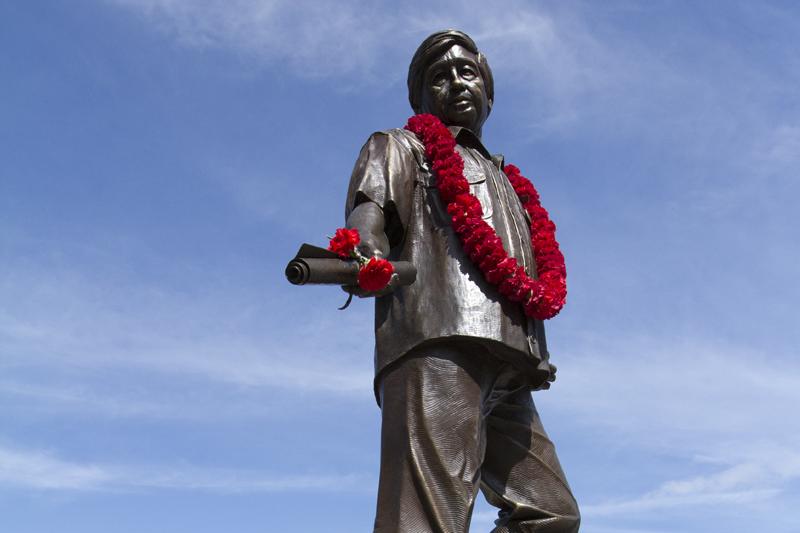
Fresno State has spent nearly three decades celebrating César Chávez. Now, the university is finally being forced to confront who he really was.
For many years, Chávez has been celebrated as a civil rights activist and a leading figure in the fight for farmworker rights. His legacy is deeply tied to the Central Valley. Institutions across California have honored him through schools, streets and public landmarks.
There is even a state holiday dedicated to him, which falls annually on March 31.
Now, that legacy is being tarnished.
Recent allegations, including statements from civil rights leader Dolores Huerta, accuse Chávez of sexual abuse involving women and minors during his leadership of the United Farm Workers union. Alongside criticism of his treatment of undocumented workers, these allegations challenge the way he has long been honored.
In response to these allegations, Fresno State President Saúl Jiménez-Sandoval announced that the university has covered the statue and will remove it, calling the allegations “profoundly troubling” and deserving of “moral reckoning.”
That response is appropriate, but it cannot be where the conversation ends. Fresno State has a pattern of honoring flawed figures and only reevaluating them when the situation becomes too significant to ignore.
Fresno State sophomore Ally Ayala expressed frustration with the continued glorification of Chávez.
“Despite the work he did for farmworkers, he treated his own people poorly and was racist toward them,” Ayala said. “Now we’re learning he also sexually abused the women who helped carry the movement forward. He deserves to be stripped of his holiday, his statues and his recognition as a historical figure.”
Statues aren’t neutral. They represent admiration and respect. When a university places a statue of someone in a space like the Peace Garden, it makes a statement about the person’s values. The university is actively choosing who represents dignity, justice and respect.
This is not about erasing history. Chávez’s role in the farmworker movement is undeniable and should continue to be taught. There is a clear difference between teaching about a historical figure and celebrating them as a moral example. Fresno State has too often blurred that line.
The university has already faced similar questions before. The removal of Henry Madden’s name from the library shows that Fresno State is capable of reevaluating who it honors when confronted with new understanding.
Madden, a former Fresno State president and key figure in expanding the university, was later criticized for his antisemitic views, prompting the university to reconsider whether his name aligned with its values. That same standard must apply here.
If the university is serious about this standard, it cannot stop with Chávez.
The Peace Garden raises a bigger issue. A space meant to represent peace and justice includes figures whose legacies are more complicated than they are often portrayed.
Mahatma Gandhi, another figure honored in the garden, has also faced criticism for racist views and harmful beliefs. His statue should also be removed. Otherwise, the university risks sending a message that accountability is applied selectively.
If Fresno State is serious about reconsidering Chávez, it must apply that same standard to others it continues to honor. That includes Gandhi. Honoring a figure whose legacy includes racist and harmful views in a space meant to represent justice contradicts the university’s stated values.
Students aren’t satisfied with simplified versions of history anymore. They expect institutions to be honest, especially when that honesty is uncomfortable.
Covering the Chávez statue is a first step. Removing it would be a meaningful one.
The issue goes beyond a single figure. Fresno State must take a hard look at its values and who it chooses to honor.
A space called the Peace Garden should represent peace, dignity and respect. Right now, it falls short of the very values it claims to represent.