
The Abridged version:
Urban farms in the Sacramento region have taken off, but the list of challenges is also growing, clouding the future.
The final installment of Abridged’s look at Sacramento’s urban farms details the hurdles farmers face in an urban environment.
Sacramento’s urban farmers look to the next quarter century with hope and apprehension. What can the movement become?
Missed the first two parts? Read them here:
Part one: How Soil Born Farms reshaped Sacramento’s food ecosystem
Part two: First, we planted front yard gardens. Now thousands rely on Sacramento region’s urban farms
The people behind the Seeds of Solidarity urban farm know all too well how land instability can inhibit effectiveness and sow disillusionment.
Last summer, the mutual aid farm in West Sacramento received notice that its lease was being cut short, by several years, to make way for the parking lot of the future California Indian Heritage Center, which is projected to open around 2030.
“We were a little surprised to receive that notice,” said Kelsey Brewer, a cofounder.
The loss of the land and move to a new site across from Oki Park in the College/Glen area of Sacramento has been a source of sadness for Brewer and others who devoted many years to stewarding their original farm into a community asset, only to have it ripped away.
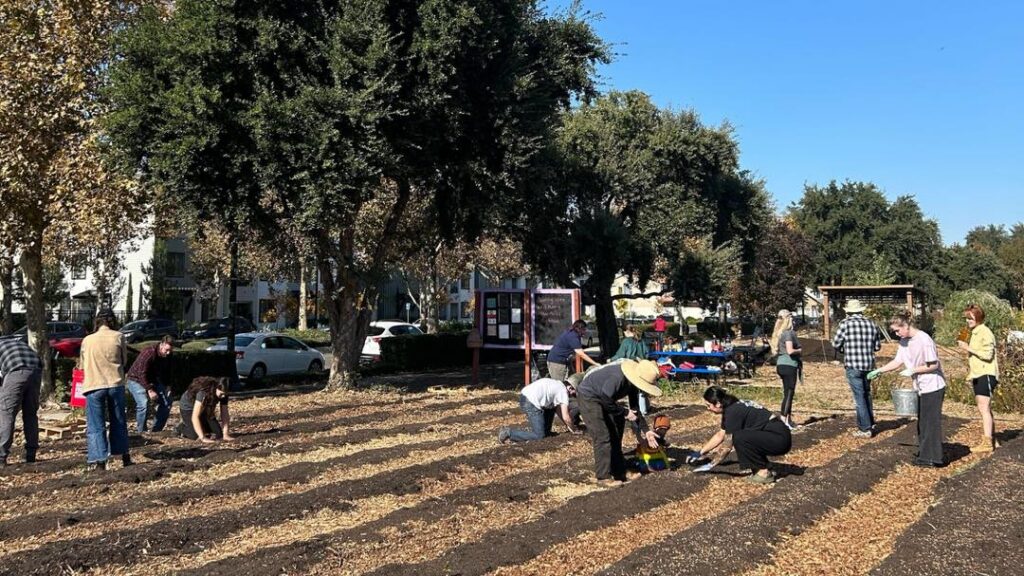 Seeds of Solidarity in West Sacramento received notice that its lease was being cut short. (NorCal Resist)
Long to-do list to reach urban farming goals
The problem of land access and instability adds to an already long list of work left to be done to fully realize the Sacramento area’s commitment to urban farming and its claim as America’s Farm-to-Fork Capital.
To do that, said Paul Towers, of the Sacramento Food Policy Council, people need improved access to tools, free seeds, plants and compost, and publicly owned vacant lots; more affordable water rates for urban farming; and expanded hours to operate residential farm stands, which for now are limited.
“For a place that proclaims itself committed to farm-to-fork, we can’t just be satisfied with a few farms and a few families being able to grow things,” Towers said. “These efforts should be universally accessible. We should be modeling how to be the best urban farmers, beekeepers, chicken keepers, whatever cropping system or livestock you wish to keep, we should be exemplifying how you can do that in an urban environment.”
Sometimes local efforts have faltered or seem to take forever to come to fruition. For example, the city-owned former tree nursery at Mangan Park in South Sacramento cycled through numerous City Council members and plans and sat mostly vacant since 2008, to get to the point now where progress is foreseeable.
Three Sisters and Planting Justice, a Bay Area nonprofit, last week launched a project to create a 1-acre seasonal farm and 4-acre tree nursery at the site. That will offer jobs and workforce training for youth and people who were formerly incarcerated. (Three Sisters’ founder Alfred Melbourne was in prison for 18 years.)
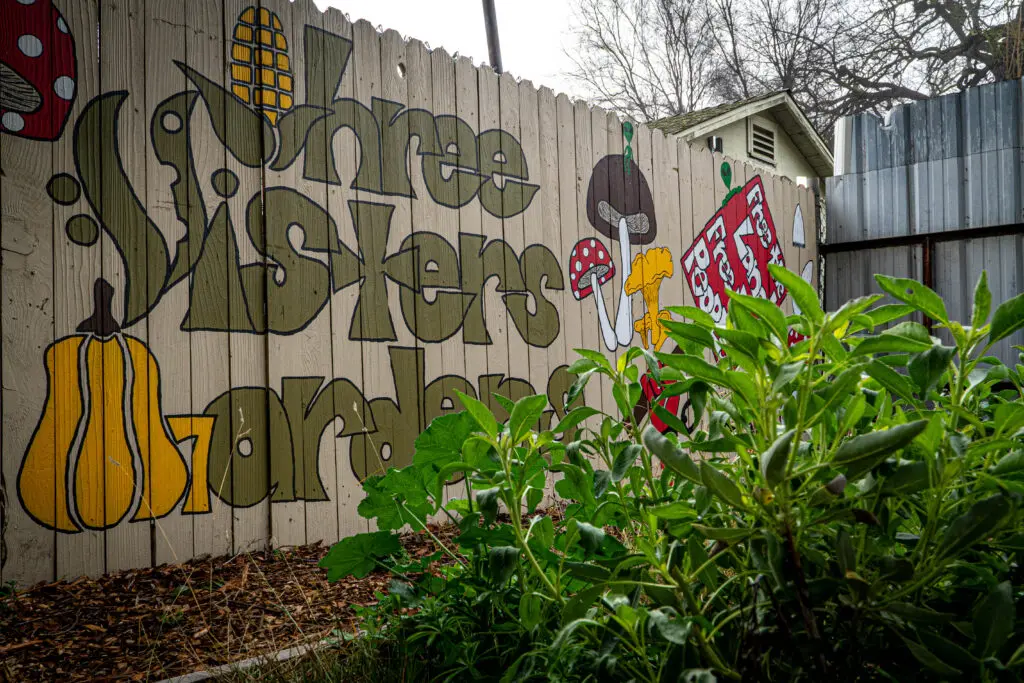 Three Sisters Gardens sign in West Sacramento. (Tyler Bastine)
‘We pack our bags, we move on.’
Another urban farming program, Del Paso Heights’ Growers Alliance, got its walking papers to depart their headquarters site, at Root Cellar Community Garden on Marysville Boulevard, this past September after 12 years there, said founder Fatima Malik.
Malik had seen the writing on the wall a few years ago when the landowner was “humming and hawing about renewing the lease and wanting to sell the land,” she said. She called the price he wanted for the 0.1-acre plot “ridiculous.” With that foresight, they proactively adopted the plots at the International Garden of Many Colors.
“We’re thankful that we were there for as long as we were even though the ground was (poor) and we built the soil, and the soil health now is so supreme and superb,” Malik said. “But we don’t just take that soil with us, right?”
Sign Up for the Morning Newsletter
The Abridged morning newsletter lands in your inbox every weekday morning with the latest news from the Sacramento region.
Like Three Sisters Gardens in West Sacramento and Seeds of Solidarity, Del Paso Heights Growers’ Alliance’s work is seeped in incorporating the cultural practices and knowledge of immigrants and refugees, and in self-sovereignty and poverty intervention. The reliance on grocery stores in a globalized food economy may be fine for those with secure financial means, but not for the people in her neighborhood or for the environment at large, Malik said. Her neighbors are struggling financially, mentally, physically and psychologically, and she feels no choice but to continue this work, which she views as healing.
“We’re going through the wounds of being so vulnerable, but also loving our community so much,” she said. “Because we do it out of a place of love for our community.”
And so they continue. “We pack our bags, we move on.”
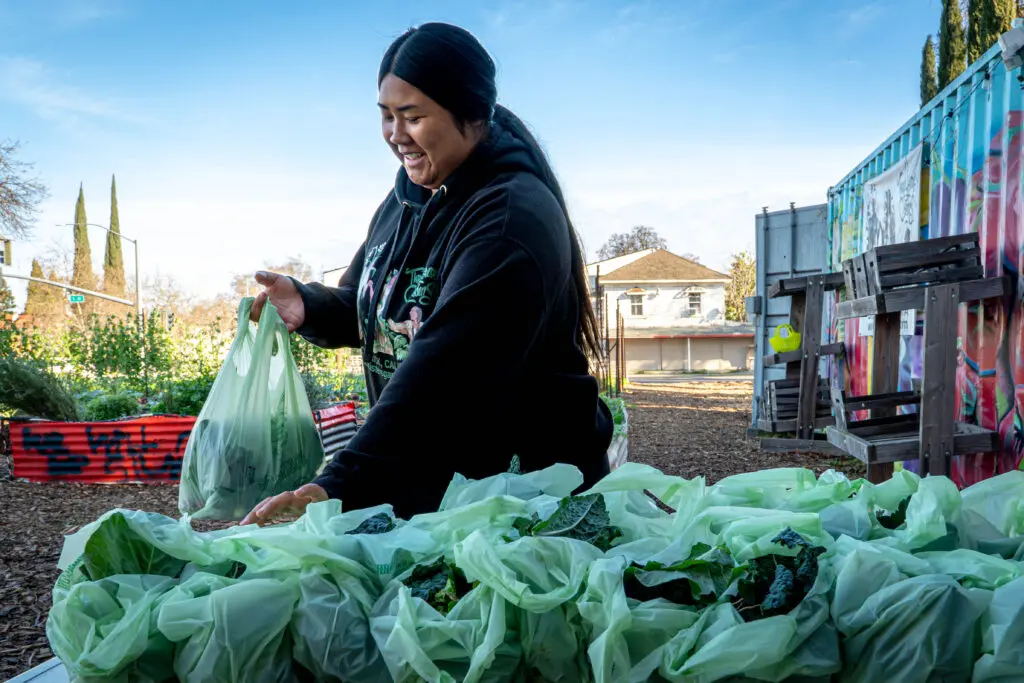 Nancy Long, employee at Three Sisters Gardens, fills vegetable bags for donation through the farm’s Community Giving program. (Tyler Bastine)
How one farmer with land stability thrives
Root 64 in Sacramento’s Tallac Village neighborhood shows how well an urban farm can do when a farmer has land access and stability.
In 2017, Randy Stannard and his business and life partner, Sarah McCamman, purchased a 1-acre property with a house on 64th Street off Fruitridge Road, “fortunate,” Stannard said, to have made a cash offer. In a perfect world, they’d love to expand and buy a property on either side of them, including one whose owner allows Root 64 to dump bulk materials there since space and access on their own land is lacking.
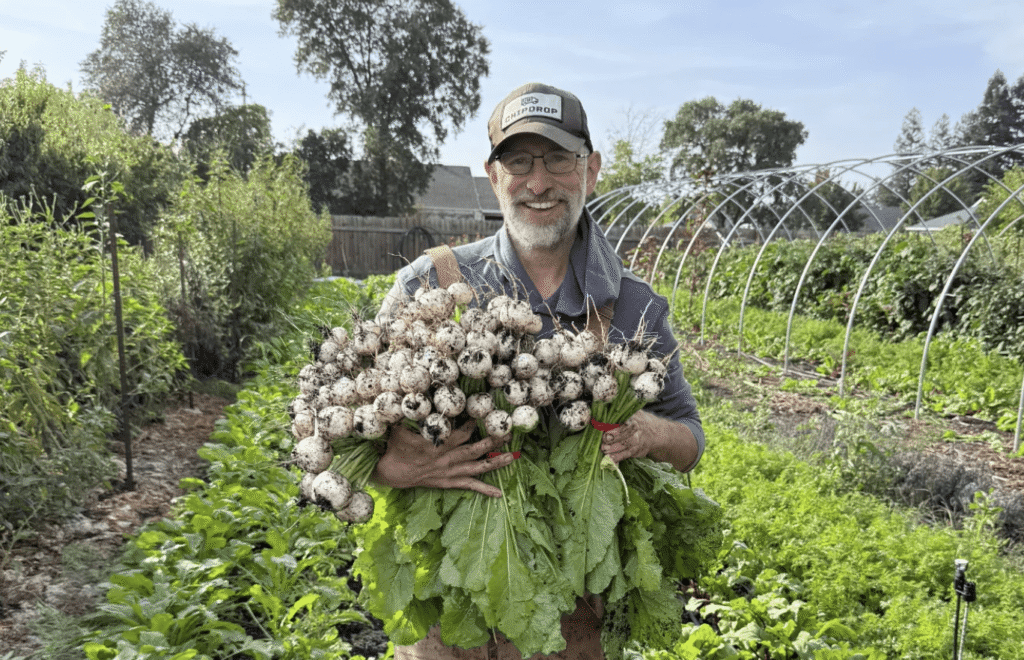 Randy Stannard at Root 64 farm. (Root 64)
Front yard market a boon
More than six years in, Root 64 is still building out infrastructure. The farm behind the house is full of upcycled and freecycled pieces found on Craigslist and Facebook Marketplace. A friend built a straw bale walk-in cooler, and a commercial version sits next to it. McCamman is the builder, designer and engineer, and crafted together the farm’s wash pack station. It has a greenhouse; it holds a big plant sale each spring, which has become “huge,” Stannard said, and provides early season income. There are compost piles, 60 garden beds and six caterpillar tunnels (structures that help extend the season for both spring and fall greens, herbs and roots, and provide partial shade for summer crops).
Root 64 is an “intensive market garden,” Stannard said, and structured as a limited liability corporation. It had a popular booth at Oak Park Farmers Market, but when their son was born during the pandemic, it opted for something convenient and close to home, setting up a farm stand in their front yard from April through November. “That has turned into a real boon,” Stannard said. “We sell way more than we ever did at a farmers market.”
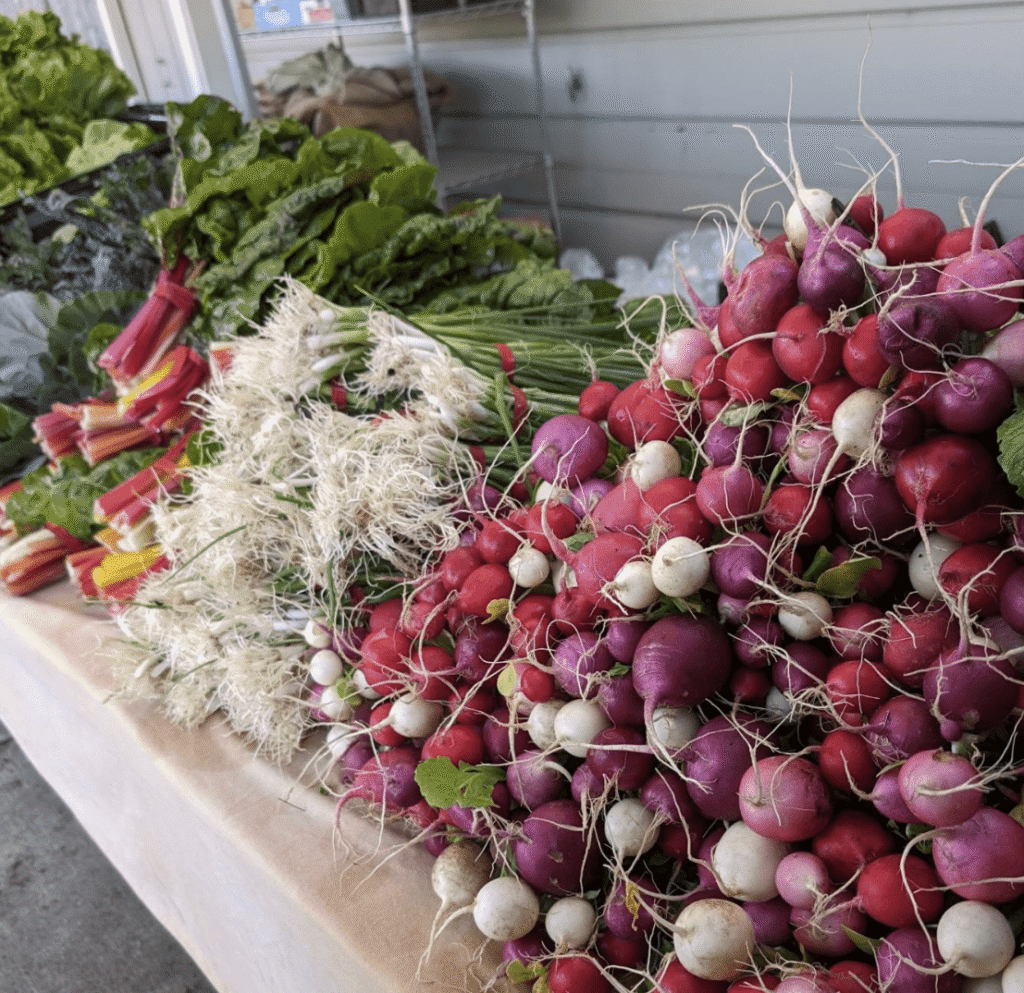 Root 64 farm stand. (Root 64)
Customers include Magpie, The Waterboy
Root 64 also sells its produce to the Spork Food Hub in Davis, Central Kitchen and restaurants such as Magpie, The Waterboy, Mulvaney’s B&L and more. Sales exceeded $150,000 last year, which is “amazing” out of this space, Stannard said.
An urban agriculture grant from the California Department of Food and Agriculture has allowed Root 64 to hire a few part-time workers during the season, an experiment to see if it can actually afford employees as a small farm business. The verdict is still out.
Stannard, who cut his teeth in the Sacramento area’s urban farming scene working for nearly 10 years with Soil Born, said the past couple decades have brought increased interest in urban agriculture and more generally in home gardening and healthy eating, but he noted there remains a core group doing the urban ag work.
“[In terms of] how many people are working in it, doing it, even just running a farm-type thing, just there’s not that much,” he said. “It’s very hard to do what we have done. It’s pretty unique, both in skill sets, resources, all the things to be able to pull that off.”
 Tomato tonnato dish at The Waterboy made from produce from Root 64 farm. (Root 64)
An ecosystem emerges
As Stannard stood along rows of cover crops, his friend Kent Thompson walked through the farm and approached him, holding out a small purple gym bag.
“What do you have in the bag?” Stannard asked. “Cash?”
Thompson pulled out a big bag of Blue Bottle coffee roast. Root 64 uses the coffee chaff — leftover peels from roasting coffee beans that are rich in nitrogen — in compost and in other places around the farm. This batch will go into the garlic and potato beds.
“I’m a friend of the farm,” Thompson said. He’s the one who built the walk-in cooler. “I think this is the most beautiful place in Sacramento. The vibes here are just off the charts.”
Capital costs unrealistic for most
The larger ecosystem and infrastructure have evolved with food hubs and farmers markets and places like the Central Kitchen and many restaurants eager for local, high-quality produce.
But the capital cost for land access and infrastructure development is unrealistic for most people if they are looking to make a living out of urban farming. This could be an opportunity for local government investment and subsidization. “People can do the growing,” Stannard said. “But to do the growing, and run a business and build out the infrastructure, that’s a tall ask.”
One day Root 64 will ideally bring in enough income that its owners can hire a skilled farm manager to run day-to-day operations and free up their mental space to do more educational programming as they transition into older farmers and parent two growing children. “But doing intensive, annual vegetable production for the next 20 years probably isn’t my path,” Stannard said. “I hope.”
What about the next 25 years?
When Shawn Harrison, founder of Sacramento’s pioneering Soil Born Farm, peers out his Rancho Cordova office window, he has a direct view of construction on the animal barn. On the wall hangs a rendering of another construction project — a farm store and culinary classroom, part of a much larger Soil Born expansion currently underway.
“I’ve lived through a lot of construction,” Harrison acknowledged.
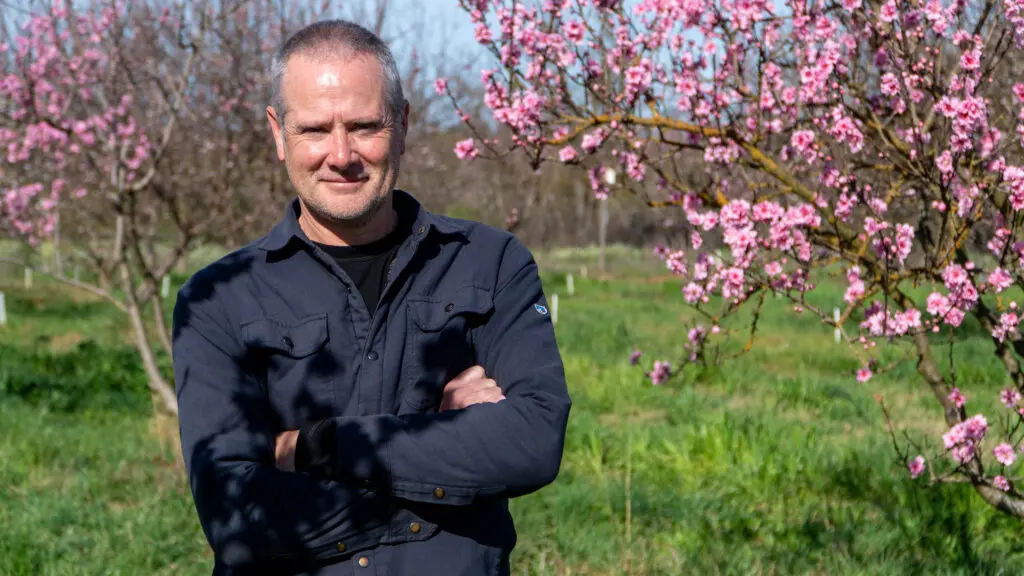 Shawn Harrison, co-founder of Soil Born Farms. (Tyler Bastine)
The question on Harrison’s mind is what will the next 25 years bring for Soil Born? They want to move out of telling the story of the past to articulating a vision of the future. Starting microbusinesses for new revenue streams, reducing reliance on grants and donations are on the to-do list.
They want to do more with farm-to-school and a systems change approach for long-term health and well-being. Harrison wants to double down on the role of the farm as a world-class demonstration site of best practices in sustainable, regenerative and ecological agriculture.
Harrison, a father of two young-adult daughters, is 54 years old. He has shifted from a young man with big dreams of changing the world to a middle-aged man living out his youthful aspirations.
He said it took him 25 years to actually understand what best practices look like and to feel smart enough to know what he’s doing. He describes his work as a privilege and a blessing, but as any farmer, urban or otherwise, can attest, also “really freaking hard.”
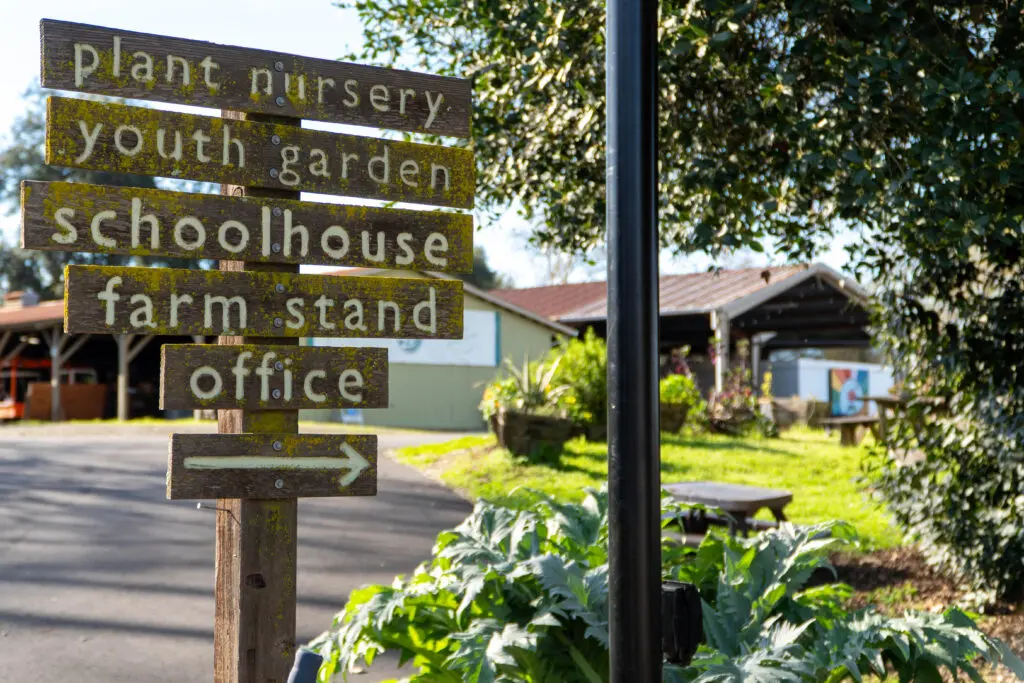 Signs at Soil Born Farms. (Tyler Bastine)
There’s work to be done
He pulled out his phone to read aloud a quote co-founder Janet Whalen Zeller recently sent him: “What a privilege to be tired from the work you once begged the universe for. What a privilege to feel overwhelmed by the growth you used to dream about. What a privilege to be challenged by a life you created on purpose, what a privilege to outgrow things you used to settle for.”
“I mean, I think that captures it all,” he said.
He rose up from his chair, gingerly stretching out his back. “I played tennis until 10 p.m. last night and I’m sore.”
It’s that good type of soreness, the one derived from having done a satisfying exercise or a good day’s work. Harrison, like other local urban farmers, may be sore and tired from physical labor, battle-tested from decades of advocating for change that not everyone welcomed, fatigued from a job that never seems to get any easier. But so far those pioneering urban farmers haven’t yet traded this life path for anything else.
“Do I plan on stopping? No, I’m as energized or more than I ever have been in terms of the possibility of the future, and where we’re going and what’s needed,” Harrison said. “What an amazing journey. I’m learning something every day, and the fruit of our labor — granted, it bumps up against all kinds of little challenges all the time that life brings — it’s rewarding, essential work.”
“There’s work to be done, you know. And while I’m on this Earth, that’s my commitment, is to try to do the work.”
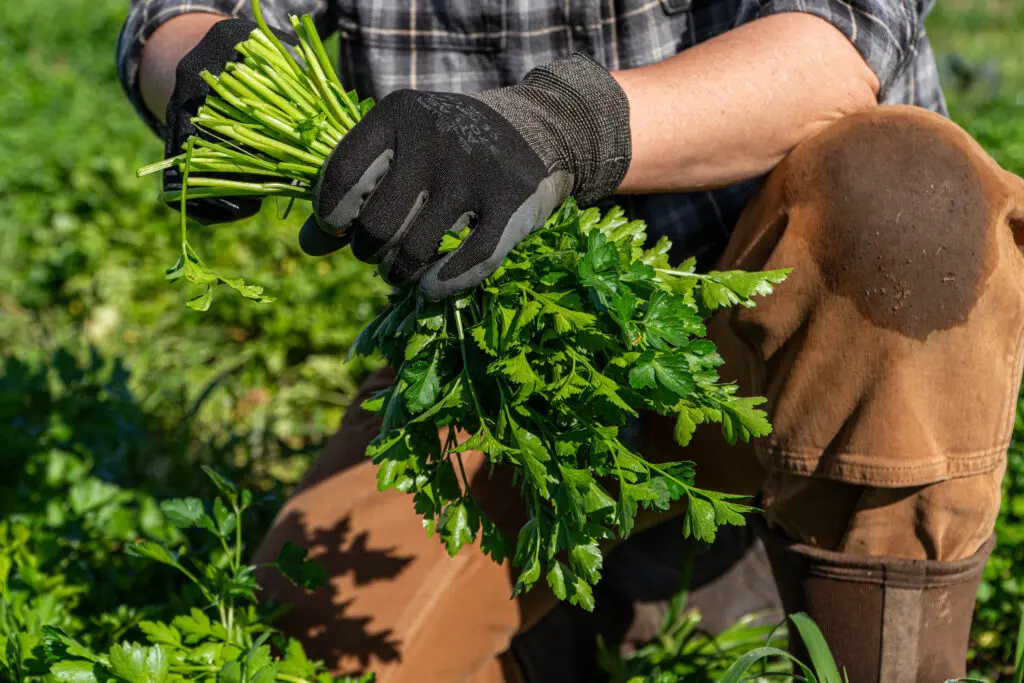 Harvesting plants at Soil Born Farms. (Tyler Bastine)
Sena Christian is a veteran journalist and freelance writer from Sacramento. She teaches journalism at Sacramento City College.