
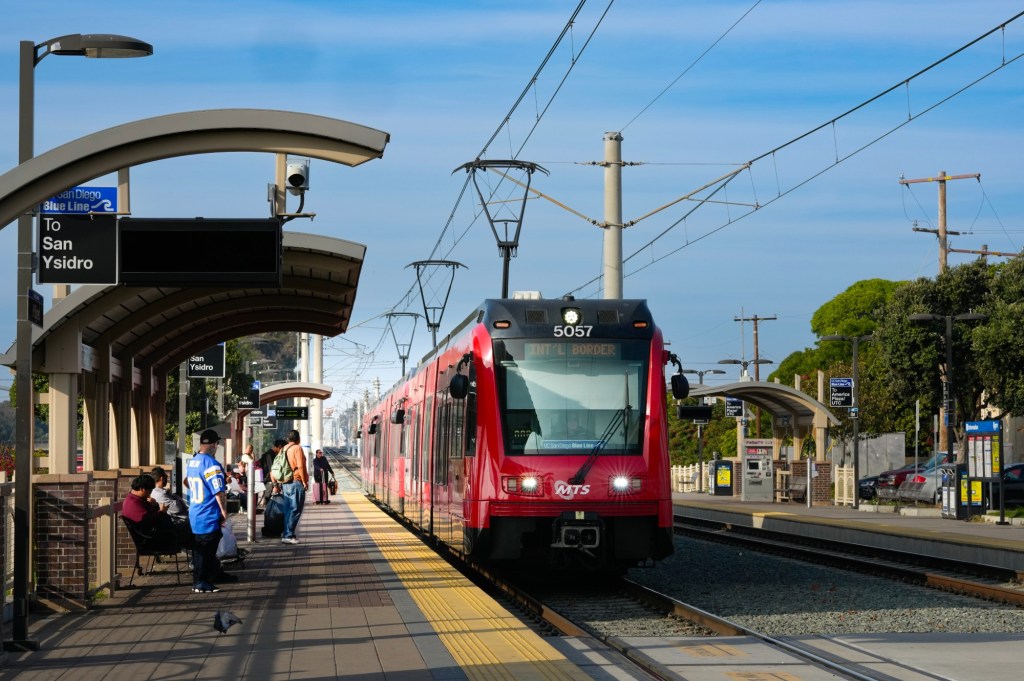
Local transit officials are blaming a recent dip in San Diego trolley ridership on the federal immigration crackdown and on lower-income transit users making fewer leisure trips because of rising household expenses.
Ridership rose 7% last fiscal year and had been projected to rise another 6.5% this fiscal year. Instead it’s down 1.3% since July — a drop that will cost the cash-strapped Metropolitan Transit System $8.4 million.
Sharon Cooney, MTS’s chief executive, said preliminary analysis shows the ridership drop is confined to trolleys — bus ridership is on target — and that there are two main causes.
“We’re seeing it across the country — that border regions are facing lower transit ridership in relation to fears of traveling due to ICE activities,” said Cooney, referring to enforcement actions by U.S. Immigration and Customs Enforcement.
“We also see that people will travel less — even though transit is their primary mode of transportation — if their household expenses are too high and they can’t afford to do other leisure activities,” Cooney told the MTS Executive Committee last week. “You’ll see the number of trips people take be lower.”
San Diego Councilmember Sean Elo-Rivera, a member of the committee, told Cooney the transit agency needs to prioritize efforts to make riders feel safe from ICE.
“I know we’ve talked about doing things to indicate to our riders that their safety matters to us, and we’re not going to do anything complicit in putting them in danger,” Elo-Rivera said.
Cooney said MTS is working with county officials to post signage on the system alerting passengers to their rights.
She stressed that MTS security guards and other personnel are always monitoring whether ICE is conducting activities within the transit system, and she said that so far they aren’t aware of any actions during the recent federal crackdown.
Elo-Rivera said he’s heard of ICE actions that, while not on MTS property, have been near enough to be a concern.
The dip in ridership slows the significant momentum MTS had been making to restore it to pre-pandemic levels.
Ridership on local buses and trolleys had been recovering from the disruptions of the pandemic much more quickly than the national average.
Annual ridership on MTS buses and trolleys rose more than 7% to 81.2 million during the fiscal year that ended last June — only 4.2 million lower than the pre-pandemic ridership of 85.4 million.
MTS’s ridership recovery of 95% was the second-highest for large transit systems in the nation and is well above the national average of 85% for large systems, according to surveys by the American Public Transportation Association.
Based on that momentum, MTS budget officials had expected another 6.5% increase during the ongoing fiscal year to 86.2 million passengers. But last week, they revised that down to 80.8 million passengers — a slight drop from the previous year.
Revenue generated per ride is also falling below projections.
An aggressive fare-enforcement effort launched in February 2025 had been boosting the revenue generated per ride, prompting MTS officials to predict it would continue to rise this fiscal year to $1.04 — a 7.6% increase over the previous year. While revenue per ride has risen, it is only up 6.1%.
Overall, passenger fare revenue is up 4.7% since the new fiscal year began in July, far short of the 14.5% projection.
Fare revenue for the ongoing fiscal year is now projected to be $80.8 million, far lower than the $89.2 million including in the budget.
The bad news on passenger revenue is mostly canceled out by good news on interest earnings and sales tax revenue, which are several million dollars over projections.
“We’re really being saved this year by the increase in sales tax forecast, which is mostly offsetting that decrease in passenger revenue,” said Gordon Meyer, manager of financial planning for MTS.