
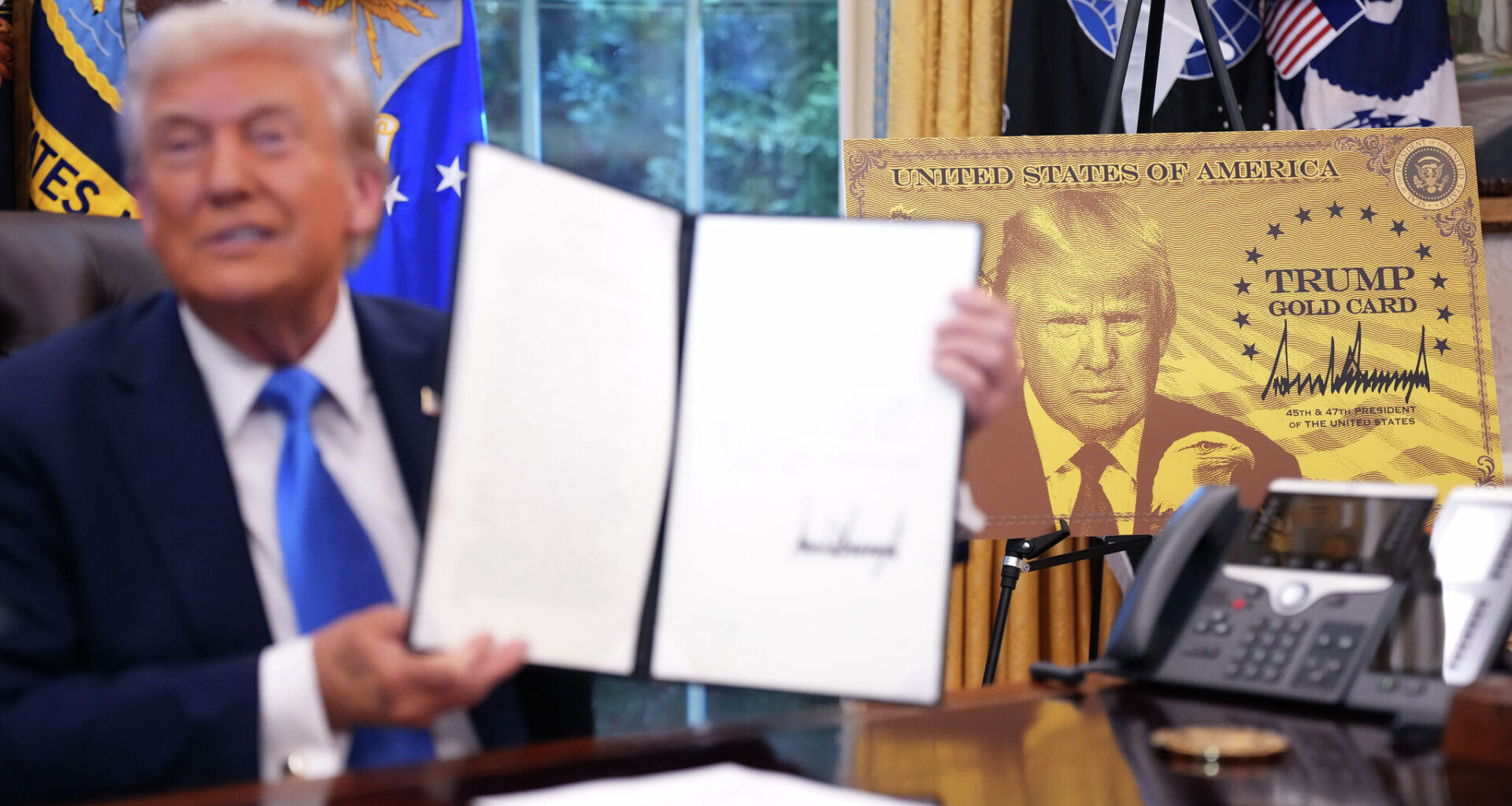
President Donald Trump holds up an executive order establishing the “Trump Gold Card” in the Oval Office on Sept.19, 2025. Trump also introduced a $100,000 fee for H-1B visas.
Andrew Harnik/Getty Images
A poster inside the Oval Office touts the Trump Gold Card, a visa program that allows foreign nationals permanent residency and a pathway to U.S. citizenship for $1 million.
Andrew Harnik/Getty Images
The Trump administration’s overhaul of the Bay Area tech industry’s most-used visa program has scrambled the plans of companies and foreign workers and left families separated across continents, as immigration attorneys brace for more shocks to H-1B holders and hopefuls as new rules roll out.
Thursday marks the end of the registration period for the latest H-1B lottery, which has been transformed under President Donald Trump’s anti-immigration policies. The employer-sponsored visa is used to bring foreign workers in for specialty jobs from software to health care and offers a pathway to a green card. But Trump has taken a restrictive stance on the program, saying the changes prioritize American jobs.
Lawyers who guide employers through the program are anticipating not only fewer applicants this year because of a new $100,000 fee, but an uptick in denials, which happened during Trump’s first presidency. Any fallout will have an outsize impact on the Bay Area labor market, where the San Jose and San Francisco metro areas have welcomed the highest concentration of H-1B workers in the country.
Article continues below this ad
Current H-1B visa holders say they feel frozen in fear, scared to travel outside the U.S. as they face added layers of scrutiny upon returning.
“There are so many broken families,” said a 40-year-old Bay Area biotech worker whose wife and two U.S.-born children are stuck in India, caught in a crippling appointment backlog to get a visa stamp required for travel. The Chronicle agreed not to identify him because he fears speaking publicly could compromise his family’s case.
San Francisco Chronicle Logo
Make us a Preferred Source to get more of our news when you search.
Add Preferred Source
His wife, who was visiting relatives with the couple’s children, expected a simple trip to a consular office for a basic interview with an immigration officer. Then, the entire system changed overnight in December. She was no longer able to schedule the needed visit. Without a stamp, her visa is useless.
New social media screening requirements that vet visa holders and applicants for threats and “anti-American content” have swamped U.S. consular employees with unprecedented workloads, prompting mass appointment cancellations. The federal government’s decision to prioritize tourism visas for the upcoming World Cup games this summer could exacerbate the existing delays, attorneys said.
Article continues below this ad
Indian H-1B holders and their families have had appointments that were scheduled in the winter delayed over a year by the U.S. State Department. Others, like the biotech worker’s wife, can’t get an appointment scheduled at all.
“H-1B visa holders … are really terrified of traveling right now,” said Veena Dubal, an immigration law professor at UC Irvine and the general counsel for the American Association of University Professors, which is suing over the new H-1B fees. “There are stories of people not just being put into secondary inspection, but even having their H-1B visa stripped at the border when they’re coming back in.”
Not traveling isn’t always an option for those whose research or university work requires it. There are family emergencies or deaths abroad. And every three years, H-1B holders and their families must renew their visas. The U.S. had previously allowed visa holders to visit a consulate in any foreign country to complete the process and get their passport stamped. But Trump changed that in September and announced visa holders had to return to their home country.
The biotech worker, who is on the wait list for a green card, has been an H-1B holder for nearly a decade and works on drugs to treat cancer. His daughter, 5, and son, 1, are U.S. citizens. His wife has an H-4 spousal visa that corresponds with his status.
Now, the couple’s home on the San Francisco Peninsula is missing the normal chatter of children. The biotech worker returned to California without his family in January for work. His daughter was supposed to start kindergarten a short walk from their home in August. Instead, his wife is navigating education options for her in India. Her sixth birthday is in April, and her father will miss it. Every day, he scours internet forums for updates and tips as his wife tries to schedule appointments.
Article continues below this ad
The State Department did not respond to requests for comment about wait times or those stuck abroad, but in a December statement called a U.S. visa “a privilege, not a right” when announcing the new vetting standards.
“The United States must be vigilant during the visa issuance process to ensure that those applying for admission into the United States do not intend to harm Americans and our national interests,” the department said at the time.
Congress limits the number of new H-1B visas to 85,000 per year. The lottery, which historically gave every petitioner an equal shot, was created because of the high demand. A new weighted selection system gives petitioners between one and four chances in the lottery based on how well their job would pay. The Department of Homeland Security said the new system would “strengthen America’s competitiveness by incentivizing American employers to petition for higher-paid, higher-skilled foreign workers.”
The H-1B visa has been a go-to for research hubs, universities and Silicon Valley, often attracting talent from India. But Trump’s $100,000 visa fee for those currently outside the United States has kept regular users of the program from entering this year’s pool for next year’s class of H-1B workers.
In addition to a fee most universities or start-ups can’t afford, the new tiered-wage system gives only one or two entries for those lower-ranking jobs in the new tier system. It could create gaps in pipelines for international students to work in universities and research.
Article continues below this ad
“We’re definitely seeing a change in the landscape in terms of employers being more hesitant to sponsor people who are outside of the United States,” said Ana Gabriela Urizar, an immigration attorney.
Bay Area employers hired about 30,400 new workers last year on H-1B visas, with the bulk of them tied to the professional, scientific and tech industries — covering a mix of jobs such as accounting, consulting, engineering and research. California leads in the country’s H-1B visas, with the federal government approving nearly 40,000 such visas for new hires in the state last year. That’s more than one in five nationwide, according to federal data analyzed by Manifest Law.
San Francisco immigration attorney Lauren Gibson said she doesn’t have a single client pursuing an employee who would be subject to the $100,000 fee this lottery cycle. Instead, employers are focusing on people who are already in the United States under a different visa status. The fee won’t be charged to employers for workers changing or attempting to extend their status, though the government might challenge that and deny the request.
“I can tell you the impact is severe here and everywhere in the job market,” Gibson said.
While some employers are still pursuing foreign workers they believe won’t prompt the massive fee, some still don’t want to take on the risk of wasting time and money on the petition process, Gibson said. If the government comes back and says the fee is required, Gibson said, many of her clients will likely drop the employees.
Article continues below this ad
How often an administration denies H-1B petitions typically mirrors its immigration policy. During Trump’s last presidency, the denial rate more than doubled to a peak of 18.3%. Denials had dropped to 2.8% under President Joe Biden.
In the last 18 months, Gibson said, immigration attorneys have seen U.S. Citizenship and Immigration Services use its ability to “exercise discretion” to deny visa status extensions or changes. While that hasn’t yet happened to one of her H-1B clients, she’s anticipating it.
The ongoing war in Iran, for example, could be used to deny a change in status or extension for Iranians on H-1B visas, she said. Whatever the reason for the denial, the visa holder would likely have to go back to their home country to pursue the process.
“You know what that means,” Gibson said, “the $100,00 fee, and they’re probably not coming back because they may not get a visa anyway.”