
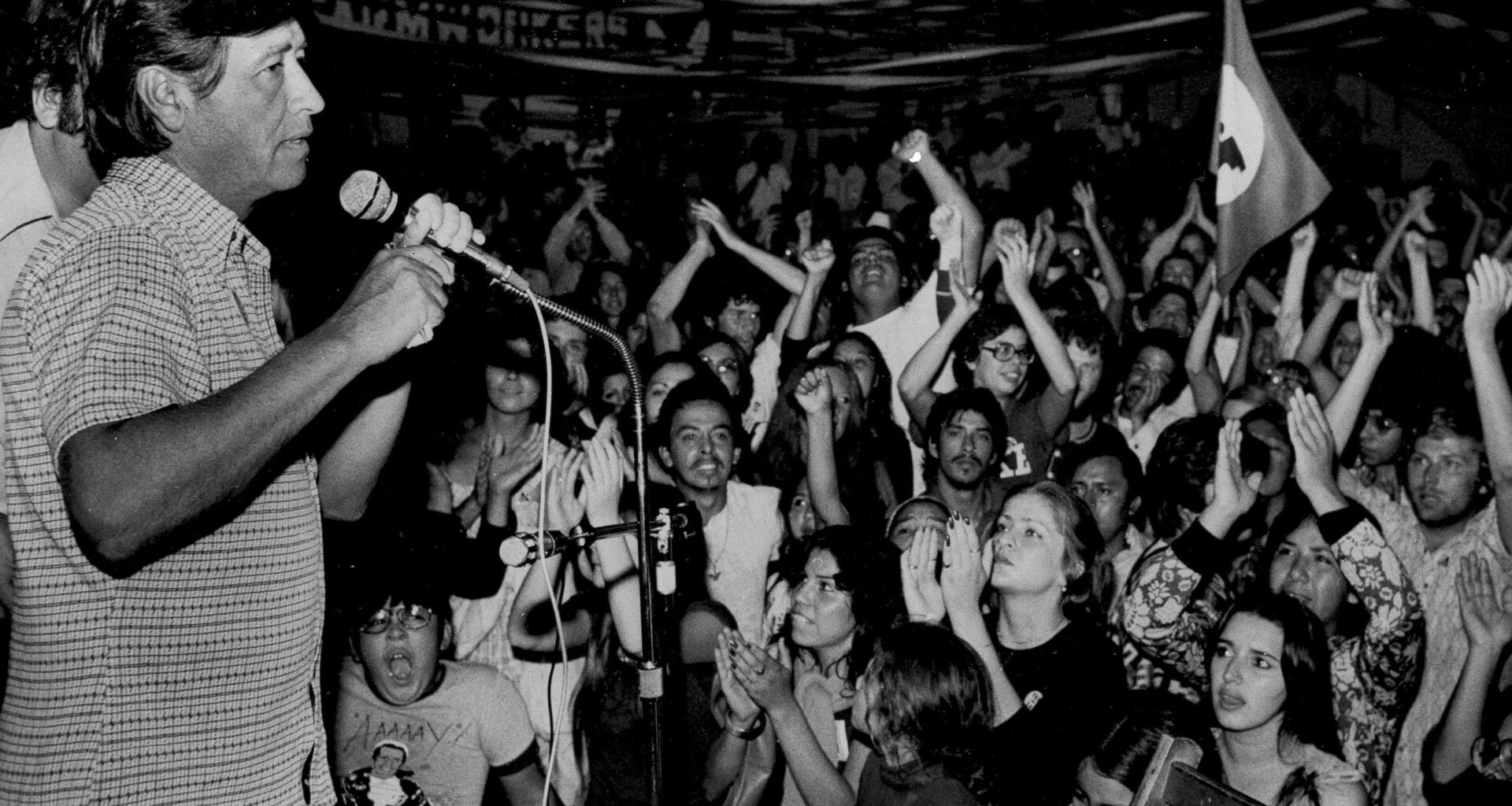
Civil rights icon César Chavez’s legacy is evident all over the East Bay. His name is on parks and schools and libraries. The farmworker movement he led through strikes, boycotts, and fasts inspired generations of local community leaders. At least one local elected official considered Chavez his personal “hero.”
So allegations reported in depth by the New York Times this week that Chavez sexually abused and assaulted women and girls, including United Farm Workers co-founder Dolores Huerta and two children of close advisors, left many in Oakland and the wider region reeling.
“It’s heartbreaking,” said Oakland Councilmember Noel Gallo. “For me, it’s someone I’ve honored, respected, and followed.”
Gallo, who represents the heavily Latino Fruitvale District, was a personal associate of Chavez, who died in 1993, and of Huerta, who is 95.
“Growing up here in East Oakland,” Chavez’s organizing “motivated many of us to not only speak out on behalf of our communities but to do the work…advocating for the humanity of not just farmworkers but those of us in the neighborhood,” Gallo said.
“The story and legacy of César Chavez and Dolores Huerta are in the DNA of many of our organizations,” said Caheri Gutierrez, communications director for the Unity Council. “Especially here in the Fruitvale.”
The Unity Council, which has supported the local Latino community since 1964, put out a statement Wednesday expressing “profound disappointment.”
“We stand in solidarity with Dolores Huerta and all survivors impacted by these actions, and we honor the courage of those who have spoken up about childhood abuse,” said Unity Council CEO Chris Iglesias.
Just under a year ago, State Sen. Jesse Arreguín, whose district includes Oakland, gave a passionate address on the Senate floor, honoring Chavez.
After the accusations surfaced this week, Arreguín said he supports survivors, including Huerta, whom he called a “long-time friend.”
“As the son and grandson of farmworkers, the labor movement has always lived in my bones and in many working families,” he said in a statement Wednesday. “The labor movement is larger than any one individual — it is a collective struggle rooted in human dignity and hard work.”
As a young organizer, Chavez worked in Oakland, developing ties to the city
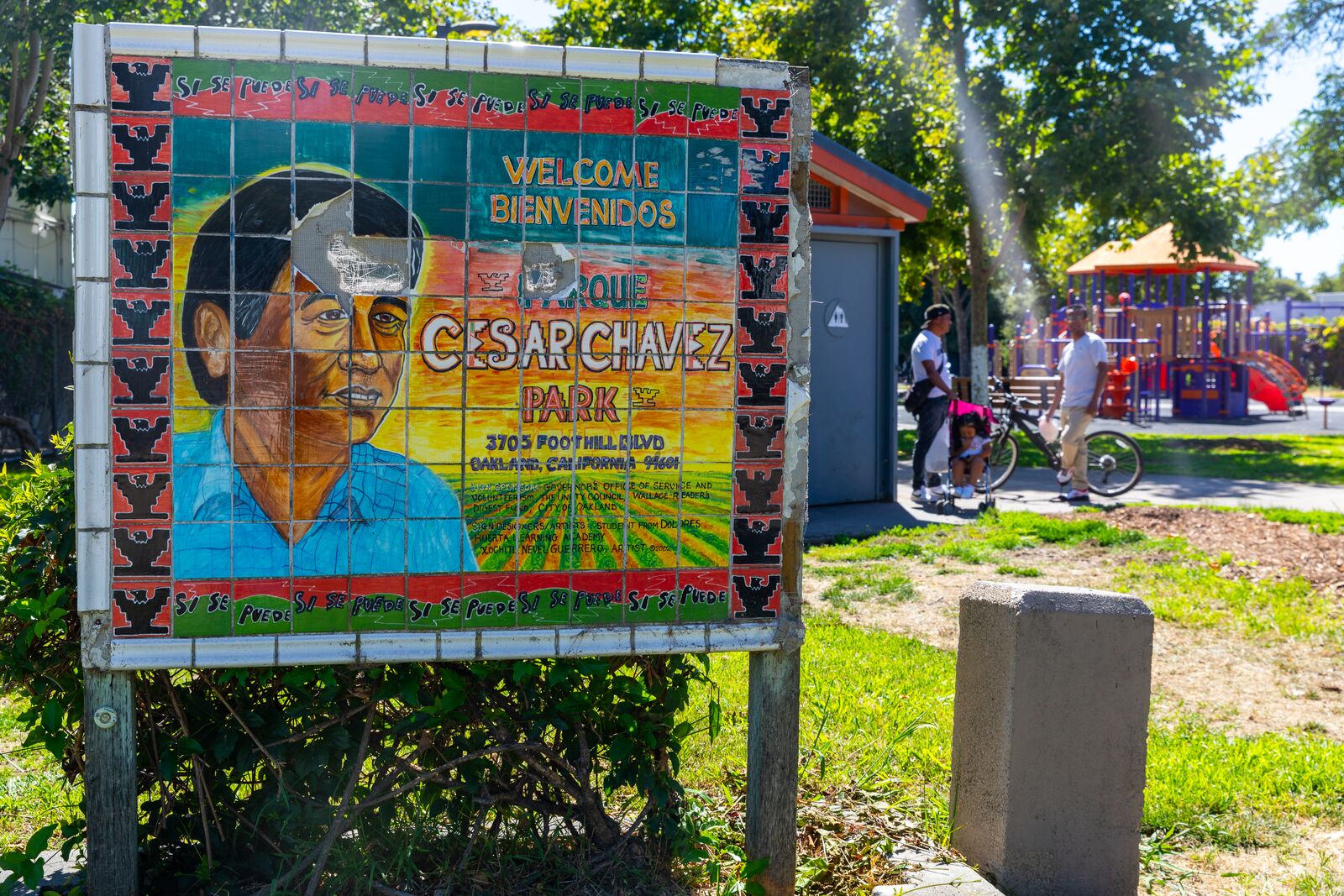 A park on Foothill Boulevard is one of many facilities named in honor of the workers’ rights leader in Oakland and the East Bay. Credit: Estefany Gonzalez for The Oaklandside
While he’s best known for his labor battles in California’s rural farmtowns, some of Chavez’s early years as an organizer included time in Oakland, where, in the 1950s, he led the Community Service Organization. The grassroots group registered voters, protested police brutality and housing discrimination, and advocated for the city’s Latino communities.
Years later, Chavez and the United Farm Workers drew on Oakland and the East Bay to support agricultural industry boycotts, join marches to the state capital and union drives, and more. In turn, Chavez’s endorsement became a coveted prize for local politicians, including radical outsiders like Black Panther Bobby Seale and more mainstream leaders like Lionel Wilson.
When he was on the school board, Gallo led the charge to name Oakland Unified’s César E. Chávez Campus.
There will be a lot to reconsider, he said.
The Oakland schools campus is one of many places bearing Chavez’s name in the city. The soccer field behind the Fruitvale school, a city park nearby on Foothill Boulevard, the Oakland Public Library branch in the Fruitvale Village, and county public health offices in Oakland, are among dozens of Bay Area buildings and facilities honoring him.
Some members of the Oakland City Council are considering renaming the César E. Chavez branch of the library in Fruitvale after Gallo.
The city and school district also pay homage to Chavez every March, coinciding with César Chavez Day. Since 2004, OUSD has recognized March 31 as César Chavez Day. And since 2014, the year Chavez’s birthday became a national holiday, the City Council has held an annual ceremony uplifting the service work of Latino and Latina community leaders as “continuing the legacy” of Chavez. The city also hosts a “Leading with Service Week” celebrating city employees in the name of the farmworker leader and movement.
The city administration is going ahead with some small changes that don’t require council approval.
The annual “Leading with Service Week” planned for March 30 to April 3 will no longer sport Chavez’s name, said City Administrator Jestin Johnson in an emailed statement.
“This week will remain a space to honor the courage, integrity, and lasting contributions of civil rights leaders — past and present — while reaffirming our shared commitment to protect workers, advance equity and inclusion, confront sexual violence, fight for justice, and uplift those whose voices have been marginalized or silenced,” Johnson said.
César Chavez Day, March 31, will remain a paid city holiday. (State legislators have already proposed changing the name to Farmworker Day.)
Johnson noted that this week’s revelations raise questions about city property named after Chavez, but said it’s too soon to tell what the council will pursue changing.
“The recent allegations concerning César Chavez — including harm against women and children, and against fellow civil rights leader Dolores Huerta — are deeply troubling. They underscore the painful truth that abuse of power is pervasive across society, affecting institutions and communities alike,” Johnson said.
Mayor Barbara Lee also issued a statement standing “unequivocally” with Huerta and the others who’ve accused Chavez.
“Their courage in speaking out must be met not only with words but with action, accountability, and an unflinching devotion to justice and dignity,” she wrote. No one person is “above accountability.”
Community organizers in Oakland on the meaning of reassessing Chavez’s legacy
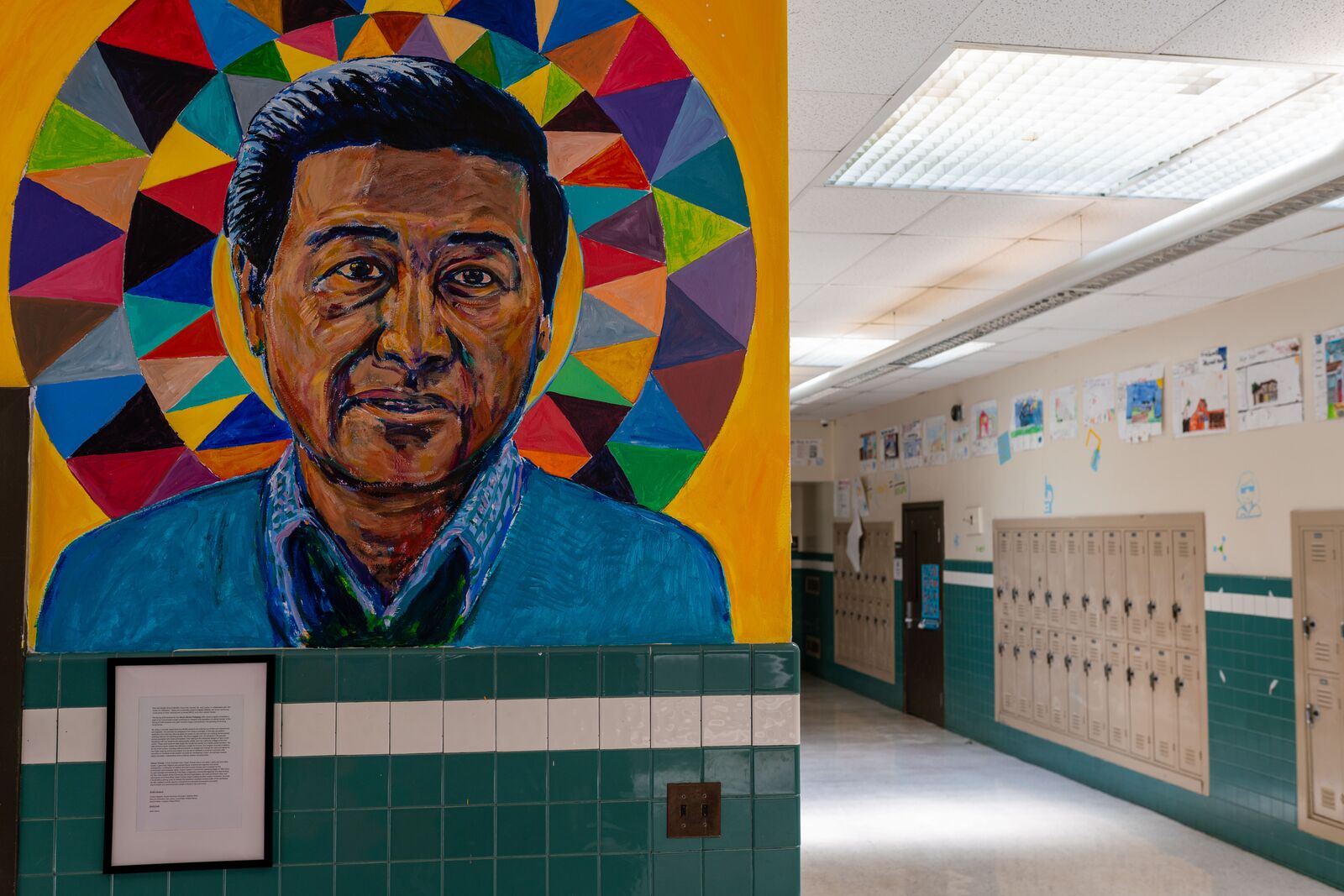 Chavez in the halls of Bret Harte Middle School in Oakland. Credit: Katie Rodriguez for The Oaklandside
In 2021, César Cruz, co-founder of East Oakland’s Homies Empowerment, spoke to The Oaklandside about how learning the history of Chavez and the farmworkers’ movement changed his life.
“I’m actually not scum,” he remembers thinking. “I came from organizers and activists; I came from people that have been victorious.” He studied the legacy, became close with members of the Chavez family, and eventually became an organizer himself.
The United Farm Workers’ nonviolent protest strategies became a “playbook,” Cruz said in the article, “and we achieved some major results.” Inspired by that movement, Cruz, then an educator, led 50 students and families on a march from Richmond to Sacramento, and went on a hunger strike over cuts in the West Contra Costa Unified School District. Huerta ended up counseling the group, and eventually they reached an agreement with then-Governor Arnold Schwarzenegger to repurpose the district’s debt.
One Richmond elementary school in that district is named after Chavez. Officials from the school and district did not respond to a reporter’s inquiries about how they’re navigating the revelations about Chavez, but the West Contra Costa Unified School District has a recent history of renaming campuses in response to new information.
On Wednesday, Cruz posted a statement responding to the allegations, sharing that he felt “real grief.”
The movement, he said, should not be reduced to Chavez’s work and legacy.
“It was [and] is Dolores Huerta, whose brilliance co-built the UFW and whose leadership has been systematically diminished in the retelling,” he wrote. “It was Larry Itliong and Philip [Vera Cruz], Filipino American labor leaders already striking in the fields of Delano before Chavez arrived, whose names have been too long erased. It was the mothers, the workers, the unnamed.”
Cruz did not respond to an interview request for this story.
Not everyone agrees that the new allegations should change things, however.
Elaine Brown, the former Black Panther Party leader, told The Oaklandside that she believes the women who’ve made accusations against Chavez should not have come forward many decades after the alleged abuses.
“As a woman, I’m not going to support someone abusing girls and women,” Brown said, “but the man has been dead all this time and has no ability to defend himself.”
Discrediting Chavez’s work and character is a “disgrace” that threatens to “dismantle” the still-necessary movement for farmworkers’ rights in the Central Valley and elsewhere, she said. “We have to continue to have Black and brown coalitions — I’m ashamed of them for doing it this way.”
The panthers supported the farmworker movement, promoting their boycotts on the front page of their newspaper, Brown said. She recalled getting Mills College to open a dormitory to house 200 workers during a march.
She added that if she had issues with an individual inside the Black Panther Party, she’d keep that information to herself so as not to undermine its legacy.
Gutierrez from the Unity Council has a very different perspective.
“The movement isn’t discredited,” she said. One person’s “shady” behavior doesn’t take away from the validity and successes of the collective work. For Gutierrez, it’s saddening that an idol of hers like Huerta allegedly underwent traumatic experiences alone and felt she had to keep quiet.
For the Unity Council, “it’s going to be phases of having conversations with the executive team and our community members — hearing them out and understanding what healing and justice means to them,” Gutierrez said.
But she does fear that the right wing could exploit the news.
“It’s a blow for the Latino community right now, because we’re already under attack,” Gutierrez said. “I can already see Trump having a field day with this.”
Sexual abuse allegations against César Chavez
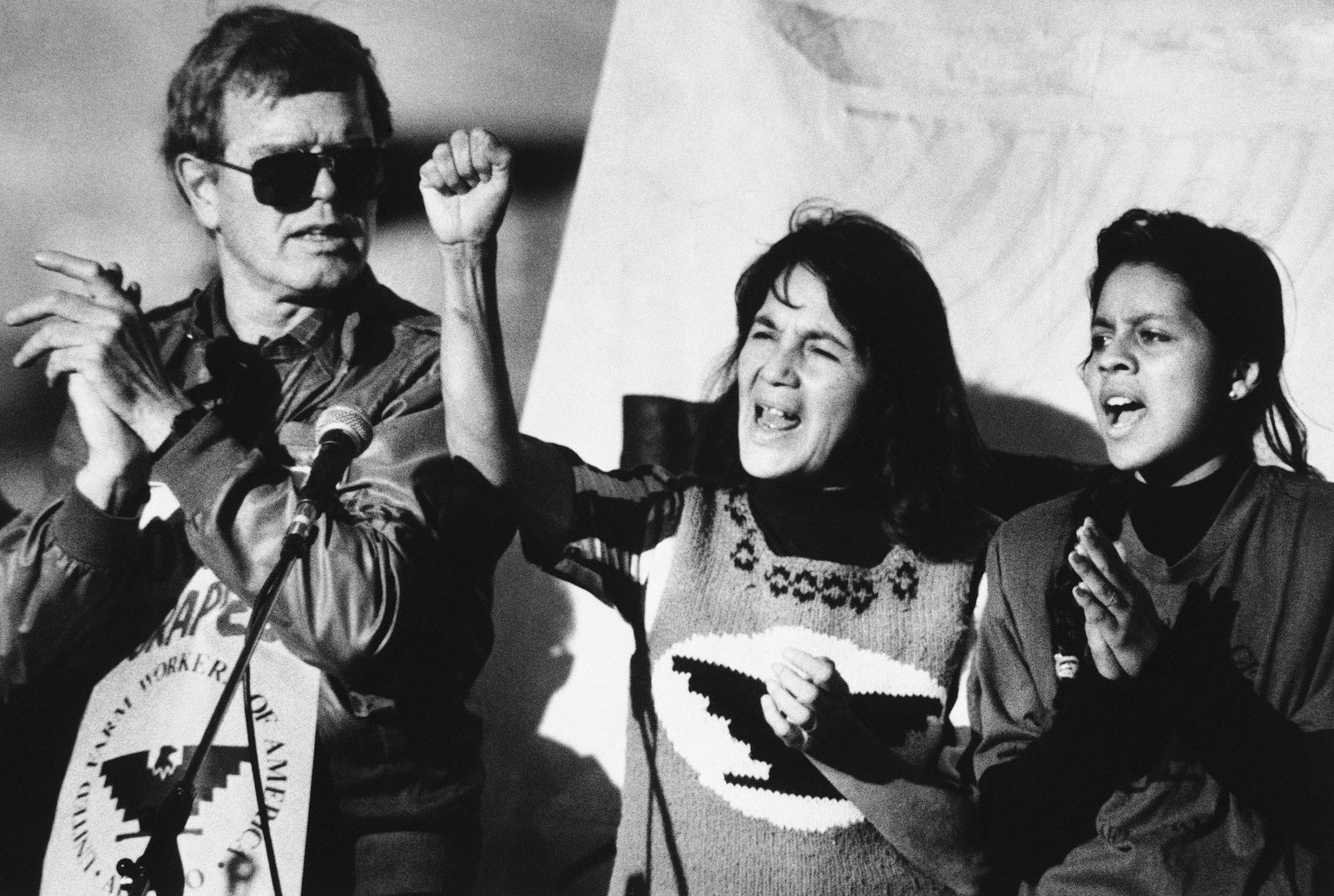 Dolores Huerta, center, leads a United Farm Workers rally in San Francisco in 1988. At age 95, she went public this week with accusations against her UFW co-founder Chavez. Credit: AP/Court Mast
The New York Times’ Wednesday investigation focused on accusations that Chavez molested Ana Murguia starting when she was 13 years old, and that he abused and raped Debra Rojas starting when she was 12. The alleged abuse took place in the 1970s.
The reporting was based on interviews with both women, whose memories were confirmed by others they confided in around the time and years later. Huerta said she was pressured to have sex and later, in a separate incident, raped by Chavez in his car in a grape field in Delano in 1966. The Times’ report cited UFW records and recordings as evidence supporting the allegations.
In a statement released Wednesday, Huerta said she stayed silent for 60 years out of concern that her words would hurt the farmworker movement. She described two sexual encounters with Chavez, one where she was “manipulated and pressured” and another where she was “forced against my will.”
“I carried this secret for as long as I did because building the movement and securing farmworker rights was life’s work. The formation of a union was the only vehicle to accomplish and secure those rights and I wasn’t going to let César or anyone else get in the way,” she said.
In 1962, Huerta and Chavez co-founded the National Farm Workers Association, which became the United Farm Workers of America.
Huerta said both of her sexual encounters with Chavez led to pregnancies, which she kept secret, and that she arranged for the children to be raised by other families.
“No one knew the full truth about how they were conceived until just a few weeks ago,” she said in her statement.
Huerta said she did not know that Chavez hurt other women and condemned his actions but emphasized that the farmworker movement is bigger than one person.
“César’s actions do not diminish the permanent improvements achieved for farmworkers with the help of thousands of people,” Huerta said “We must continue to engage and support our community, which needs advocacy and activism now more than ever.”
Eli Wolfe, Jana Kadah, Darwin BondGraham and The Associated Press contributed reporting to this story.
“*” indicates required fields