
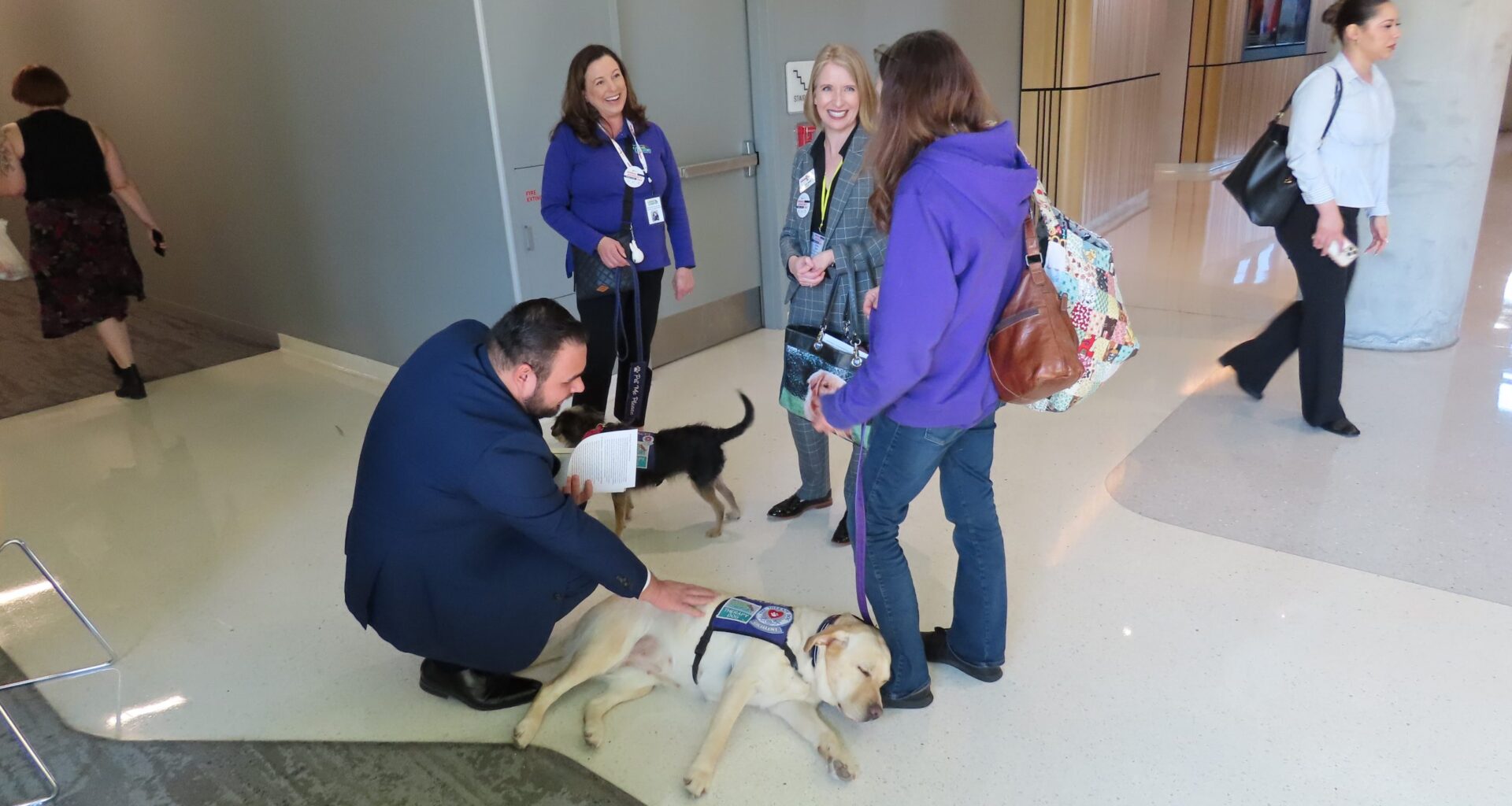
Nearly 100 animal advocates from across the state, including about a dozen from the Tri-Valley, met with legislators in Sacramento this month to talk about animal welfare bills that seek to address a myriad of issues such as illegal cockfighting, the overpopulation of cats and dogs and coexistence with wildlife.
The fourth annual Animal Advocacy Day, which took place on March 3, was sponsored by a number of animal welfare organizations, including the San Francisco Society for the Prevention of Cruelty to Animals (SF SPCA) and Pleasanton’s own Valley Humane Society (VHS).
“Today was a great opportunity to take really important animal welfare legislation directly to the legislators who serve our district and who serve all of California,” Rebecca Burton, the marketing manager for VHS, told the Weekly following the event. “It was a really special opportunity that a lot of people often don’t get.”
Valley Humane President and CEO Melanie Sadek told the Pleasanton Weekly it was the organization’s second year in a row sponsoring the event and the first time they had volunteers show up to advocate alongside VHS employees and herself.
“It’s the first time where we’ve really done a push to get people to come up and kind of feel what it’s like to have a say in the capitol,” Sadek said.
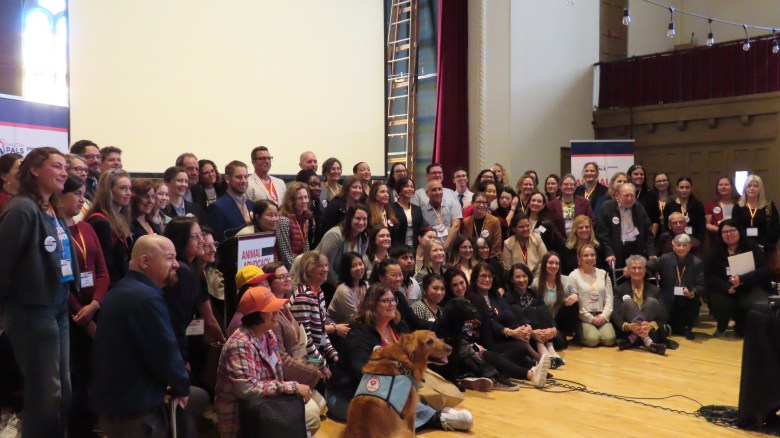 Nearly 100 advocates from across the state pose for a photo at the church before heading out to meet with legislators at the Capitol Annex Swing Space.(Photo by Christian Trujano)
And while it was many of their first time doing this type of advocacy work at the state capitol, for many of the volunteers and participants at Animal Advocacy Day, they said they felt like it was their duty to show up and speak up for animals because they can’t do so themselves.
“We live in a world where you have to be loud and what I’m learning is … people don’t realize the power that they have by speaking up,” Shyamalima Karan, a Pleasanton resident and volunteer at VHS, told the Weekly. “As constituents … you think your duty as a citizen just ends after you vote but, not really. Sometimes (legislators) need to hear what you have to say.”
Participating organizations and their volunteers for the event included the American Society for the Prevention of Cruelty to Animals (ASPCA), the San Diego Humane Society, Best Friends Animal Society and Humane World for Animals.
The day started in front of the VHS shelter in Pleasanton where 11 people got on the Black Tie Transportation bus and began the drive to the state capital. According to VHS, the bus ride was free, courtesy of the chauffeur company.
The group arrived in Sacramento around 9 a.m. at Westminster Presbyterian Church, where they checked in and attended a presentation from several animal welfare leaders who went over the details of the bills that the advocates would be discussing with lawmakers. They later walked over to the Annex Swing Space, located just across the street from the State Capitol, to meet in small groups with individual legislators and their staff members.
State Sen. Scott Wiener (D-San Francisco) and Assemblymember Chris Rogers (D-Ukiah) were among some of the people who spoke during the presentation about the importance of some of these bills.
Wiener in particular talked about Assembly Bill 2010, also known as the “Spay/Neuter Improvement for Pets (SNIP) Act”, which he is championing. According to the informational sheet handed to advocates to distribute to legislators, the SNIP Act updates regulations for high-quality, high-volume spay and neuter clinics, allowing them to operate in larger surgical spaces without the current requirement for a fully enclosed operating room.
“Current regulations require a separate surgical suite for aseptic procedures, a restriction that significantly slows high-quality, high-volume spay and neuter services and prevents the effective use of community clinics in underserved and rural areas,” according to the information sheet.
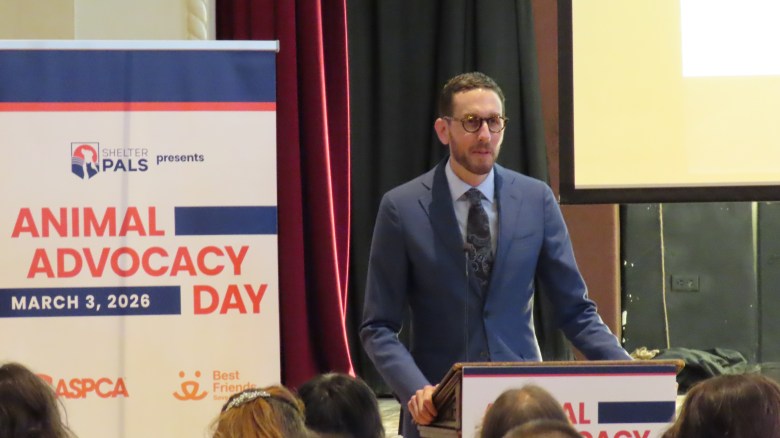 California Sen. Scott Wiener speaks with advocates about one of the bills he is championing: Assembly Bill 2010, also known as the Spay/Neuter Improvement for Pets (SNIP) Act. (Photo by Christian Trujano)
Jennifer Scarlett, CEO of SF SPCA, said as a veterinarian who has performed countless spay and neuter surgeries throughout her career, bills like the SNIP Act are important because it allows the veterinarians to conduct surgeries in places just like the church where the opening reception for the Advocacy Day was held, a practice she said is critical to addressing the overpopulation problem in the state and stop shelters from being forced to euthanize animals — an act that shelters overwhelmingly are against.
“It is our only safe, effective and permanent humane way to stop the reproduction of dogs and cats,” Scarlett said, adding that based on data, even with mortality rates, over the span of five years cats and dogs have the ability to produce anywhere from 7,000 to 10,000 babies.
Burton was one of the advocates who was particularly supportive of the SNIP Act.
“We do have an issue with access to care in the state of California and there’s a veterinary shortage,” she said. “So any opportunity to really bridge that gap is one that I support.”
Another one of the Tri-Valley advocates who felt strongly about the SNIP Act was Liwen Cheung, a Danville resident and VHS employee. Cheung joined the advocacy group with her daughter after having heard about last year’s Advocacy Day and feeling compelled to join this year’s group.
As someone who works the front desk at VHS, Cheung said she gets a lot of calls from people inquiring about spay and neuter services for their own pets as well as feral animals.
“I didn’t realize there were actually some barriers to getting high-volume, high-quality spay and neuter clinics … so I think that is one that I can really relate to,” she said.
Advocates also spent the day seeking a legislator who would champion a $5 million general fund budget appropriation in the 2026-27 state budget that would help implement Senate Bill 1233, which authorizes California veterinary schools to create specialized, high-volume spay and neuter certificate programs.
While the bill has already been approved, the funding needed to help launch these training programs at the University of California, Davis School of Veterinary Medicine and the Western University of Health Sciences College of Veterinary Medicine has not.
According to the advocacy informational materials, the funding request, would allocate $5 million — half for each school — to help pay for faculty positions, facility retrofits, equipment, certification programs and low- or no-cost public spay and neuter services to train veterinary students and licensed professionals in efficient, high-volume techniques that “increase statewide sterilization capacity and deliver long-term public health and animal welfare benefits”.
Another bill that advocates presented to legislators and their staff members was Assembly Bill 928, also known as the “Cockfighting Cruelty Act”. According to the advocacy information sheet, the bill would give law enforcement and animal control agencies additional tools to address illegal cockfighting, including abusive “fowl yard” practices that confine and condition roosters in ways that cause significant suffering.
“This bill will address gamefowl yards across the state and safeguard local communities from the cruelty, noise, avian disease and criminal activities linked to cockfighting,” according to the informational sheet. “Exemptions are included for legitimate poultry operations, hobbyists, and educational programs.”
The bill also excludes bantam chickens, which are not used as fighting birds.
According to the animal welfare leaders during the morning presentation, the bill imposes a “$2,500 fine for each rooster exceeding a limit of 25 on any parcel of property while restricting their movement through tethers or solitary confinement”.
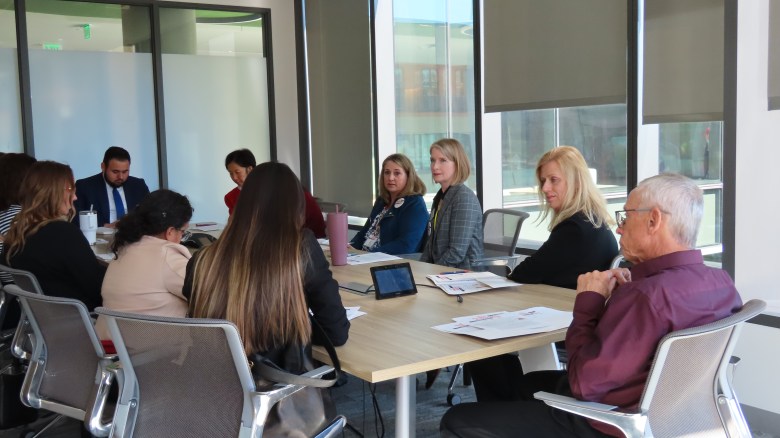 Residents from virtually all of the Tri-Valley cities meet with a staff member from California Assemblymember Rebecca Bauer-Kahan’s office. (Photo by Christian Trujano)
It was first introduced in 2025 and is currently in the Senate Agriculture Committee — it will be taken up for a vote in the summer.
“We view this bill as (being) one step closer to combating cockfighting in California and stopping this really inhumane treatment of these birds,” Jenny Berg, California state director for the Humane World for Animals nonprofit, said during the initial meeting with all the advocates. “These are (birds) raised and kept in really horrible conditions and we want to stop it before it grows and becomes this widespread problem across California.”
Sadek pointed out that the cockfighting bill was a particularly interesting one to have to deal with because it originally received a lot of opposition during last year’s California State Senate Committee on Agriculture meetings because many people were saying it would negatively affect farmers and others who simply owned a lot of chickens for non-cockfighting reasons.
However, according to Sadek, a lot of those who spoke up during last year’s committee hearings were in fact known cockfighters who were trying to put more pressure on committee members to amend the bill in their favor.
For Karan, one of the bills that really stood out to her was Senate Bill 1135, which aims to establish a permanent statewide wildlife coexistence program within the California Department of Fish and Wildlife (CDFW). The legislation would promote “humane conflict-prevention strategies to address growing human-wildlife conflicts”.
“The bill will require CDFW to rely on practices based in science and indigenous knowledge to pursue nonlethal conflict prevention, incident tracking, public education, tribal consultation, and partnerships with local governments, ranchers and community organizations,” according to the information sheet. “The bill also codifies and strengthens the state’s approach to wolf-livestock coexistence and compensation.”
Karan, who had been at the State Capitol just last month for the California State Parent Teacher Association Advocacy Day representing Foothill’s Parent Teacher Student Association, said she recognizes the importance of speaking with legislators and advocating for things like coexistence with animals because those animals can’t speak for themselves.
“It can be a frustrating process, but you also have to stand up for what you believe in and if you believe in it enough, or strongly enough, you keep trying because giving up is not an option,” Karan said. “Especially when it comes to animals (because) they can’t speak for themselves. My fur baby cannot come here and ask for all of these things.”
She said that her own children grew up loving nature and having a desire to protect animals, which is why the coexistence bill means so much to her.
“We need to learn how to coexist because we have to share the world,” Karan said. “Just because (animals) are in our way, doesn’t mean that they don’t belong.”
The last bill that advocates brought up to legislators and their teams was Assembly Bill 1733, which aims to create a new educational category for veterinarians and registered veterinary technicians who provide free spay and neuter services to shelters and rescue groups.
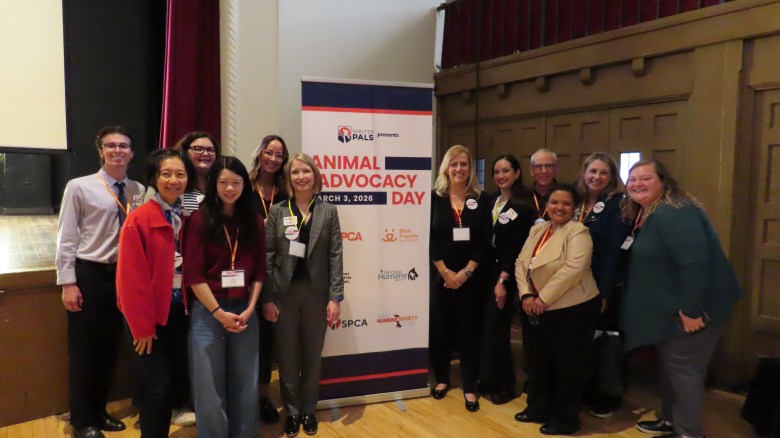 Advocates from the Tri-Valley pose for a group photo at the Westminster Presbyterian Church in Sacramento before walking over to the Capitol Annex Swing Space. (Photo by Christian Trujano)
According to the information sheet, pro bono spay and neuter work is currently grouped under a self study category and by removing it from that category and allowing these veterinarians to receive continuing education credits by recognizing up to four hours of free spay and neuter support provided to shelters and rescue organizations, it encourages them to volunteer their services more in their communities.
After the long day of advocating, the group of Tri-Valley residents and VHS employees made the long trip back home where some of them reflected on their hard work.
Cheung was one of those who reflected toward the end of the day and said she appreciated being able to learn about the legislative process and was grateful to be a part of that process.
“It just made me realize that this is where change happens,” Cheung said. “It’s like ground zero and my daughter and I get to be a part of that. So that was very exciting.”
Most Popular