
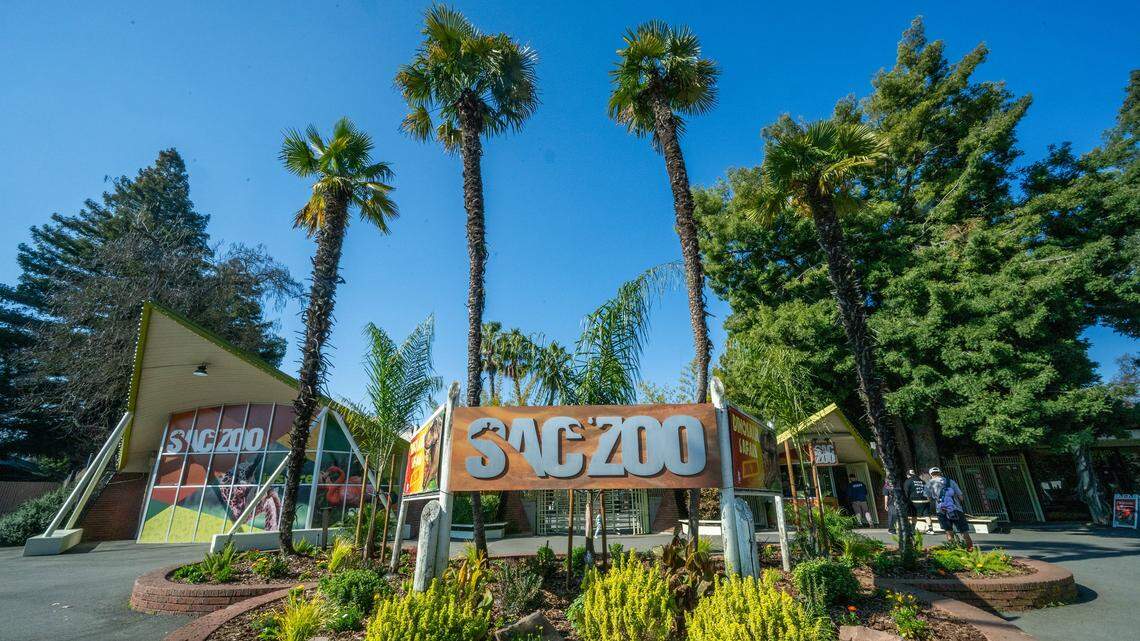
For about a century, the Sacramento Zoo has had a home in William Land Park. And that home has always been small.
It occupied about 4 acres when it opened in 1927. Over time it grew to 14.3 acres. That size makes the zoo one of the smallest accredited by the Association of Zoos and Aquariums, or AZA, a national nonprofit organization that monitors zoos for animal welfare and other standards.
“Our footprint is really small … given the metro area and the size and the number of visitors that come in,” said Dan Simon, who was hired as Sacramento Zoo’s CEO late last year.
Change could be underway in Land Park. The Sacramento City Council could soon review a “memorandum of understanding” with the zoo to study the organization’s September request to expand its park footprint by 5.8 acres, a roughly 40% increase in size. The council was set to review the agreement Tuesday before the item was postponed.
Bringing that change might require patience. Touring the grounds in February, Simon noted where the lion Slamson and the lioness Binti reside. Zoo handlers are hoping two will become friendlier.
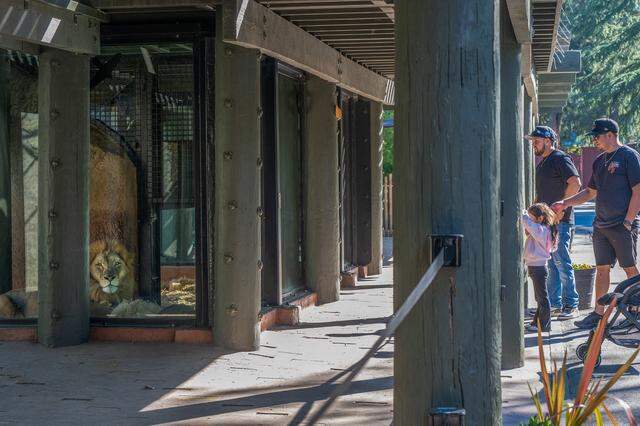 Visitors to the Sacramento Zoo look toward Slamson, a male lion, hoping also to see Binti, a female, on last week. The zoo has over 400 animals, drawing about half a million visitors annually. RENÉE C. BYER rbyer@sacbee.com
“The keepers have literally worked for months, slowly building their relationship,” Simon said.
Expansion would allow the zoo to develop new exhibits and have a safer drop-off zone for schoolchildren. But it would also require building consensus about what the park must give up to make room for that growth.
Why some people aren’t onboard
Dale Claypoole, 82, stood by what was left of the pony ride area in Land Park, shortly before city workers finished removing its signage and fencing in late February. The pony rides, a park tradition since 1926, had ended in 2022 with the retirement of the concessionaire and her ponies.
Sacramento Zoological Society board president Elizabeth Stallard proposed in September that the zoo expand in Land Park in two areas: a 4.4-acre space that includes the former pony ride area; and a 1.4-acre space that currently has a statue of Sacramento pioneer Charles Swanston, a cascading water feature and a garden.
Proposed zoo expansionThe Sacramento Zoo has submitted a request to expand its footprint in William Land Park. The zoo proposes to expand in two areas totalling 5.8 acres, a 41% increase in acreage. 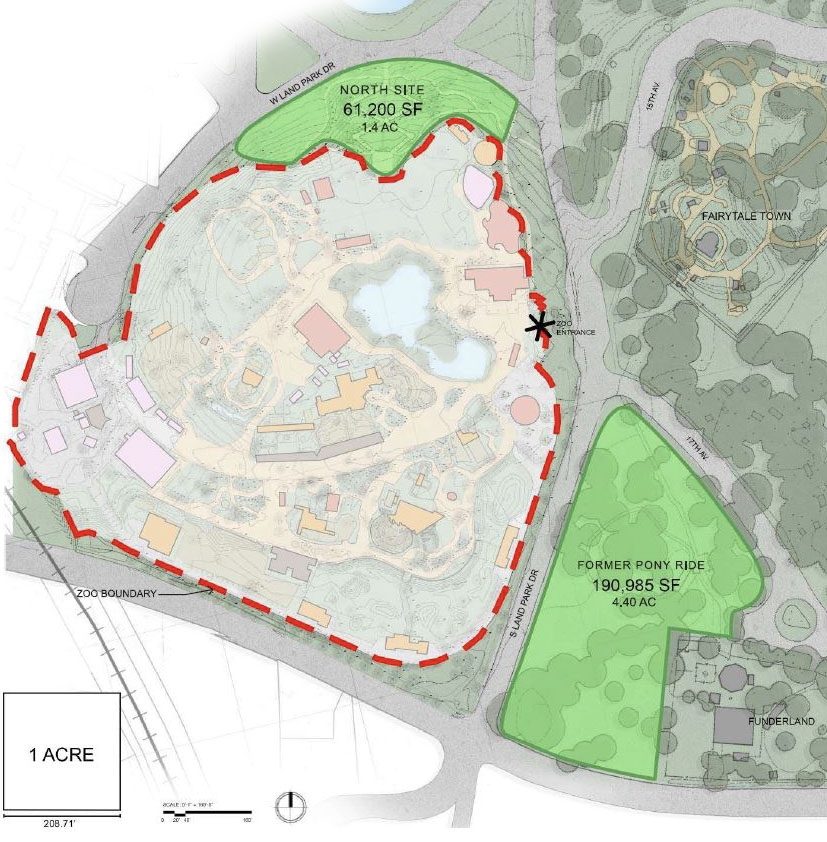 Source: Sacramento Zoo
People like Claypoole are gearing up for a skirmish over the proposal. They’ve had this fight before and won it. The Land Park Community Association began in the ’80s as a group called the Association to Preserve Land Park. It opposed a previous effort to expand the zoo into the pony ride area with a bridge over Land Park Drive.
Claypoole had a copy of a city resolution from 1988 that set a wide range of conditions, including that further expansion of the zoo would “take place elsewhere than in William Land Park.”
That resolution would have to be abandoned to carry out the zoo’s burgeoning plans, which became clearer when a city staff report was posted online last week that included test concepts for the two areas.
In the former pony ride area, the test concept calls for a drop-off zone, education hub and aviary, among other amenities. A new fence encircles the area along Sutterville Road and Land Park Drive, and borders the kiddie amusement park Funderland.
The idea of adding fences evokes the previous conflict for Claypoole.
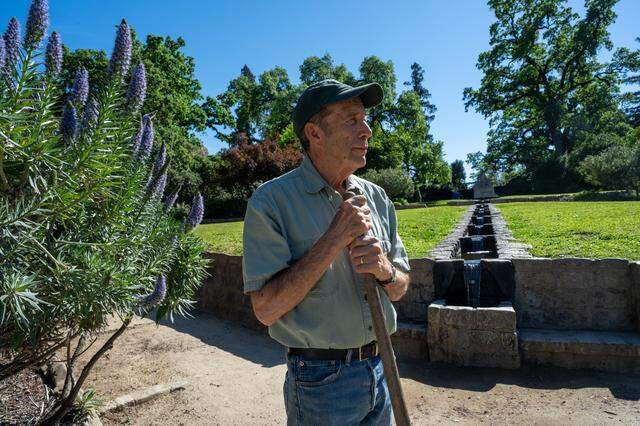 Dale Claypoole, 82, a member of the Land Park Volunteer Corps, rests against a shovel on March 17 as he stands near the Charles Swanston statue — an area in William Land Park that the zoo would like to annex. Claypoole’s wife, a master gardener, helped select flowers planted near the statue by the volunteer corps. RENÉE C. BYER rbyer@sacbee.com
“That’s what we were about: keeping it open, freely open,” said Claypoole, who is a member of the Land Park Volunteer Corps, a nonprofit that helps maintain that park. “This will all be fenced in.”
The 1.4-acre Swanston statue area includes a water feature that cascades below to a lily pond across 15th Avenue. The monument, which was decapitated in 2022, carries the inscription “To the pioneers” and honors Swanston, an early Sacramento settler who once owned some of the land that became the park.
The statue and its surrounding paths and gardens are depicted on the park’s first general plan map, which dates to the 1920s.
The zoo’s test concept for the area includes three exhibits and a mixture of walking paths. Claypoole said he, his wife and other gardeners would oppose the zoo’s expansion into the gardens.
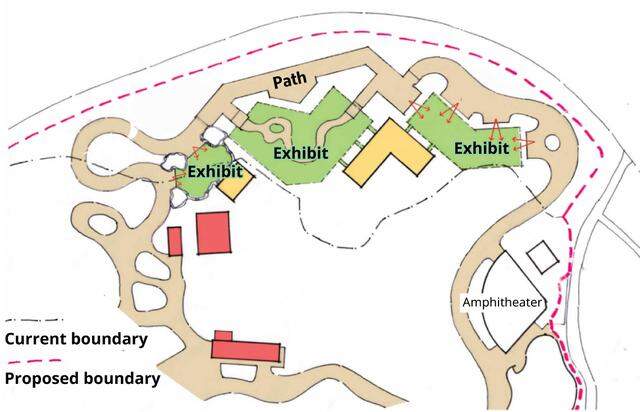 A test concept for the proposed 1.4 acre northern Sacramento Zoo expansion, currently the site of a historic statue and cascading water feature, shows three new animal exhibits. Sacramento Zoo
“I wouldn’t mess with gardeners,” Claypoole said. “They’re very good, very passionate people.”
Others have concerns, too.
Rick Stevenson, another Land Park volunteer, mentioned a large oak tree near the Swanston statue. He estimated the tree is a couple hundred years old.
“That is possibly the biggest and the oldest tree in the park,” Stevenson said.
Jeffrey Schaff, vice president of the Land Park Community Association, also believes many people would oppose expansion of the zoo into the Swanston statue area.
“That is going to be a big, big fight in the community,” Schaff said.
Why the zoo wants to expand
Simon arrived at the Sacramento Zoo in December after a stint at Fossil Rim Wildlife Center in Glen Rose, Texas.
“You get to this sort of inflection point where you need to make some investments, you need to make some improvements for just the evolution of a zoo,” Simon said. “I’ve been through that, worked through that, done a lot of projects at other zoos.”
In the past, the zoo’s size reportedly threatened its accreditation. Simon, who is also an AZA accreditation inspector, said the organization values that zoos have space.
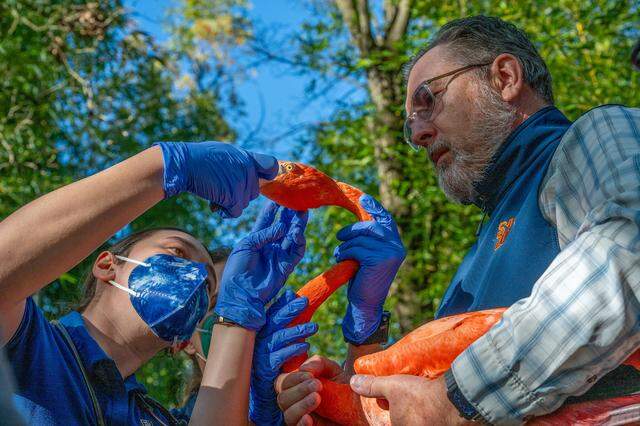 Dan Simon, right, CEO of the Sacramento Zoo, holds a Caribbean flamingo during its annual exam during the flamingo roundup on March 12. RENÉE C. BYER rbyer@sacbee.com
“With animals they want complicated and rich habitats to make sure that the animals can display all their natural behaviors,” Simon said. “They look at holding, they look at the exhibit space. And so exhibits are getting bigger and more complex over time, right? So we have to respond to that.”
AZA president and CEO Dan Ashe expressed support for expansion efforts, noting that the zoo already had lions, giraffes and a rhinoceros.
“They have a very impressive collection of animals,” Ashe said. “But with more space, they’ll be able to do more.”
The increased expectation for exhibit space has forced the zoo to give up some of its larger animals over time. It no longer exhibits elephants, polar bears or hippos.
Its four chimpanzees were relocated to other zoos in 2023, with two joining an existing troop of nine in the Kansas City Zoo’s 3-acre exhibit. According to AZA guidelines, there should be a minimum of eight chimpanzees in a troop.
The zoo has explored expansion in many locations since the rejection of its 1980s Land Park proposal. In 2005, it considered moving near Sutter’s Landing Regional Park. When that proved too expensive, moves to locations including Arco Arena, Cal Expo, Delta Shores and the Haggin Oaks Golf Course were floated.
The longest and most serious relocation effort was for the Elk Grove site. After four years of study and planning, the zoo scrapped the plan in April 2025 — the day before a $10 million project contribution was due — because of rising costs and fundraising shortfalls.
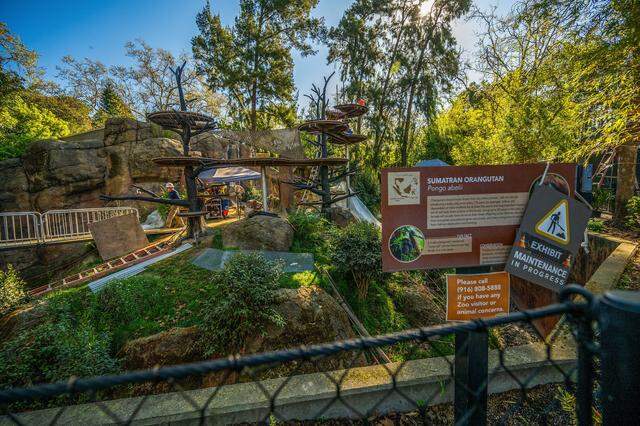 Construction is ongoing at the new Sumatran orangutan exhibit at the Sacramento Zoo on March 12. Matt McKim, the zoo’s chief animal programs director, said the exhibit — which is scheduled to open by early May — focuses on the orangutans’ welfare while also improving the visitor experience. RENÉE C. BYER rbyer@sacbee.com
Stallard said during a Land Park Community Association meeting on March 5 that the Elk Grove zoo would have been 27 acres in its first phase with approximately half the land being a savanna. She said that move fell through primarily because “we were going to have fewer animals and fewer species.”
City and zoo leaders have stressed that expansion talk is still in its early stages. If the zoo expands, it will do so on land the city owns, as all of Land Park is one 236-acre city-owned parcel.
The zoo has been operated since 1997 by the zoological society, a nonprofit. The city is unlikely to contribute resources beyond the land, and the zoo will be responsible raising funds for the expansion.
Sacramento Mayor Kevin McCarty said during Tuesday’s City Council meeting that the memorandum of understanding with the zoo will be postponed until late April. “We want to work with them — how they can remain viable here for another 100 years. But with that, we need to have engagement with the community and so forth,” he said. “We are committed to making it work for the zoo for another century.”
Simon is hopeful about the expansion. He said he loved that the zoo’s location, which he believes is a great place for the zoo to deliver its mission.
“At heart, we want to connect people with wildlife and a lot of times that’s kids,” Simon said. “We want kids to really make that connection, because then they’re going to care about animals as they get older and they’re going to make great decisions about habitats and how they can help animals.”
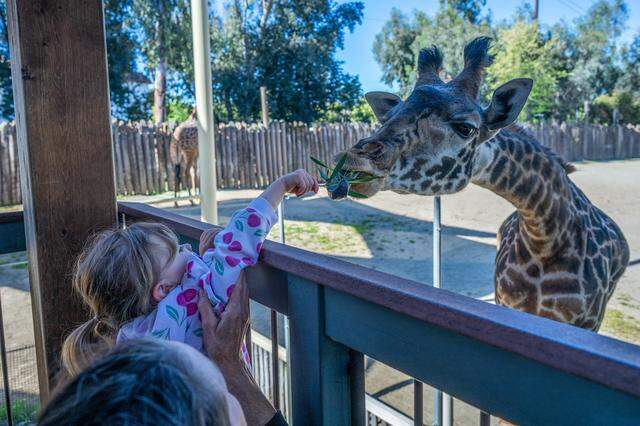 Navy Hyden, 2, feeds Cheyenne, one of the Sacramento Zoo’s five Masai giraffes, during a visit to the zoo on March 12. An expansion of the zoo could allow for a safer drop-off zone for visiting school children. RENÉE C. BYER rbyer@sacbee.com What the zoo means to people and Sacramento
On a weekday morning in February, Latacia Pace was one of many parents at the zoo with her two children.
Pace, a Del Paso Heights resident originally from Seattle, said she was used to animals having more space to roam but she didn’t have many complaints about Sacramento Zoo. She said her year-long zoo pass paid for itself in the first week. Months later, her family was visiting the zoo two or three times a week.
“Buying the pass — it’s the most cost-effective thing you can do,” Pace said.
The zoo holds a special place in the heart of people like Art Scotland, 79, a retired judge who serves on the Sacramento Zoological Society’s board and has spent much of his life in Land Park. He began to get emotional when asked what the zoo meant to him.
“It means so much to me because of my experiences,” said Scotland, who added that he “cared very much about endangered species” and that he thought the zoo’s staff was very capable.
Sacramento City Councilmember Rick Jennings, whose district includes the zoo, said during the Land Park Community Association meeting earlier this month that he fell in love with Land Park when he came to Sacramento in 1986.
Jennings later said in an interview he started taking his children to the zoo after he arrived in Sacramento. They loved the parrot exhibit, because the family had an African parrot, Baby. The zoo now has the largest collection of thick-billed parrots among AZA zoos, according to staffer Kristene Hirsch, who works with the birds.
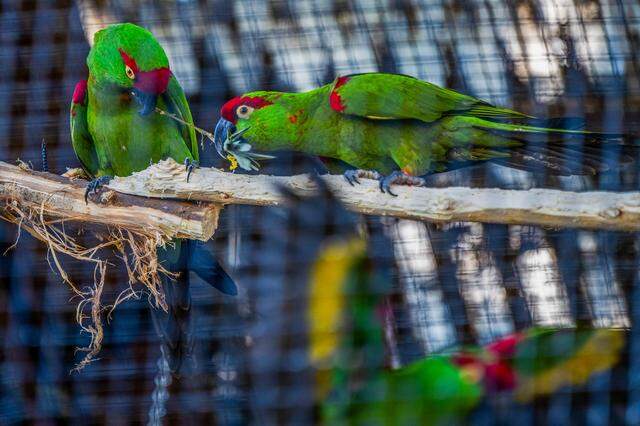 Thick-billed parrots share a piece of bamboo at the Sacramento Zoo on March 12. The zoo breeds the parrots as part of an endangered species program and plays a role in national coordination for the species’ care and conservation. RENÉE C. BYER rbyer@sacbee.com
Jennings supports the general idea of expanding the zoo, and hopes to help with donations and fundraising.
“My hope is that you and I are having this conversation 25 years from now and talking about the great decision that the city of Sacramento made and the council in expanding the space in order for this zoo to be a benefit for the city of Sacramento for years to come,” he said.
The Bee’s Ishani Desai contributed to this story.
Related Stories from Sacramento Bee
The Sacramento Bee
Graham Womack is a general assignment reporter for The Sacramento Bee. Prior to joining The Bee full-time in September 2025, he freelanced for the publication for several years. His work has won several California Journalism Awards and spurred state legislation.