
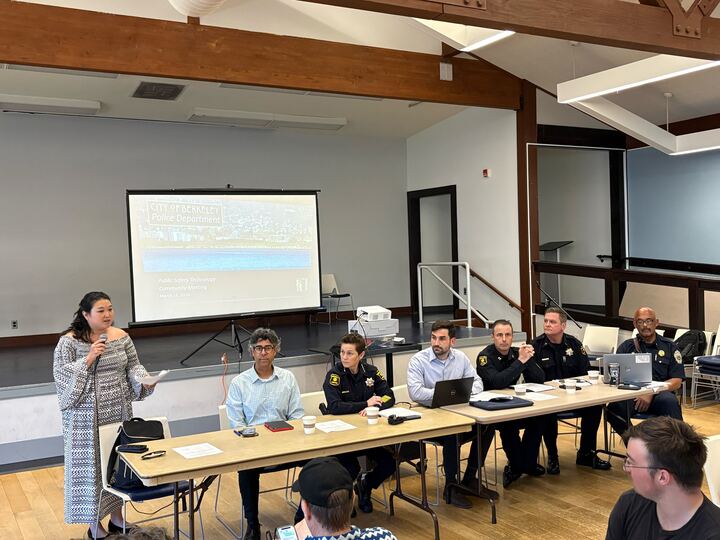
 Berkeley Mayor Adena Ishii set up a town hall-style meeting on a proposal for new surveillance equipment at the South Berkeley Senior Center on March 18, 2026. Credit: Alex N. Gecan/Berkeleyside
The Berkeley Police Department has asked for what could amount to a $2 million surveillance suite with the controversial tech vendor Flock Safety.
The company has faced scrutiny amid reports that law enforcement officers elsewhere have used data from its hardware to investigate people who’ve had abortions, monitor protesters and locate undocumented immigrants for deportation. Some cities have canceled their use of Flock over these and other concerns, occasionally stating outright that the company misled them.
All told, the proposal would nearly triple the city’s annual maximum commitment to Flock for at least the first year, from $212,500 to $567,500.
BPD is hoping for three new drones running Flock software; a new 16-camera fixed-surveillance network run by Flock; centralized software to sync Flock hardware with other systems; a renewal on the city’s extant network of 52 Flock automated license plate readers (ALPRs); and access to private cameras around the city, possibly also through Flock systems.
The plate readers — cameras intended to track vehicles passing along major Berkeley streets — have been up and running since 2024. BPD wants to install the new fixed-surveillance video camera network in commercial districts, mostly in northwest, southeast and downtown Berkeley. One of the drones they are looking at would launch from police headquarters and could reach anywhere in the city within minutes.
Berkeley redrew its map of proposed fixed-surveillance camera locations in 2025. The blue pins indicate where they were first meant to be installed, before a BPD analysis found those locations were likely to duplicate work the city’s plate readers were already doing. The red pins indicate the 16 locations Berkeley decided on in March.
A council vote Tuesday is in some ways just a procedural step in several parallel, years-long efforts by BPD to build out its ability to use tech to track down suspects after crimes are committed. But Berkeley privacy advocates have taken issue with the expansion for years, fearing the creation of a mass surveillance network following the movements of all in the city.
Meanwhile, the Police Accountability Board has recommended the city consider stronger safeguards like stricter data retention policies and higher specificity on costs if it intends to move ahead with the purchase, especially if BPD wants all of its hardware to come from one vendor.
This sort of brand loyalty “significantly degrades the city’s ability to negotiate privacy protections, conduct independent audits, manage data parameters or enforce limits,” the PAB wrote to the City Council this month, though the board acknowledged there were also advantages to buying hardware systems that can speak to each other more easily.
Mayor Adena Ishii hosted a town hall-style meeting on surveillance technology Wednesday that drew about 100 people, including several past and present members of the Police Accountability Board, as well as other Berkeleyans who frequently speak out on matters of policing and police oversight. It also drew political operators from further afield, like Edward Escobar, Tuan Ngo and Chris Moore, who recently lobbied Richmond to turn its Flock plate readers back on.
Dozens of Berkeley residents and local advocates have also already written to the council, almost all of them opposed to it entirely or hoping at least for more restrictions. Like their neighbors who attended Wednesday’s session, many worried that federal immigration agents might gain access to Berkeley’s networks as President Donald Trump prosecutes his campaign of mass deportations.
Some Bay Area cities like Santa Cruz, Mountain View and Richmond, have begun to bail on Flock, though Richmond reversed course this week. Oakland voted in December to re-up its multimillion-dollar contract with Flock and keep using its network of almost 300 cameras, albeit with new restrictions on what data outside agencies could access.
Police say technology has helped make high-profile arrests
Part of Flock’s appeal to BPD is that its systems are so compatible — sort of like a household committing to one manufacturer or another for all personal computers, tablets, phones and smart devices.
BPD Chief Jen Louis said she had looked at other vendors when researching her proposal.
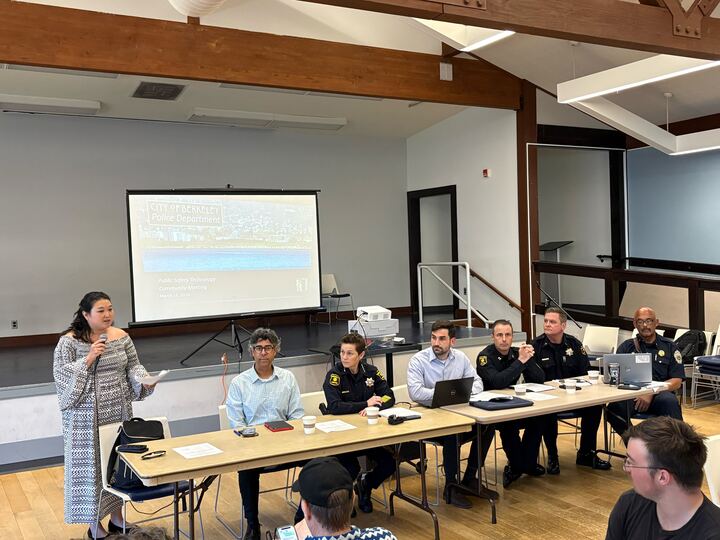
“The next closest was Axon,” she said at a town hall-style meeting Wednesday, referring to the Arizona-based company that makes BPD’s body-worn cameras, and also builds cameras, drones and plate readers. “They’re at least 18 months behind in technology from where Flock is right now.”
 BPD Chief Jen Louis (second from left, in BPD uniform) speaks with community members and advocates at a town hall meeting on surveillance technology on March 18, 2026. Credit: Alex N. Gecan/Berkeleyside
Berkeley police and other officials have long touted cameras and plate readers as invaluable tools to track criminals moving into and out of Berkeley, particularly the sophisticated retail thieves that prey on Fourth Street, San Pablo Avenue and other high-commerce sections of the city. They have attributed several high-profile arrests to their plate reader network, including two suspects tied to an attempted murder in January.
And as police officials pointed out at a town hall in January, BPD had used plate readers for parking enforcement for nearly a decade before it expanded into criminal enforcement, and there have been surveillance cameras (not run by Flock) in San Pablo Park, at the Berkeley Marina and elsewhere in the city for years as well.
As far as privacy and data security are concerned, “Ultimately, we own this data. The vendor is just the processor,” Arlo Malmberg, BPD’s civilian point person for data and analysis, said at the January town hall. “We control the access, we do the audits and we hold the keys.”
In many instances where data from Flock hardware went where it should not have, it appears to have something do with individual officers accessing data or sending it on improperly, although in at least one case, Flock has exposed live video streams — from the same type of cameras Berkeley is looking to buy — to the internet.
Berkeley also seeks access to private surveillance cameras
Officially, the council is only taking a single vote Tuesday, but that one vote would approve eight different things, including four separate use policies (one each for community video streams and video cameras and two for drones, which have additional use policy requirements under city ordinances) and four separate contract adjustments with Flock.
When Berkeley first contracted with Flock, it projected its two-year trial period to cost $344,500, and capped the amount it would pay in that period at $425,000. The two-year renewal is for less — $330,000 for two years, or $660,000 if the city keeps the readers for four years. The three-year drones contract would cost $750,000, a four-year video camera program $310,000 ($600,000 if extended for three more years) and the Nova software $75,000 for the first year. (The software costs were already earmarked for grant funds the city accepted in July.)
Assuming BPD keeps re-upping on all four pieces of Flock hardware and software, that comes out to $567,500 a year. Louis wrote that part of the cost of the hardware would be offset by the department cutting three sworn officer positions, at a cost of about $870,000 a year, but given that BPD has far more than three vacancies year over year, it is unclear if that is a real-world savings or just one on paper. Those vacancies, however, are part of the agency’s basis for asking for more equipment, arguing that a greater digital reach makes the officers it does have more efficient.
The council already signed off on a tentative use policy for drones in 2023. They were poised to actually purchase cameras in September but pumped the brakes as headlines about leaks from Flock networks began to pile up.
BPD has also asked for access to “community data streams,” or access to feeds and recordings from private surveillance cameras, typically operated by business districts. Options for that hardware are up to the people and businesses that buy them, but police officials name-dropped Flock’s interface, called “Safety Wing,” for private cameras in their proposal.
Where those privately owned cameras will be placed remains to be seen, so it is unclear if they will be outdoors along roads and sidewalks, inside businesses like stores and restaurants or both. They will, however, have to be marked “in a conspicuous manner” so that passers-by know they are under BPD surveillance, according to the proposed use policy. Business owners are forbidden from positioning cameras to shoot “areas where a reasonable expectation of privacy exists” — insides of homes and yards, restrooms or changing areas or medical facilities.
Separately, BPD is looking to expand its access to helicopters and canine units from other departments and its freedom to use tear gas and pepper spray. A council committee has already signed off on both but, so far, the matters have not been scheduled for the full council. The council has, however, rescinded a nearly three-decade-old mandate that effectively doubled BPD’s reporting requirements for pepper spray, a weapon that was of high concern at the time but which officers use only a handful of times a year.
Natalie Orenstein contributed reporting to this story.
“*” indicates required fields