
With the horrific allegations against Cesar Chavez reverberating across the country, communities around California are rushing to strip the civil rights leader’s image from public spaces amid accusations he sexually abused two girls and raped Dolores Huerta — his ally in the farm labor movement and an icon in her own right.
Obviously, Chavez must be removed from the parks, streets, schools and other tributes created in the decades since his death in 1993. What’s less obvious is what happens next.
School districts with schools or buildings named for Chavez are weighing what to do. San Jose City College dedicated a large mural featuring his image on its Cesar Chavez Library last year, and the San Jose Evergreen Community College District that oversees SJCC plans to start conversations with the community about its next steps.
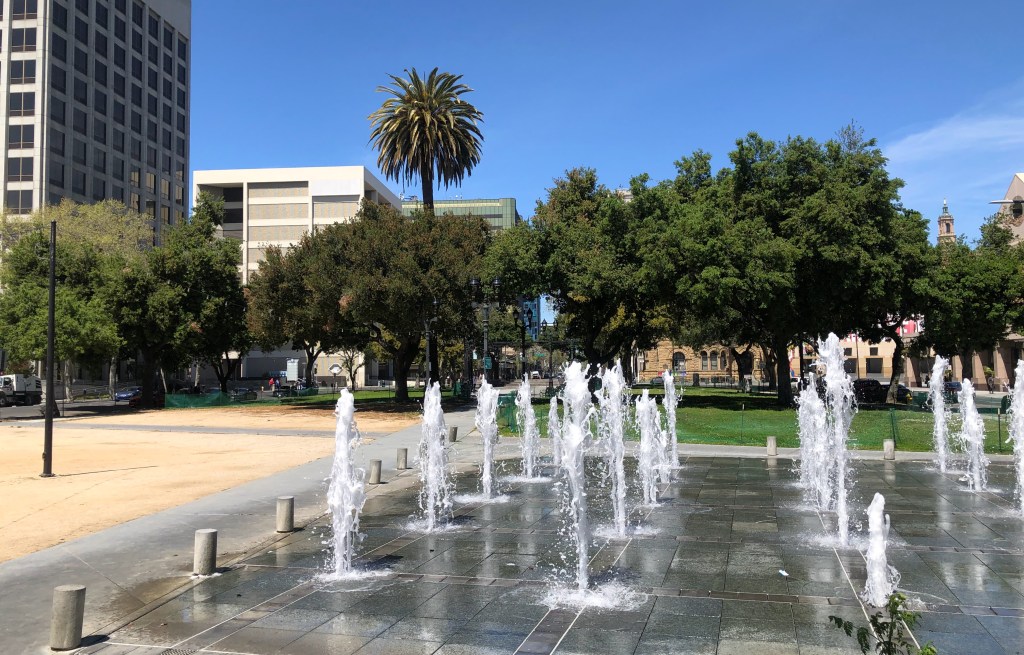
In San Jose, the largest memorial to his life is Plaza de Cesar Chavez — the 2.2-acre park in the heart of the city is home to Christmas in the Park, San Jose Jazz’s Summer Fest and several other community events every year. There is already buzz about renaming the park after Huerta or calling it “Farmworkers Plaza.” Similar solutions are proposed for schools, libraries and streets that currently bear Chavez’s name, as if we could just cover his name with white-out and write in a new one.
It’s not that simple, and it shouldn’t be.
Chavez’s history with San Jose goes back decades and is deeply embedded in the community.
Blanca Alvarado, then a member of the San Jose City Council, introduced the idea of naming the downtown park in Chavez’s honor at a public memorial there a few days after his death in April of 1993. For five months, people weighed in on both sides of the issue, and the Mercury News published editorials strongly in favor of the idea. The San Jose City Council unanimously voted in favor that October.
Since Chavez had lived in San Jose and started organizing here in the 1950s, many felt at the time he more than deserved that honor. If the intent was to honor the farmworker movement, it was through Chavez himself, often referred to as a “local son.”
Huerta may have been as important to the farmworker movement as Chavez, but she doesn’t have the ties to San Jose — a key reason why the city memorialized him in such a significant way.
Now, Mayor Matt Mahan and Councilmembers Anthony Tordillos, Pamela Campos, Peter Ortiz and Domingo Candelas have begun the sensitive process of determining the fate of Chavez tributes in the city and plan to involve the community in deciding how best to honor the farmworker justice movement.
Removing his name from Plaza de Cesar Chavez should come first, but determining a new permanent name should be a thoughtful, reflective process and not a knee-jerk reaction to Chavez’s alleged crimes. That would allow it to build a new history and allow a community — one that includes many who knew Chavez — time to heal. The city should consider reverting to the park’s longtime name, Plaza Park, as a temporary measure while that happens.
The state is in similar quandary with Cesar Chavez Day.
California declared Chavez’s birthday, March 31, a state holiday in 2000, with San Jose following suit in 2001 and Santa Clara County in 2003. Since the New York Times revealed the allegations this week, elected officials have quickly pivoted the focus of celebrations from Chavez to the farmworker movement.
In a joint statement, Santa Clara County Supervisors Otto Lee and Sylvia Arenas and County Executive James Williams said, “The annual César Chávez holiday has always been about much more than a single individual. … we are choosing to focus our observance on honoring the farmworker movement that inspired a nation, including the bravery and leadership of Dolores Huerta.”
The California Legislature and Gov. Gavin Newsom should move quickly to take the state holiday off the books for next year — when celebrations for Chavez’s 100th birthday would have taken place.
Alexandra M. Macedo, an assemblymember from Tulare, introduced legislation Wednesday to rename the March 31 holiday “Farmworker Day,” a well-intentioned solution that sounds like the right answer but would only be a Band-Aid. What happens when a curious student asks why Farmworker Day is celebrated March 31? Can you imagine the teacher saying, “Well, it’s the birthday of someone important to the farm labor movement, but we don’t talk about him.”
If the legislature wants to honor farmworkers, it should be a deliberate and respectful effort — not a hasty move that simply serves to solve a political embarrassment. How about celebrating Farmworker Day on July 29? That’s the date in 1970 when the Delano Grape Boycott ended, a significant moment in the farm labor movement.
Alvarado, who also led the charge for Santa Clara County to recognize the Cesar Chavez holiday when she was on the Board of Supervisors, said this week, “Today, we stand in compassion with the victims and in support of his family, and the millions, like me, who followed him on a noble crusade of justice for farmworkers. We are all in pain!”
She fought for Chavez’s name to be on that park. But today, she understands why it must come down not only there but around California and the rest of the country.
What happens next is important. We shouldn’t rush it.