
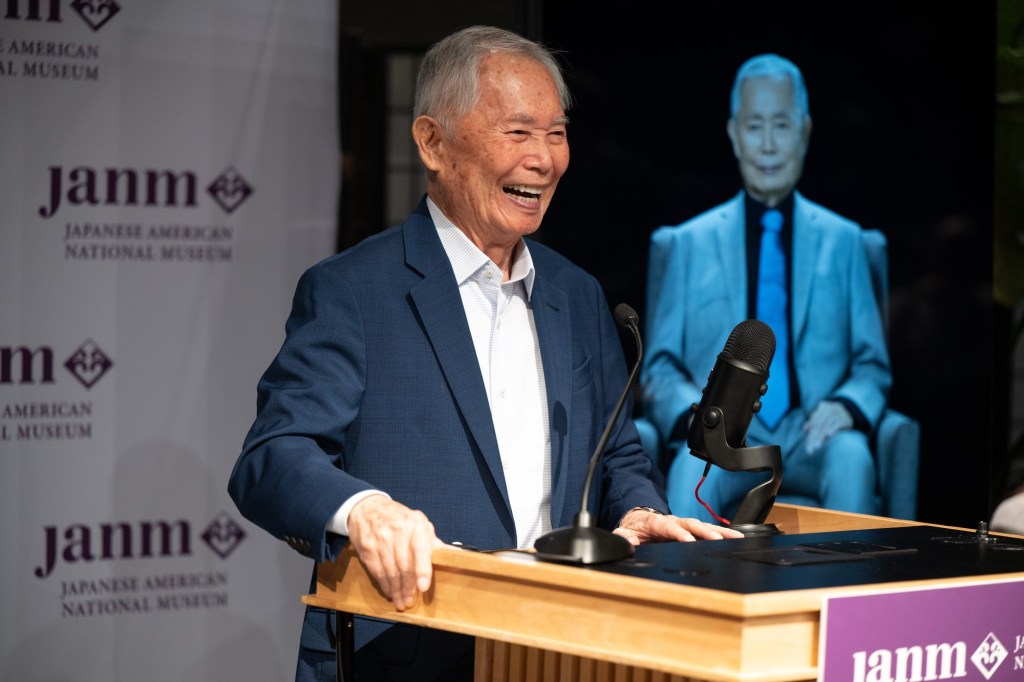
Actor and activist George Takei introduced an interactive digital storytelling experience Thursday, March 19, at the Japanese American National Museum in downtown Los Angeles, allowing visitors to engage with him and other survivors of World War II incarceration.
The presentation at the museum’s Democracy Lab will showcase the StoryFile technology, which uses artificial intelligence and recorded interviews to simulate conversations with participants, according to museum officials.
Each participant answered hundreds of questions over several days, creating a database of responses. Visitors to the digital displays ask questions into a microphone, and AI technology finds and returns an appropriate answer directly from the hours of video, museum officials said.
Takei, who was incarcerated with his family as a child, is one of several people featured in the project. Other StoryFiles include former prisoner June Aochi Berk, draft resister Takashi Hoshizaki and prisoner Mary Murakami.
“First-person storytelling has always been an important part of JANM’s mission to share the lessons of history forward, and to connect past and present,” museum President and CEO Ann Burroughs said in a statement. “We are so grateful to these individuals and their families who have devoted countless hours of their time and energy to ensure that their stories are preserved for generations to come.”
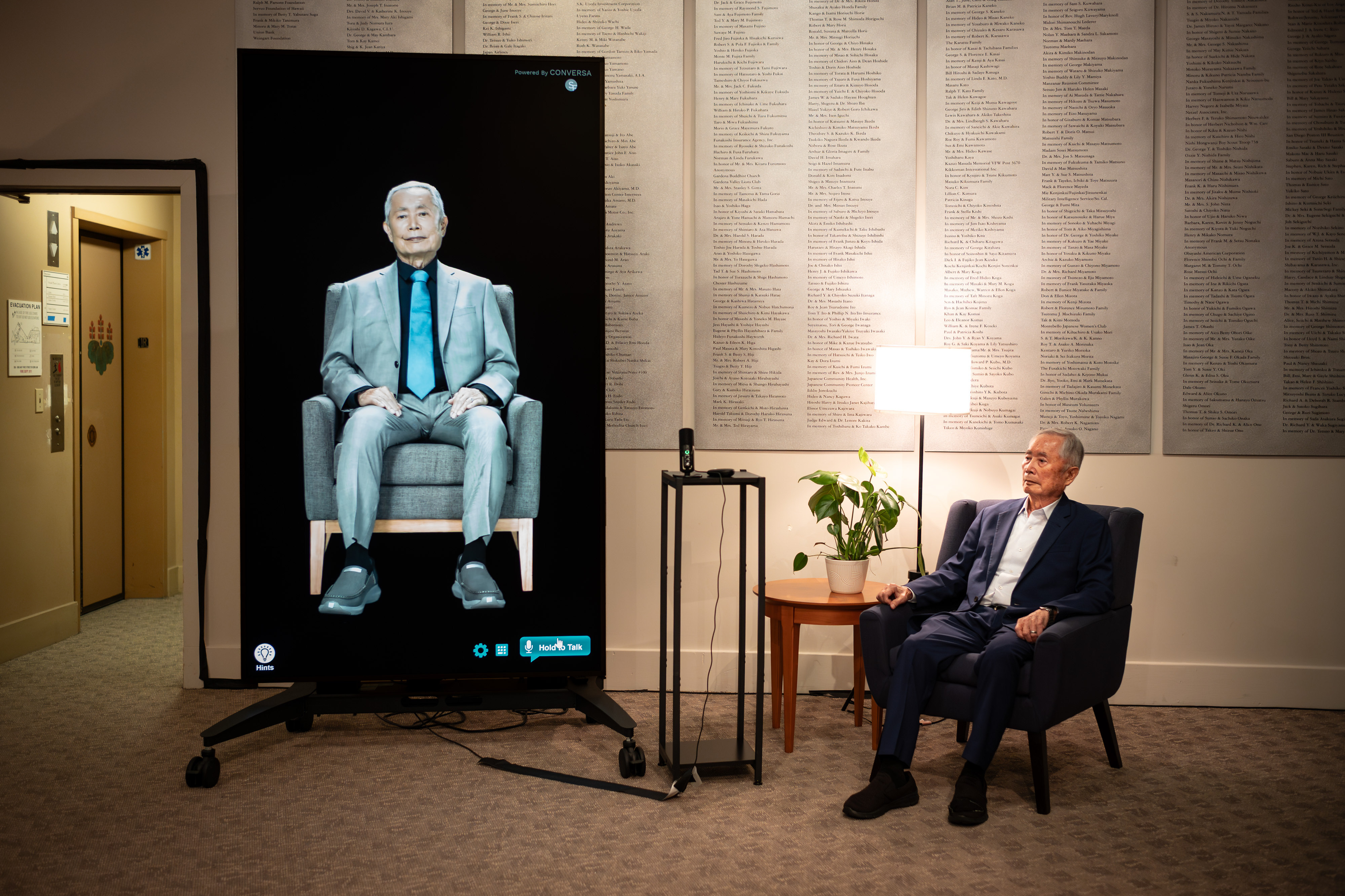
Actor George Takei sits with an AI image of himself at the Japanese American National Museum in Los Angeles on Thursday, March 19, 2026. Takei is one of four “storyfile” subjects that visitors to the museum will be able to interact with when the museum re-opens in November 2026. All of the subjects were interred at relocation camps during WWII. (Photo by David Crane, Los Angeles Daily News/SCNG)
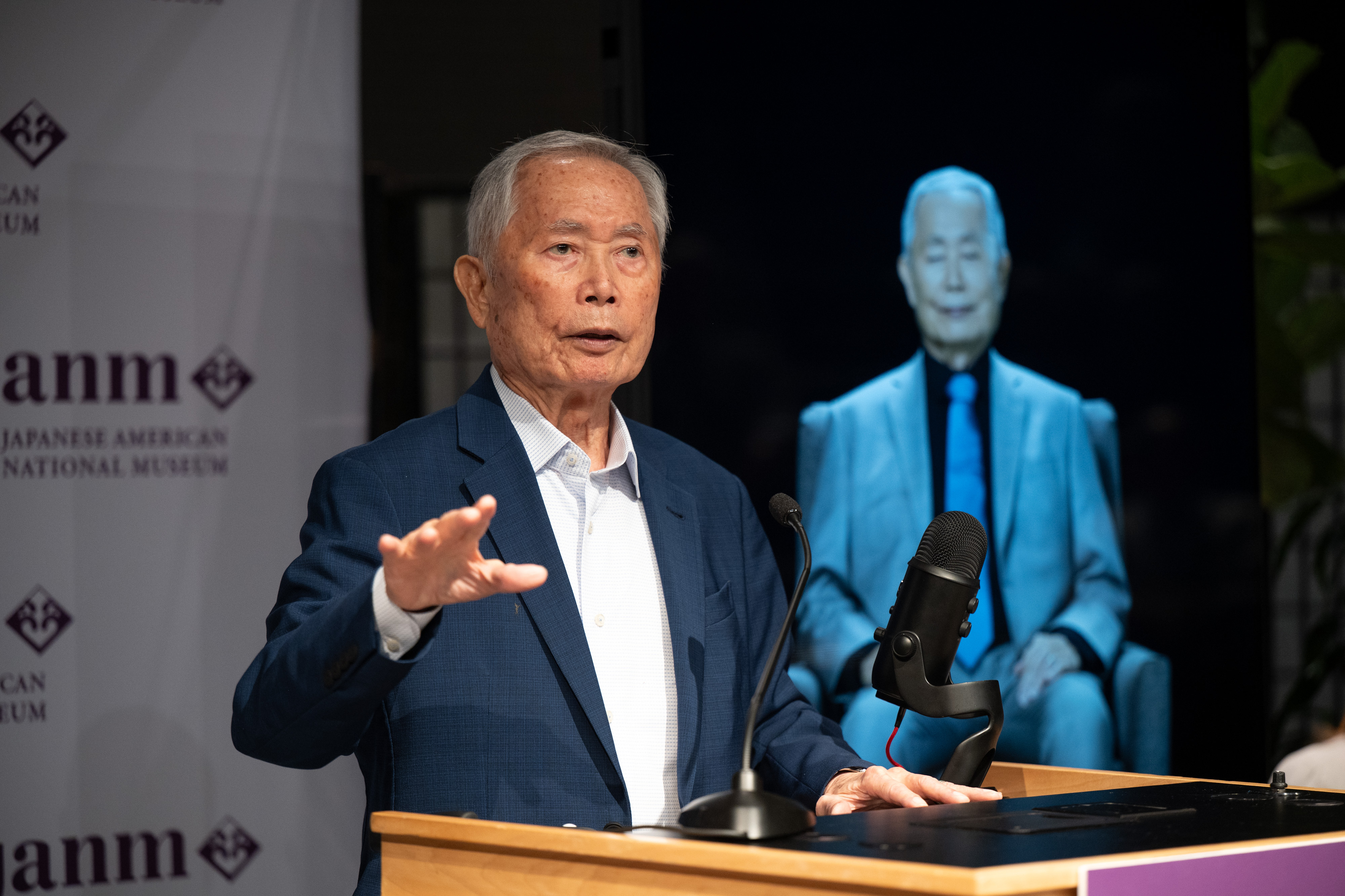
Actor George Takei with an AI image of himself at the Japanese American National Museum in Los Angeles on Thursday, March 19, 2026. Takei is one of four “storyfile” subjects that visitors to the museum will be able to interact with when the museum re-opens in November 2026. All of the subjects were interred at relocation camps during WWII. (Photo by David Crane, Los Angeles Daily News/SCNG)
Show Caption
1 of 2
Actor George Takei sits with an AI image of himself at the Japanese American National Museum in Los Angeles on Thursday, March 19, 2026. Takei is one of four “storyfile” subjects that visitors to the museum will be able to interact with when the museum re-opens in November 2026. All of the subjects were interred at relocation camps during WWII. (Photo by David Crane, Los Angeles Daily News/SCNG)
The technology is designed to preserve firsthand accounts of Japanese Americans who were held in U.S. incarceration camps, often referred to as internment camps, during World War II.
The 88-year-old Takei — best known as “Star Trek’s” Hikaru Sulu, the helmsman of the USS Enterprise — wrote about his childhood incarceration in his 2019 memoir “They Called Us Enemy,” describing how his family was confined in camps during the war.
During a 2022 appearance at Chapman University in Orange, he reflected on the moment when his family was forced from their Los Angeles home by soldiers.
“They stopped on the front porch and with their fists they banged on the door. My father answered the door and they pointed those bayonets at all of us and told us to leave,” said Takei, who was 5 years old.
When his mother came out of the house, “tears were streaming down her cheeks. The terror of that morning is seared into my memory,” Takei said.
The StoryFile installation is part of the museum’s broader renovation project, with new exhibits and interactive features planned for the reopening of its main Pavilion late this year.
A public preview of the StoryFiles is scheduled for Saturday, March 21. Tickets are available at janm.org/events.
The Democracy Lab, where the preview will be held, is on the site where Japanese Americans were gathered before being transported to incarceration camps.