
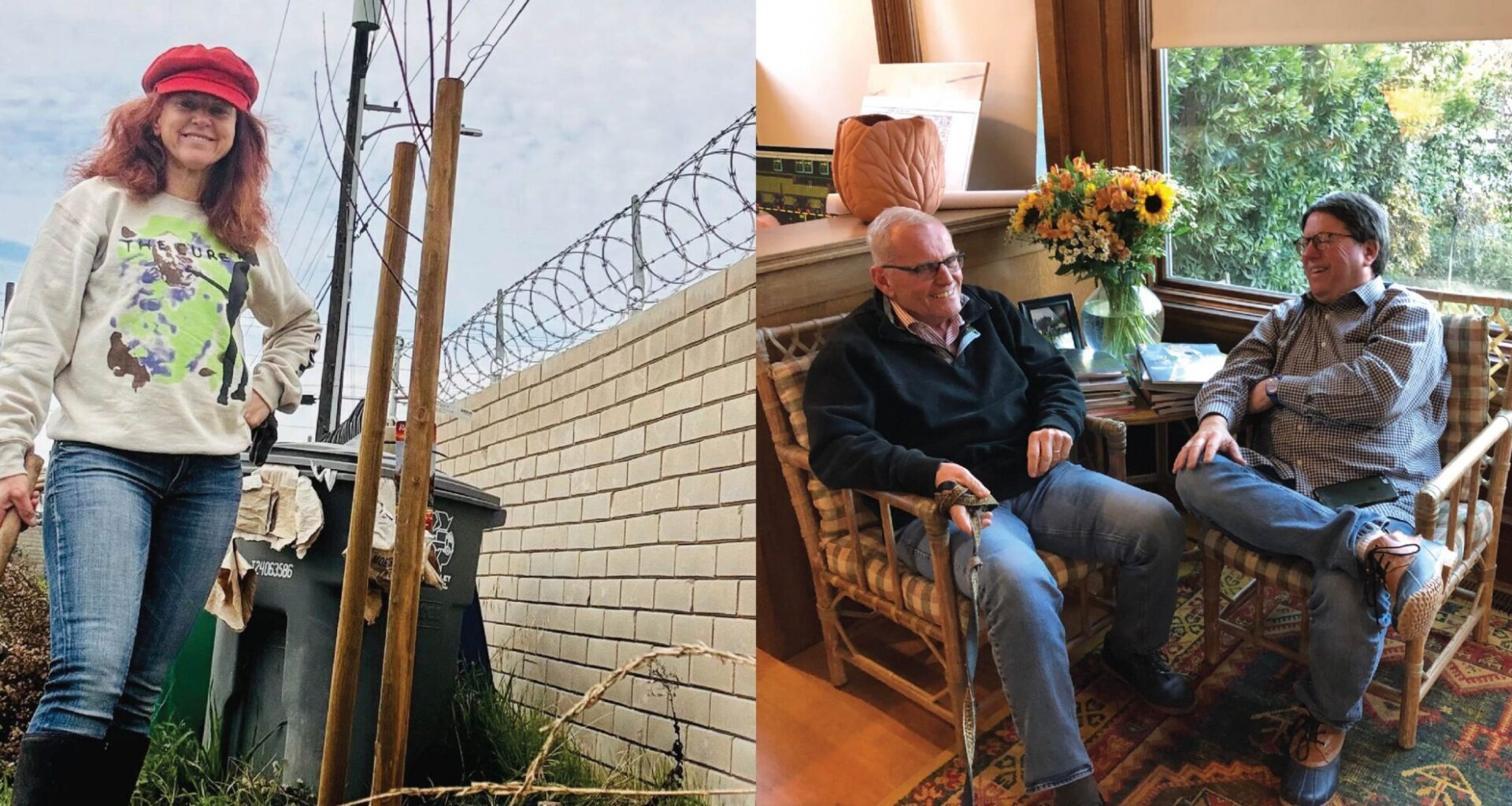
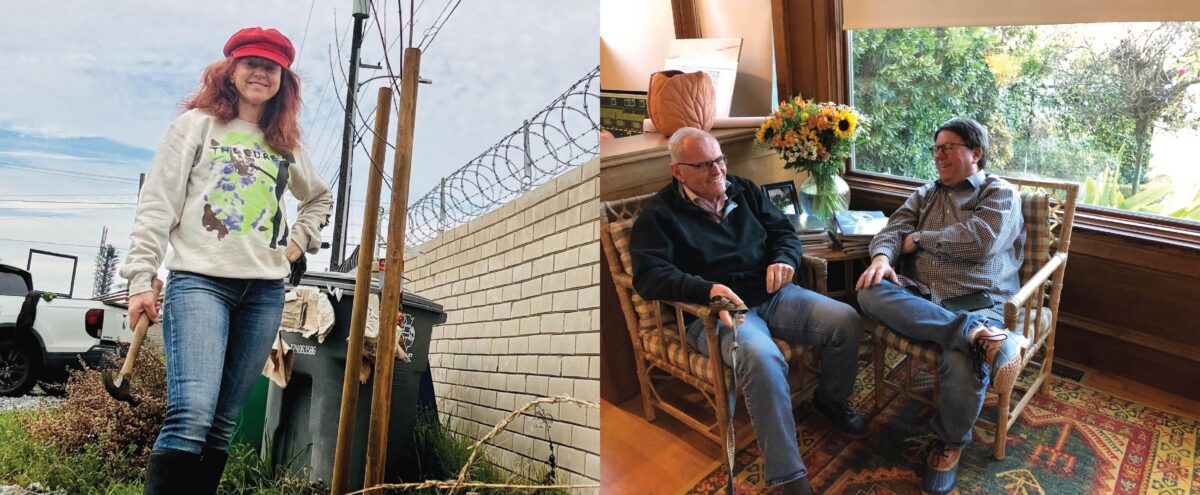
Photos contributed | Tree Fresno CEO Mona Cummings (left) and cofounders John Valentino and Robert Boro (right).
published on March 19, 2026 – 3:18 PM
Written by Ben Hensley
More than 40 years ago, a seed was planted.
Today, that seed stands tall — and its leaders are laying the financial groundwork to make sure it keeps growing.
In 1985, a one-off fundraising effort transformed into what is now known as Tree Fresno, a local nonprofit that, for four decades, has pushed to expand the urban tree canopy across Fresno County and the greater Central Valley. As the organization celebrates its 40th anniversary, leaders are preparing to publicly unveil a new endowment meant to sustain the nonprofit’s work for years to come.
“The founding was interesting because we didn’t really have in mind founding an organization,” said John Valentino, Tree Fresno’s secretary and one of its longtime board members. “I think the concept was originally Roger Rocka’s idea…that instead of just talking about it and celebrating ourselves as a city, why don’t we do something that could really improve the city.”
A telethon and a threat
Valentino said the idea came together during Fresno’s 100-year celebration when organizers partnered with KSEE 24 for a two-hour fundraising telethon. The event preempted “The Golden Girls,” he noted, and drew enough support to change the group’s plans.
“We raised about $28,000 in two hours,” Valentino said. “And everyone was pleased with that, and we thought maybe there’s a constituency for a permanent organization of people that support the concept of improving our city by tree planting.”
The telethon, which raised the equivalent of over $84,000 when accounting for inflation, is why some supporters associate the group’s beginnings with 1985; though its official incorporation wasn’t until the following year, Tree Fresno — then known as Fresno Tree People — firmly planted its roots in the Valley.
After operating under that name for several years, the group changed its name after hearing from a Los Angeles organization with a similar name.
“They sent us a letter,” Valentino said. “A polite letter, but it said if you don’t change your name, we’ll sue you.”
That prompted the 1989 transition to Tree Fresno, a name the nonprofit has carried ever since.
In those early years, Valentino said the organization had no paid staff and was instead powered by volunteers, many of them tied to the landscape industry and united by a common belief that Fresno could be improved through the planting of trees. Eventually, the nonprofit hired a small staff to organize events, turning ideas into more consistent action.
Roots that held
Some of the nonprofit’s earliest signature projects are still visible today.
Valentino pointed to the McKinley Avenue canal planting as one of the group’s first major efforts, aiming to create a greener entrance near the Fresno airport. They also reintroduced tree foliage to the Blackstone Avenue median, bringing trees and landscaping to one of the city’s most prominent commercial thoroughfares.
“We planted the median island on Blackstone,” Valentino said. “A lot of those trees are still there.”
For CEO Mona Cummings, those long-standing plantings are part of the continued draw for involvement in the organization’s mission. The visible legacy, she said, provides residents with something tangible to connect with over time.
“I hear the stories — ‘Oh, we planted trees 25 years ago, 30 years ago, and here they are today,’” Cummings said. “And I think that’s what inspires people to want to get involved in tree planting.”
Growing the canopy
Today, the nonprofit’s work extends well beyond the city limits. Cummings said the nonprofit works with 24 cities throughout the Central San Joaquin Valley, and more than 30 school districts and agencies — a footprint, she noted, that has grown considerably as the organization has deepened its partnerships over the past decade.
Much of its recent planting work has focused on areas hardest hit by poor air quality and extreme heat, often through state-supported grants targeted to disadvantaged communities.
“That means targeting areas that are most impacted by air pollution or heat,” Cummings said.
Cummings said Tree Fresno has also worked to broaden its business partnerships. Businesses, she said, often play a key role as long-term stewards because they come pre-equipped to maintain areas on their properties. Even with that expanding reach, the nonprofit remains lean.
“We have only two full-time people,” Cummings said. “But we get things done through the partnerships, through the volunteer engagement, through the board directors.”
Building for tomorrow
That lean structure is precisely why Tree Fresno’s new endowment matters.
Cummings said the organization has been quietly building the fund over the last several years, hoping to formally introduce it to the public during the organization’s 40th anniversary celebration on April 25 at Simonian Farms. The nonprofit has already grown the fund to roughly $200,000, with the goal of eventually raising upwards of $1.5 to $2 million.
The anniversary dinner hopes to raise funds for the future of the nonprofit. Featuring a special dinner and 80s themed celebration, the event offers limited seating, but aims to bring together community members, supporters, partners and friends to celebrate the nonprofit’s achievements over its 40 years.
The aim, she said, is to create a financial foundation capable of supporting the organization even if public grant funding becomes less reliable.
“Bill Lyles told me that the only way you can get people to donate to your endowment fund is if you have one,” Valentino said.
The anniversary celebration will cap off a busy spring that also includes Earth Day and Arbor Day events, volunteer plantings and a 5K run and walk connected to the organization’s outreach.
For leaders, the 40-year milestone is less about looking back and more about recommitting to work they believe remains unfinished.
“We thought it could be transformational for the city,” Valentino said. “And it really hasn’t been as transformational as I would have hoped at that time. But that’s — that can still be our goal.”