
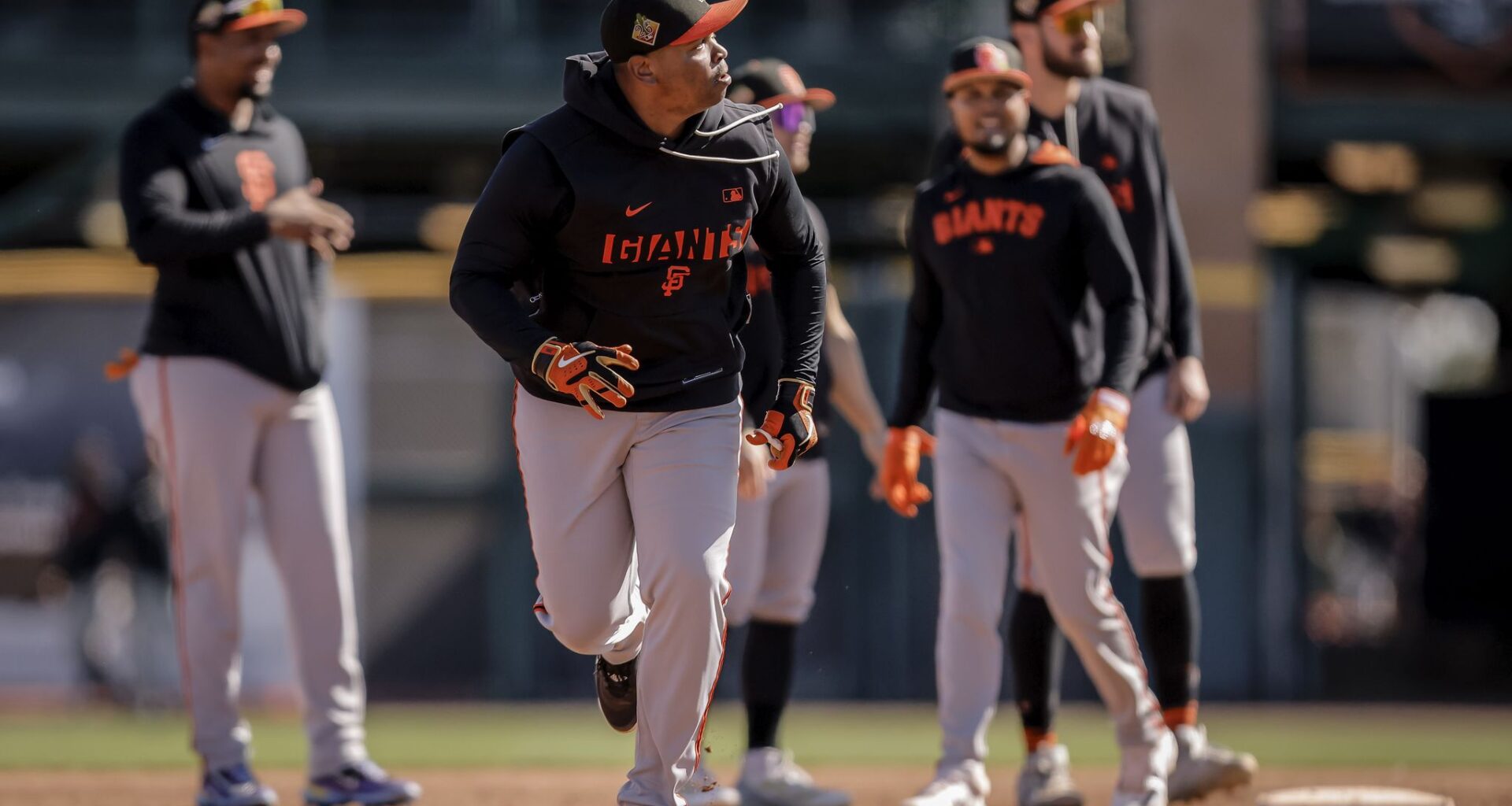
Giants first baseman Rafael Devers does baserunning drills during spring training at Scottsdale Stadium in Arizona on Feb. 20.
Carlos Avila Gonzalez/S.F. Chronicle
SCOTTSDALE, Ariz. — When Buster Posey decided to bring in his own manager and coaches last fall, one thing the San Francisco Giants top baseball executive said he wanted was a staff “obsessive about the details, obsessive about the work.”
That was taken at the time to mean more emphasis on pregame drills and preparation, a focus on continued development at the big-league level and greater intensity. Under new manager Tony Vitello, the Giants are doing all of that this spring, especially when it comes to fielding and baserunning.
“It’s noticeable,” general manager Zack Minasian said. “For me, personally, the respect I have for the prior coaching staff, even back to Bruce Bochy’s coaching staff, the previous front offices, I don’t necessarily look at things and compare and contrast, but it’s more watching and seeing, ‘How does this feel?’ And it does feel fast-paced, extremely intentional.”
Article continues below this ad
Nowhere is the increased energy more evident than in infield drills. Ron Washington, the guru of infield coaching, has his group practically sprinting through their pregame work.
“I’m a fan,” third baseman Matt Chapman said. “We’ve been getting a lot out of it. It’s as close to game speed as possible, and that helps guys make good in-game decisions.”
San Francisco Chronicle Logo
Make us a Preferred Source to get more of our news when you search.
Add Preferred Source
Washington said that if the infielders get through pregame drills perfectly, sessions can be as short as four minutes. That’s as zippy a drill as you’ll see in any sport.
Article continues below this ad
“The more accustomed they get to it, the quicker it gets, and the more intense,” Washington said. “Because now they’re comfortable. They know how to go about it, and they can come back there to the back field and knock it out and go about their business.
“They’re engaged, and it’s different from something that they’ve ever been involved in. They see it almost like competition to do what I’m trying to get them to do. That’s the fun part.”
For someone such as Bryce Eldridge, who is working to become a MLB-ready first baseman, this near-sprint workout pace is especially helpful. He knows if he makes a mistake, it’s right back to the beginning — “if you do one little thing wrong, Wash will let you hear about it” — but that challenge gives it even more of a game-time feel.
“I’m at the point now I don’t even think during the game, it’s just all reaction, and that’s a good spot to be in,” Eldridge said. “The less you think, the better and the easier it is for you. It’s definitely good for me and with how my development is going, trying to be more natural out there and flowy instead of thinking about how my feet are moving and where my glove is.”
Popup priority drills — clumps of fielders converging and figuring out who makes the catch — have borrowed something from the college game this spring. The coaches signal to the PA booth to blast the loudest music possible to simulate crowd noise, something Vitello did at Tennessee and Chapman recalls doing at Cal State Fullerton. It’s ear-splitting and it’s effective.
Article continues below this ad
Giants manager Tony Vitello watches a popup from the dugout during a spring training game against the Seattle Mariners at Peoria Stadium in Arizona on Feb. 21. Popup drills have been a particular focus of the new skipper’s fast-paced drills.
Carlos Avila Gonzalez/S.F. Chronicle
“I like coming out here and watching popup priority, because it’s like half popup priority, half EDM concert,” Minasian said. “But it makes sense, they’re not doing it just to do it. You have a popup in a big situation in front of 45,000 fans and it’s tense, it’s loud, and we need to be able to communicate. But there is also an element that I hope is fun for players because it’s fun for us to watch.”
Vitello usually picks the music. It would make little sense to go for easy listening, so he leans as heavy as he can while picking something to up the tempo in general. The EDM hit “Tsunami” is one he used at Tennessee; this spring, it’s often Drowning Pool’s “Bodies,” which when played at full blast sounds like a teenager throwing a house party while the parents are away and the neighbors are about to call the cops.
“I was surprised,” catcher Patrick Bailey said. “I can’t speak for everybody else, but it was cool, a fun strategy to go about making something more difficult.”
“Tony picked some music that’s crazy,” Washington said. “But it’s got to be loud — it’s no good otherwise.”
Article continues below this ad
When it comes to baserunning, some of the learning is happening during the spring games. Vitello has his fastest runners and his best baserunners (sometimes different things) experimenting with when they can steal, when they can’t, going first move, different counts, different situations. That has led to more pickoffs than maybe you’d expect, but that’s absolutely OK — this is important data for a first-time big-league manager and a new coaching staff.
“It’s spring training, it’s a little easier if a guy gets thrown out,” Vitello said. “In the season, stakes are a little higher. It’s easy to sit back and say, ‘We should have done this, or let’s do that,’ but it’s expensive experience when you make a mistake or you’re aggressive and it costs you. It’s a delicate balance.”
Before Wednesday’s game, the Giants were 13th in steals this spring, with 26 — 12 of them from nonroster outfielder Jared Oliva — and were 10th in caught stealings with seven.
“They’ve definitely been harping on not being scared to make mistakes right now, seeing what we’re capable of,” Eldridge said. “Why not do that now, and then we know where we’re at during the season?”
The Giants were last in the league in steals last season with 68, another area where they can make strides.
Article continues below this ad
“We have the personnel for it,” infielder Christian Koss said. “It’s not like we’re a slow team, and even our let’s say not-burners can still run. It’s not about being fast, it’s about picking the right time, and as a team, we can do better with it.”
Utility infielder Christian Koss works on baserunning drills during spring training at Scottsdale Stadium in Arizona on Feb. 20.
Carlos Avila Gonzalez/S.F. Chronicle
With extreme heat in the Phoenix area for the final days of camp in Arizona — 100-plus degree heat was expected every day — the expectation was that pregame work could get cut back a bit, but given how fast Washington’s workouts are when done right, that’s OK.
“Our practices haven’t been crazy long or intense and that’s a tribute to the players, because they’ve been on task when we’ve asked them to do things,” Vitello said. “We just move on to the next thing because mission accomplished.”
The biggest takeaway from all of this is the planned aggressiveness in all areas and the uptick in zip everywhere.
“There’s a lot of energy,” Bailey said. “We’re definitely working harder, and I think you can kind of see that in our play right now. I think that’s important to set the standard and foundation for what we want to do this season.”