
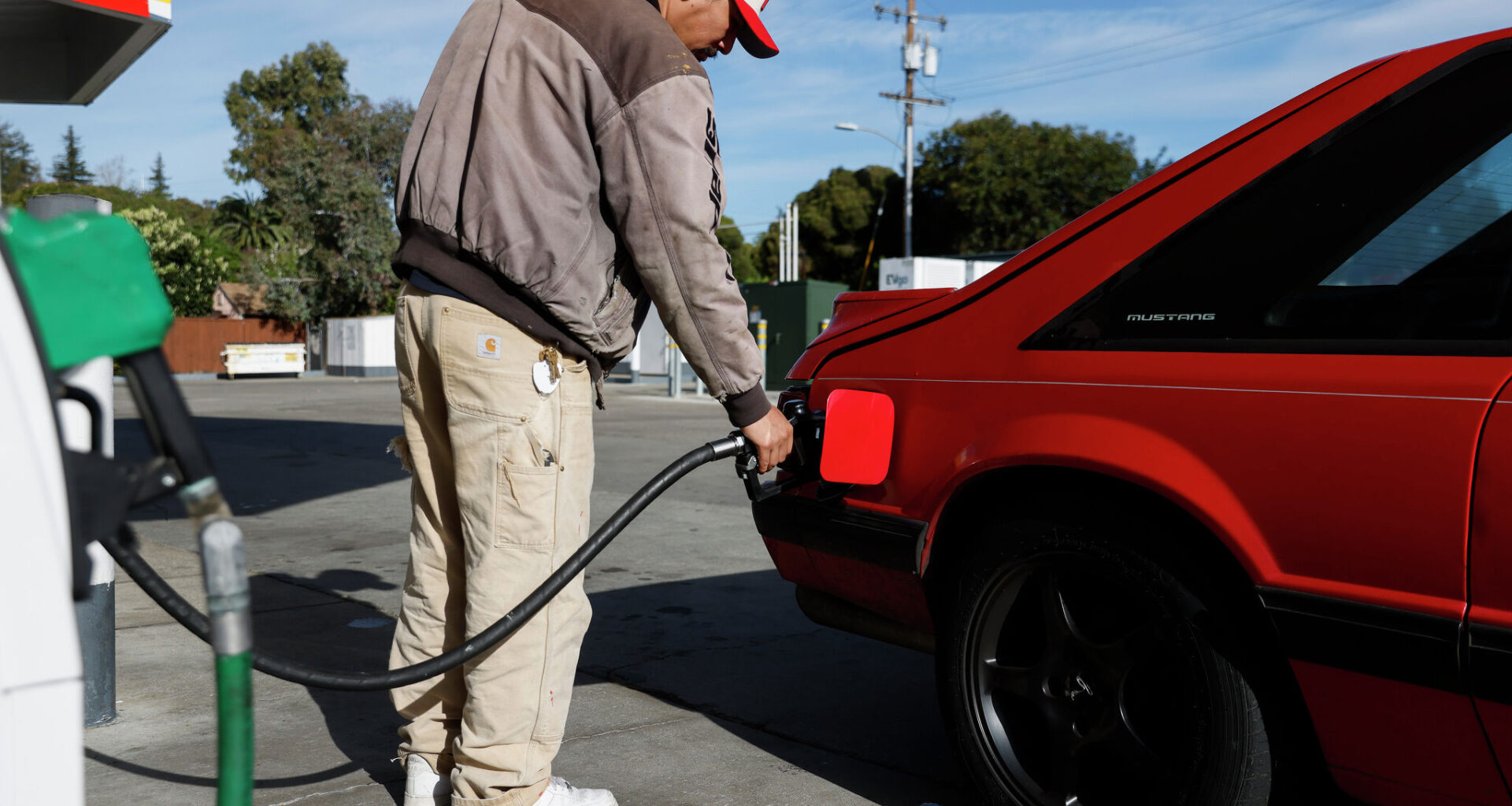
Alejandro Torres fills up at a gas station on Fruitvale Avenue in Oakland on Friday. Some drivers are altering their routines as gas prices rise and could hit $7 a gallon in the coming months.
Jessica Christian/S.F. Chronicle
Commuting by car is growing increasingly unaffordable in California. Thanks to President Donald Trump’s war with Iran, gas prices in California rose sharply this month to $5.50 a gallon. Experts say gas could top $7 per gallon in the coming months. Meanwhile, electricity prices have also skyrocketed in recent years, making electric vehicle commutes more costly, albeit less than gas vehicles.
Price spikes at the pump have become an issue in the California governor’s race, with one candidate, San Jose Mayor Matt Mahan, calling on the Legislature to suspend the state’s gas taxes.
Many Bay Area commuters — even those like me who mostly ride the bus or BART — aren’t waiting for Sacramento to try to fix the problem; we’re using carpools as a way to cut down on the cost of getting to work.
Article continues below this ad
Twice this past month, on my daily commute from the East Bay to downtown San Francisco, a car pulled over at my AC Transit bus stop and the driver asked if I wanted to carpool into the city. Both times, I hopped in. It saved me $13 that week and ultimately got me downtown just as fast as the bus, which runs directly from my stop to Salesforce Tower in the carpool lane.
My hosts — a middle-aged couple in a Toyota RAV 4 hybrid and a young man in a Subaru Forester who picked up two people from the bus stop — were happy to give me a free ride. Each Bay Bridge crossing into the city with three or more passengers and a FastTrak Toll Tag saves drivers $4.25. The carpool lane also shaves 20-30 minutes of toll plaza gridlock. As a result, everyone in the carpool wins. I’ve never been asked to chip in for gas money in the dozen or so times I’ve commuted this way.
San Francisco Chronicle Logo
Make us a Preferred Source to get more of our news when you search.
Add Preferred Source
Still, I get that not everyone is eager to jump into a car with a stranger who pulls up to a bus stop. The fear of being abducted or harmed can’t be discounted. But my experiences have been anything but harrowing.
Article continues below this ad
One morning last week, the male driver and his female companion were engrossed in an audiobook version of a Sherlock Holmes mystery, and we didn’t speak during the journey. During another ride, I couldn’t help but eavesdrop on a conversation about the difficulties of raising surly teenagers. Headphones can be advisable, in other words, but that’s really no different than commuting on the bus or BART.
The benefits of carpooling are compelling and well-established. A 2018 study by UC Berkeley researchers found that, “Because carpooling reduces the number of automobiles needed by travelers, it is often associated with numerous societal benefits including: 1) reductions in energy consumption and emissions, 2) congestion mitigation, and 3) reduced parking infrastructure demand.”
In September, California ended a program designed to spur the adoption of electric vehicles that allowed them to use carpool lanes no matter the number of passengers.
The green stickers my wife and I had affixed to our plug-in hybrid Prius are now worthless, so we swing by the bus stop on the mornings she teaches at the University of San Francisco in search of a third, whom we drop off at Salesforce Tower. These are the same people I ride to work with on a normal day, and recognizing one another certainly helps to allay fears. One middle-aged woman has become a regular and waves at us as we approach the intersection, happy to get a free ride into work. Sometimes we have more people stepping forward than we have room to accommodate.
511 SF Bay has also jump-started its Casual Carpool program, which designates pickup locations where drivers can be paired on a first-come, first-served basis with passengers. Popular before the COVID pandemic, Casual Carpool has locations in Alameda, Albany, Berkeley, El Cerrito, Emeryville and Fairfield. With more people returning to jobs in San Francisco, the 511 said, “The system has resumed in areas where demand has increased.”
Article continues below this ad
Sure, some people will always be wedded to the routine of driving into San Francisco alone. In an informal Chronicle poll taken last week, readers were asked, “How high would California gas prices have to go for you to change how much you drive?” Thirty-eight percent of respondents said there was “no amount” that would change their daily routines.
But there’s little doubt that higher fuel prices will push a larger number of people to use carpools. In a 2013 study published in ScienceDirect, researchers found that a 10% rise in the price of gas corresponds with 10 additional cars in high-occupancy-vehicle lanes per hour.
It is true that greater adoption of carpools won’t, in and of itself, cure what ails the Bay Area’s transit. They won’t, for instance, help close BART’s nearly $400 million deficit. And in a grim preview of what life for commuters could portend if transit service cuts become a reality, on the day I filed this story, the 20 people waiting at my usual 8:20 AC Transit bus to Salesforce were informed by the driver that every seat on the coach was full. We’d have to wait an hour for the next bus to arrive — and pray it had enough seats. A chorus of groans ensued.
Guest opinions in Open Forum and Insight are produced by writers with expertise, personal experience or original insights on a subject of interest to our readers. Their views do not necessarily reflect the opinion of The Chronicle editorial board, which is committed to providing a diversity of ideas to our readership.
Read more about our transparency and ethics policies
I stood there for a moment, wondering if the couple in the RAV 4 might magically appear to offer me another chapter of Sherlock Holmes. Alas, while carpools are a wonderful option when available, they can’t be relied upon.
Article continues below this ad
So I set off on a 20-minute hike to the El Cerrito Plaza BART Station. At least I didn’t have to buy gas.
David Knowles is the deputy editorial page editor for the Opinion section.