
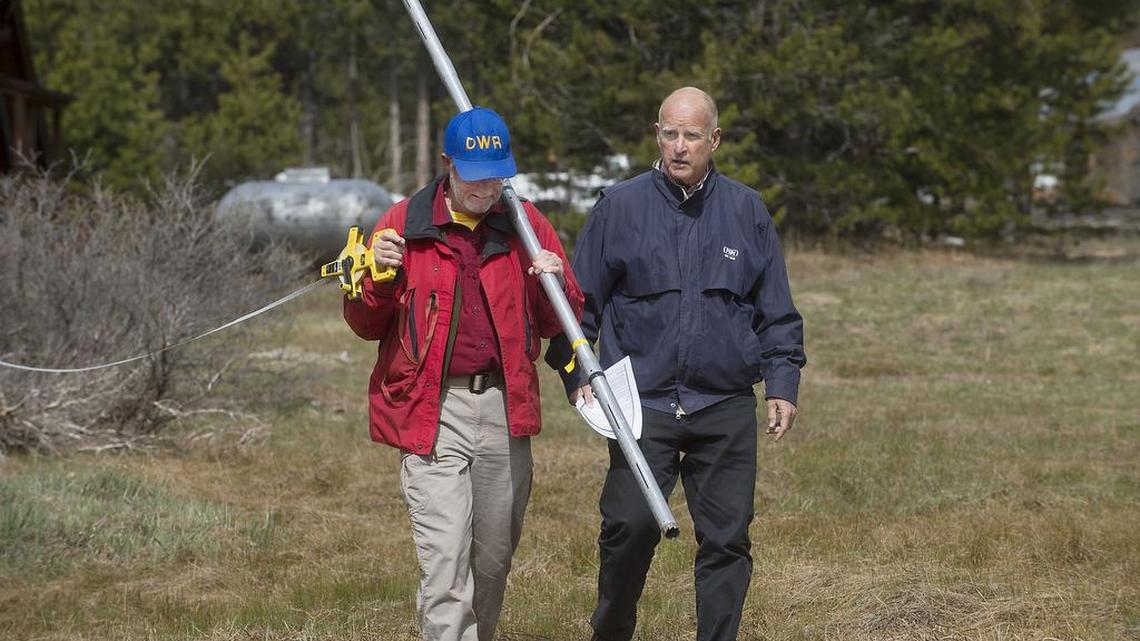
State employee Frank Gehrke and then-Gov. Jerry Brown walk through Carol Pearson’s drought-plagued meadow near Echo Summit in April 2015. This year’s April snowpack could approach low levels.
Randall Benton
Sacramento Bee file
If California is entering its next historic drought, the weather cycle would begin precisely like this, with a stretch of summer-like weather before it is even officially spring.
A meager Sierra snowpack hovering at less than 50% of average is on track to melt away under a scorching sun and all but disappear in the coming days to near record-low levels. Temperatures in Southern California this week are reaching into the triple digits. In Redding, peak heat is more than 20 degrees above average.
In terms of whether this becomes a drought, “this could be that marker of year one,” said Michael Anderson, the state climatologist with the California Department of Water Resources.
California has enjoyed three above-average precipitation years with healthy snowpacks in a row. This abnormally wet pattern has lulled us collectively into a false sense of water security. That is all changing now, and rapidly.
Long-timers of the state are accustomed to the rhythm of these cycles. Reservoirs exhaust their reserves in the first year. Farmers in the San Joaquin Valley begin to pull even more heavily on groundwater. And governors declare a drought long after its onset, and only because there is some water management regulation in Northern California that requires an emergency exemption.
But this drought, should it be truly beginning, would feel different from any in the past. It would put western water management to the test in new and unprecedented ways. And it’s far from clear whether we’re up to the task.
Beware of the Colorado River
The Colorado River is the backbone of the western water grid. It serves seven states and the Republic of Mexico. It is the difference between Las Vegas and Tucson being vibrant societies or empty swaths of desert.
The existing heat dome is sitting atop the Colorado watershed. For years, water agencies and various presidential administrations have failed to figure out how to permanently reduce water use. And now, its massive reservoir straddling Utah and Arizona, Lake Powell, is emptying rapidly.
The massive turbines inside the dam have reliably produced electricity for four western states for more than half a century. But the receding lake could render these turbines dry and inoperable some time later this year, absent an unscheduled delivery of water from an upstream dam that ironically is known as Flaming Gorge.
What was once the unthinkable is the coming new normal.
“Droughts are usually where you kind of look at your big picture,” Anderson said. Looking about, our water picture is increasingly perilous and combative.
The Donald Trump drought?
President Donald Trump and his federal Bureau of Reclamation operates the Colorado River. In California, his Central Valley Project (CVP) manages some of the most important water infrastructure in the state, including Folsom Dam here in Sacramento and Shasta Dam, the state’s largest, north of searing hot Redding.
The Colorado River has operated for nearly 20 years under rules that expire this year. Trump, of all presidents, gets to rewrite them in the coming months.
In California, the CVP is supposed to provide the necessary environmental flows through the Sacramento-San Joaquin Delta along with its sister system, the State Water Project (SWP), originating on the Feather River. And as an important aside, my spouse, Karla Nemeth, operates the SWP as director of the California Department of Water Resources.
“We can get through this year, not perfectly, but certainly without serious difficulty,” Anderson said. But next year, if it’s dry?
There is a tradition of the CVP and SWP collaborating closely to manage with less water and balance obligations between the environment and its human customers. The alternative to partnership is a form of operational chaos, the systems operating under conflicting sets of reservoir releases and pumping regimes in the Delta, leaving it to courts and regulators to resolve conflicts. Are we mere months away from that?
A teaching moment
Most Californians are blissfully unaware of the state’s many water predicaments. The reliability of water flowing from the tap lulls us into a false sense of security. For the insiders and experts like Anderson, droughts are hopefully teaching moments that test whether California can manage better in moments of shortage.
Here’s a scary thought. We could stay warm through Halloween.
Climate change, says Anderson, can mean “getting robbed in your spring and your fall.”
The weather is out of our hands. Our politics, however, are entirely manufactured.
What is now missing, if we are truly entering a drought, is any sense of collective resolve among our leaders to withstand our future together.
Related Stories from Sacramento Bee
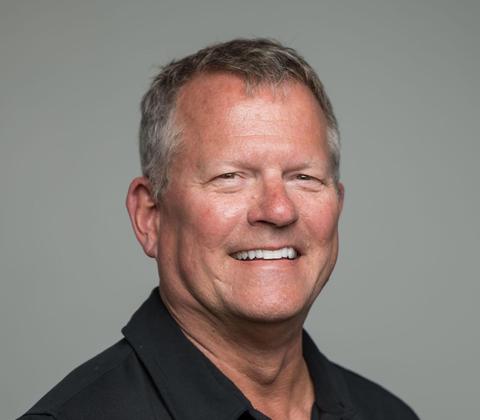
Tom Philp is a Pulitzer Prize-winning editorial writer and columnist who returned to The Sacramento Bee in 2023 after working in government for 16 years. Philp had previously written for The Bee from 1991 to 2007. He is a native Californian and a graduate of the Medill School of Journalism at Northwestern University.