
Before he came to Newman Hall Holy Spirit Parish near UC Berkeley last year, Friar Xavier Lavagetto oversaw the Catholic campus ministry at Stanford University, and led mass in its famed Memorial Church. Built at the turn of the 20th century, the building harkens back far earlier with its Romanesque architecture, shimmering mosaics and intricate stained-glass windows that make it a centerpiece of the campus.
Lavagetto’s new home could hardly be more different.
Newman Hall has hulked at the corner of Dwight Way and College Avenue since 1967, defined by a shell of colossal concrete panels, which also form the walls of its sanctuary and much of the rest of the interior. It’s a showcase for brutalism, and like other examples of that often-maligned architectural movement, Newman Hall starkly divides opinion.
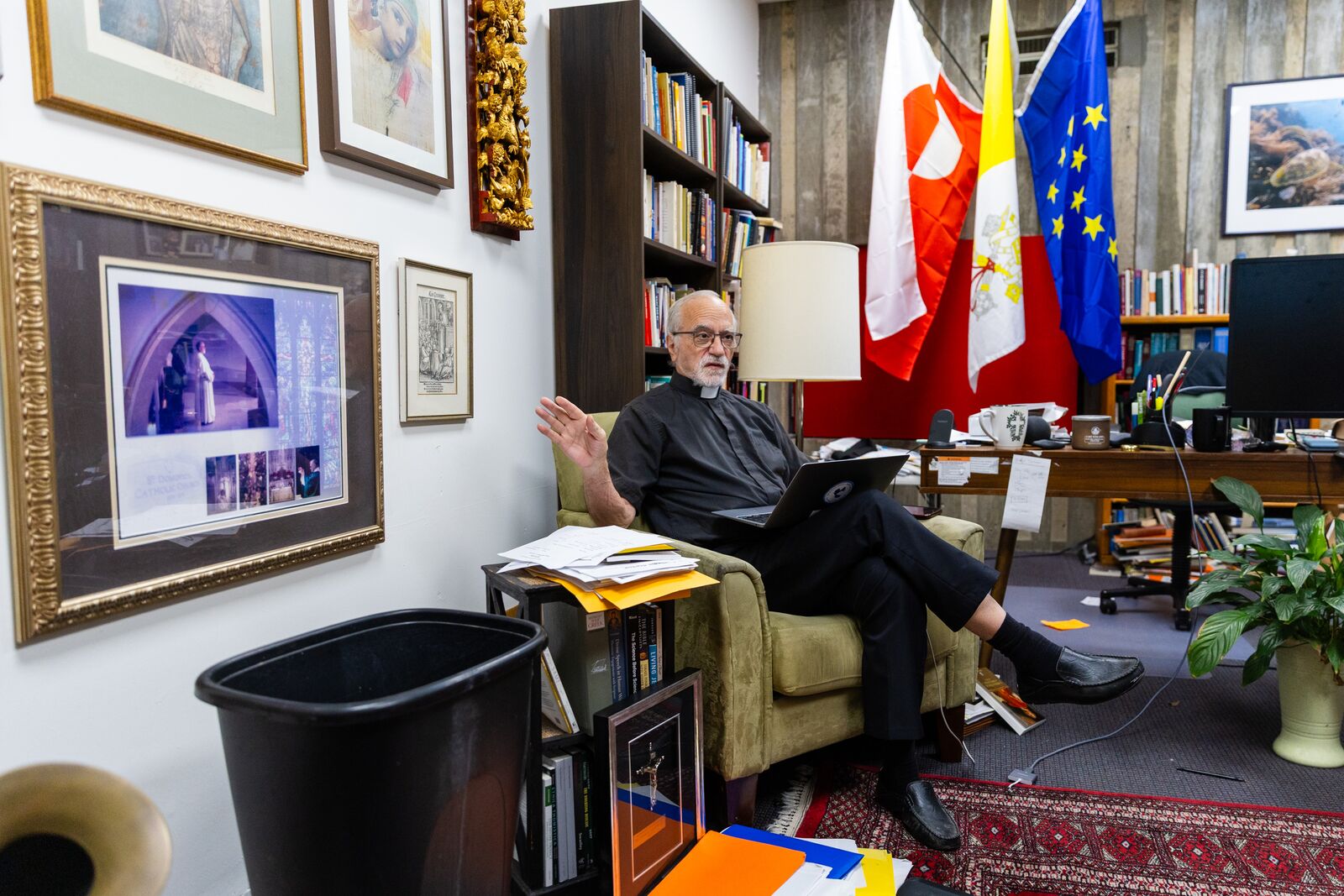 Lavagetto keeps a trash can in his office to catch water that drips from the ceiling. His office is directly below a leaky second-floor patio that the parish plans to redesign. Credit: Estefany Gonzalez for Berkeleyside
But as the parish looks to raise $600,000 for repairs to its nearly 60-year-old home, a recent tour showed why those with a fondness for brutalism — or anyone who can appreciate creative design — will delight in exploring the building.
“It’s really massive, but there’s such a thoughtfulness to it,” said John King, the former urban design critic at the San Francisco Chronicle who retired in 2024. “It embodies all the good things [from] that kind of heroic, rugged era of architecture.”
As Lavagetto has gotten used to his new home, he has found details to appreciate — like how the sanctuary arrays its pews nearly 180 degrees around the pulpit.
“It’s an excellent preaching space,” he said.
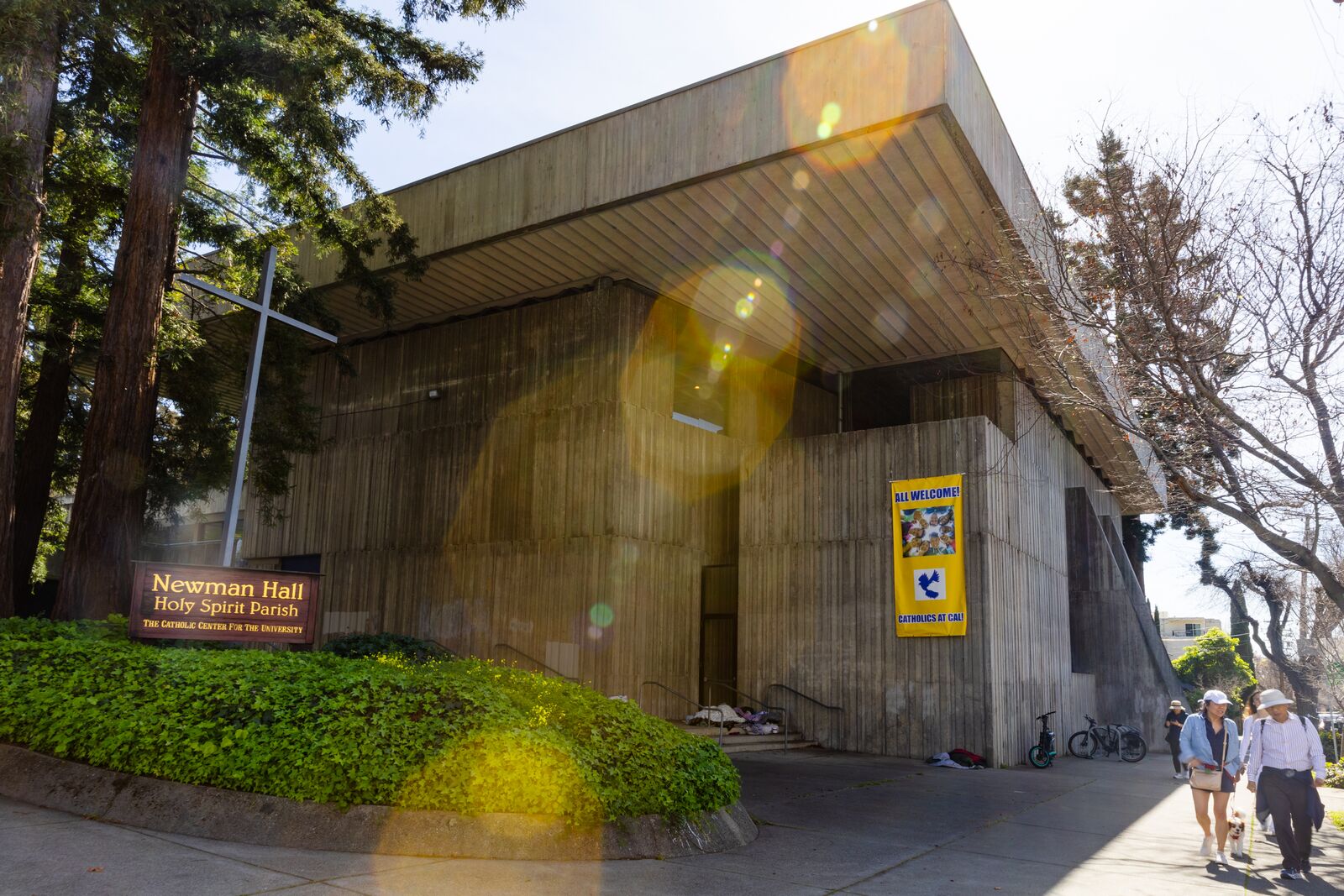 Newman Hall has stood at the corner of Dwight Way and College Avenue since 1967. Credit: Estefany Gonzalez for Berkeleyside
Still, the building is showing its age. A leaky second-story patio above Lavagetto’s office lets in rain, forcing the parish to spend $13,000 recently to remediate black mold, which is expected to return. The original single-pane windows that flood the concrete spaces with natural light are poorly insulated. And the building is still heated by its original boiler, said longtime parishioner Rob Hopcke — a system so outdated that many of the repair technicians who know how to service it are aging out of the field.
An exaltation of concrete that doesn’t feel like a bunker
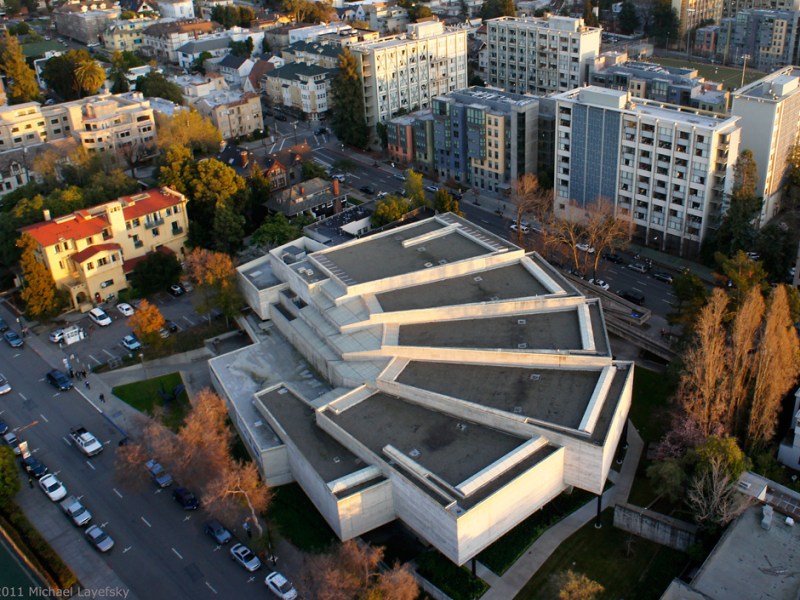
Designed by the architect Mario Ciampi, Newman Hall opened a few years before his masterpiece a few blocks north: the original Berkeley Art Museum building, which wowed visitors with soaring concrete galleries that flaunted gravity and, it turned out, seismic safety. Ciampi also designed celebrated school buildings in the suburbs of San Mateo County, as well as several less-beloved public plazas along San Francisco’s Market Street.
The Berkeley Art Museum and Pacific Film Archive left Ciampi’s building in 2014 for their current home downtown because of earthquake safety concerns. After major renovations, the building between Durant Avenue and Bancroft Way reopened in 2021 as Woo Hon Fai Hall, the home of a biotech business incubator known as the Bakar BioEnginuity Hub.
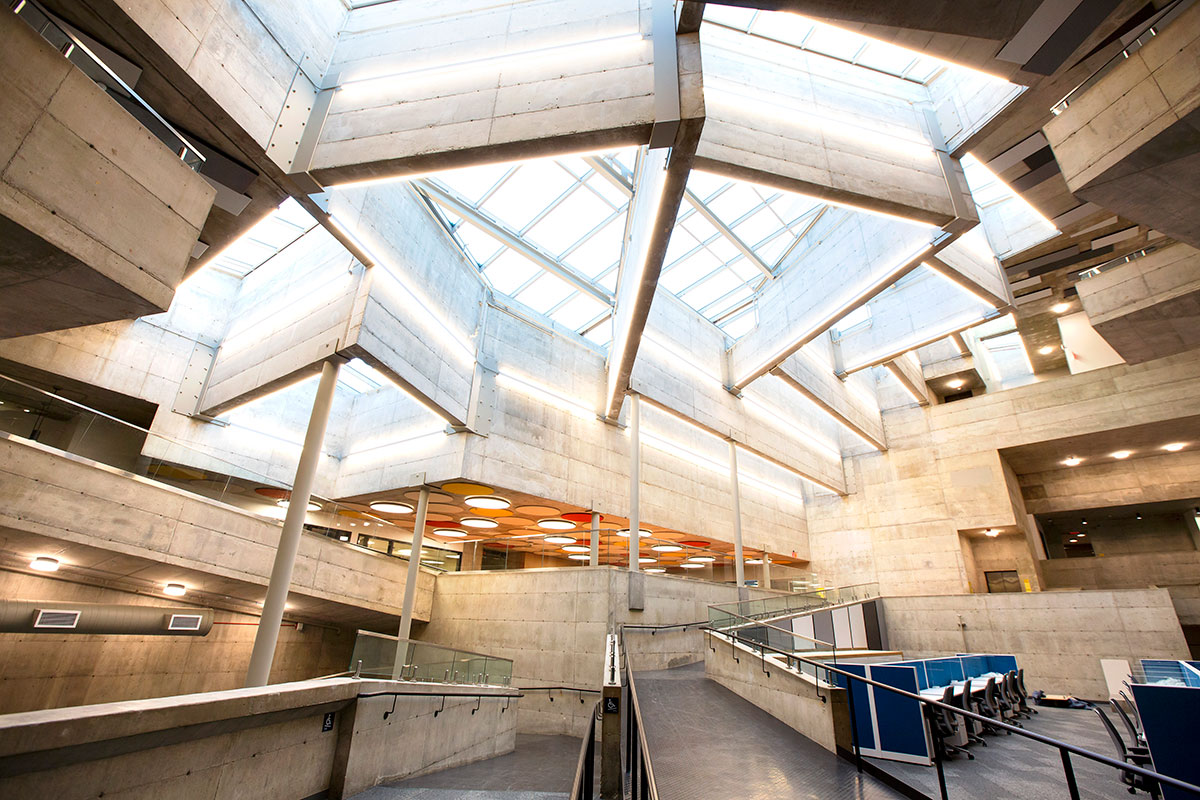 A few blocks north of Newman Hall is architect Mario Ciampi’s most famous building: the former Berkeley Art Museum, home since a seismic renovation to the Bakar BioEnginuity Hub. Credit: Brittany Hosea-Small
That remains the “more adventurous, swaggering, cool” Ciampi building, King said. But its lower-profile sibling, Newman Hall, deserves recognition as the better “example of what brutalism set out to do” by being in touch with the needs of its users, he said.
“It’s all about concrete — it’s all about heft and form and depth,” he said, “but there are so many smart moves around it.”
The concrete walls, for example, are made up of alternating panels set off by a half-inch or so that create the building’s distinct vertical lines and give the material a sense of depth that is reminiscent of stone or brick, King said. While Newman Hall is an imposing presence along College Avenue, he said, it makes a “person-scaled shift” near the corner with Dwight Way, pulling back from the sidewalk to form an entry courtyard that welcomes visitors with a grove of a dozen redwood trees.
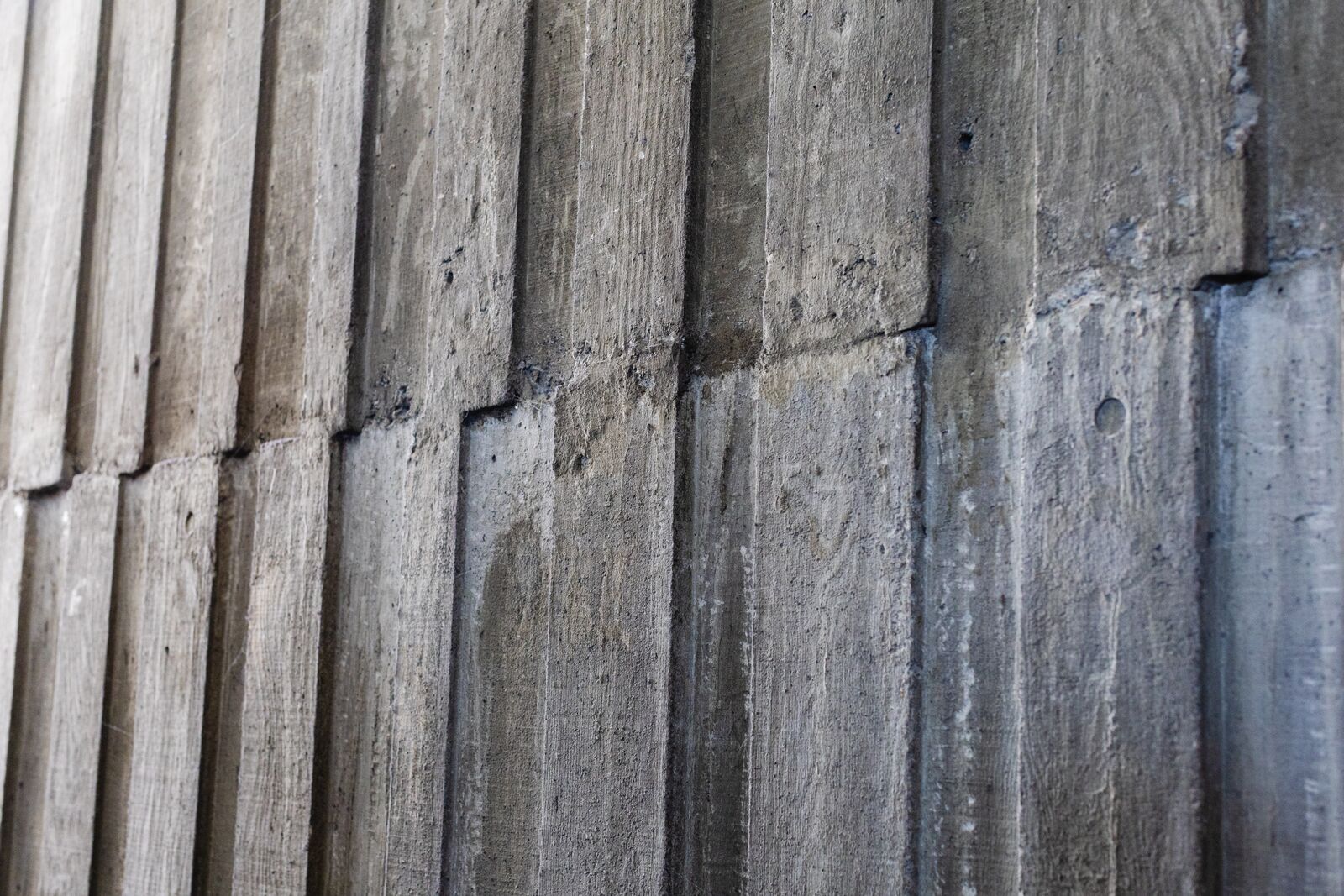 Newman Hall-Holy Spirit Parish’s walls, inside and out, are made of board-formed concrete. Credit: Estefany Gonzalez for Berkeleyside
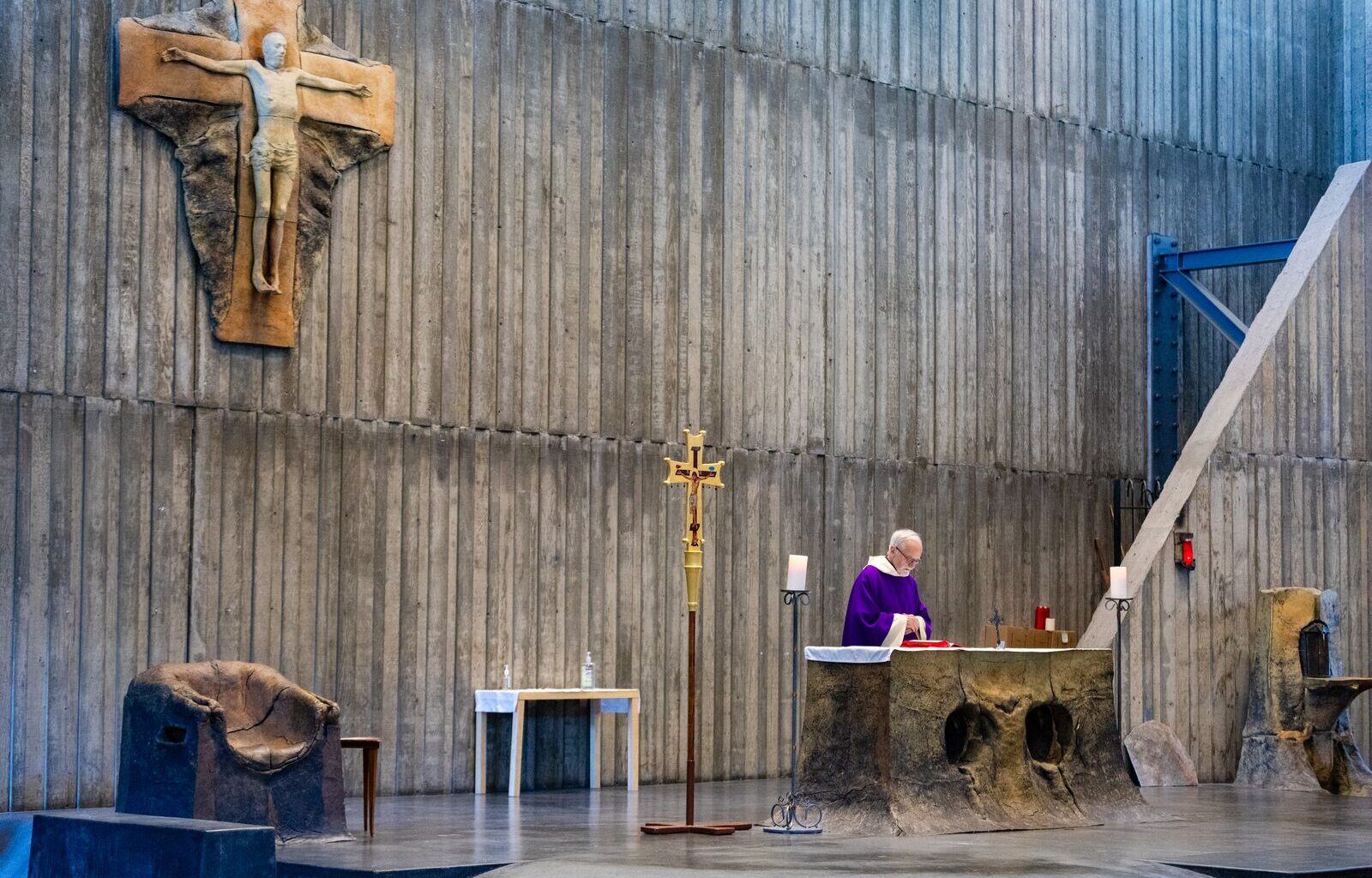
It all comes together in the church’s sanctuary, where the concrete walls soar up to the ceiling but never touch it. The top of the space is instead ringed with glass, the roof supported by thinner pieces of steel, letting in a halo of sunlight that moves with the hours and seasons.
The focal point of the space is a pulpit that swells like a mound of earth out of the polished concrete floor. Its altar and other fixtures were created by the sculptor Stephen De Staebler, made from clay he dug out of the East Bay Hills. There is no grand stained glass window, and few bold colors at all — instead, the palate is a naturalistic gray and earthen brown.
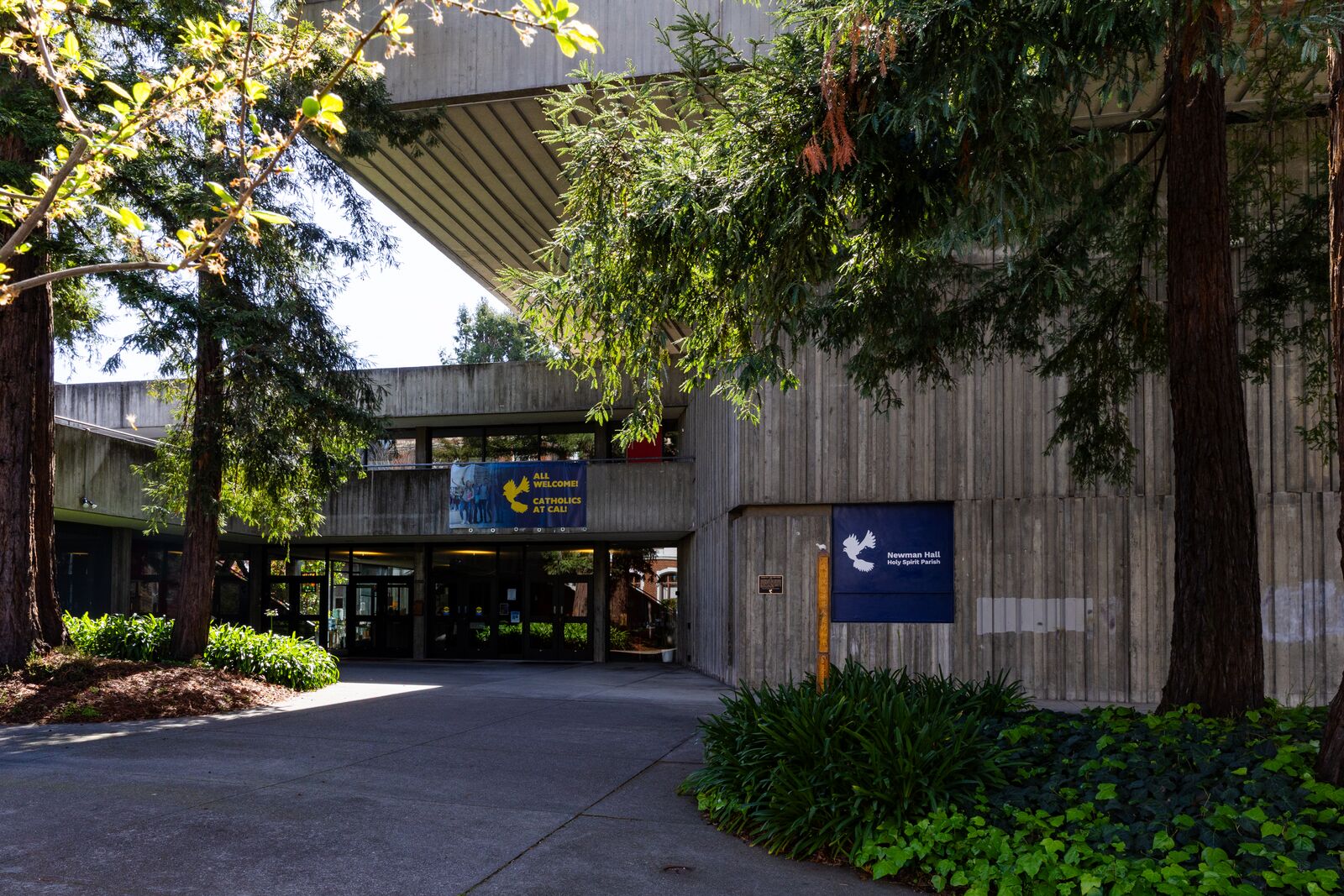 Former urban design critic John King praised the “person-scaled shift” of the entryway, where the concrete building draws back from its hulking exterior to a welcoming green space. Credit: Estefany Gonzalez for Berkeleyside
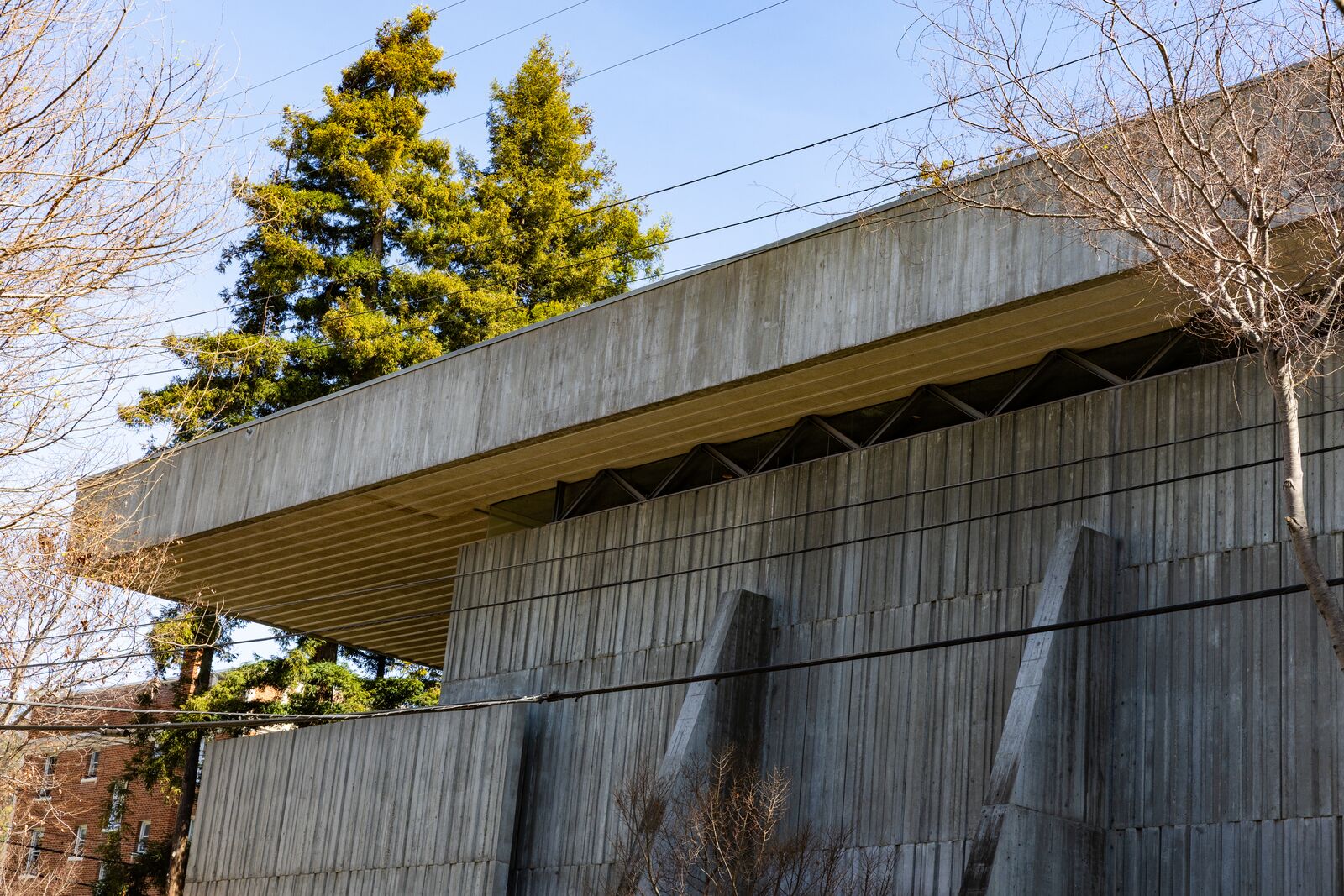 A view of the College Avenue side of the church. Credit: Estefany Gonzalez for Berkeleyside
Hopcke noted Ciampi’s use of board-formed concrete, which takes on the grain pattern and notches of the wooden casts it’s poured into, gives the walls more warmth than people would normally associate with the material. That effect ratchets up during a candlelight mass.
“It’s like you’re worshiping in the catacombs,” he said.
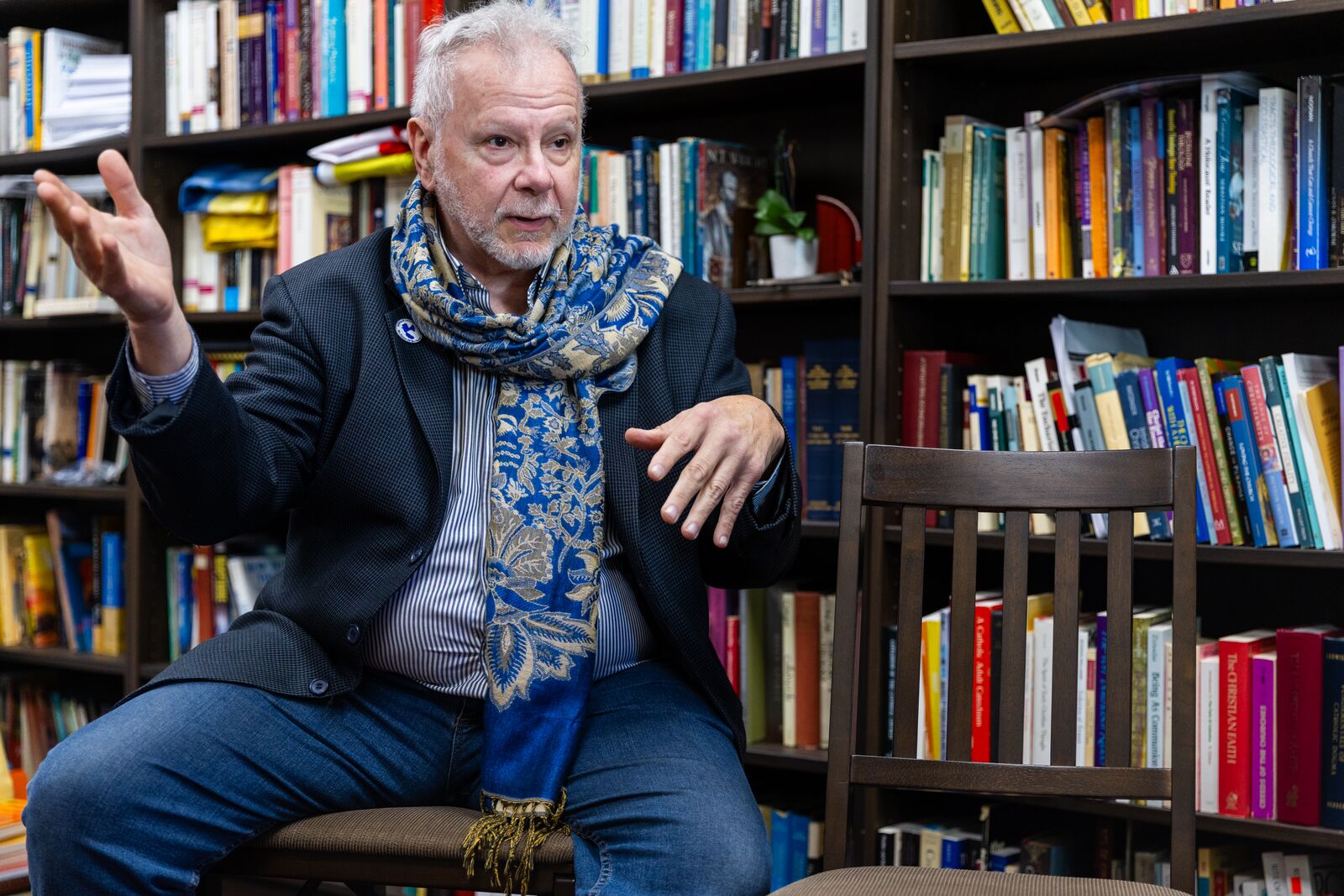 Longtime parishioner Rob Hopcke speaks about the church inside Lavagetto’s office. Credit: Estefany Gonzalez for Berkeleyside
Hopcke hears from plenty of UC Berkeley students who grew up going to more traditional churches and find Newman Hall’s architecture austere and difficult to love.
But he sees the building as an embodiment of the pivotal era in which it was built. Along with the other upheaval of the 1960s, Newman Hall opened a couple of years after the Second Vatican Council ushered in a wave of changes that extended to the architecture of Catholic churches, which were redesigned in an effort to make the experience of mass more communal and the church itself less hierarchical.
“It’s not just aesthetically” interesting, Hopcke said, “but historically significant too.”
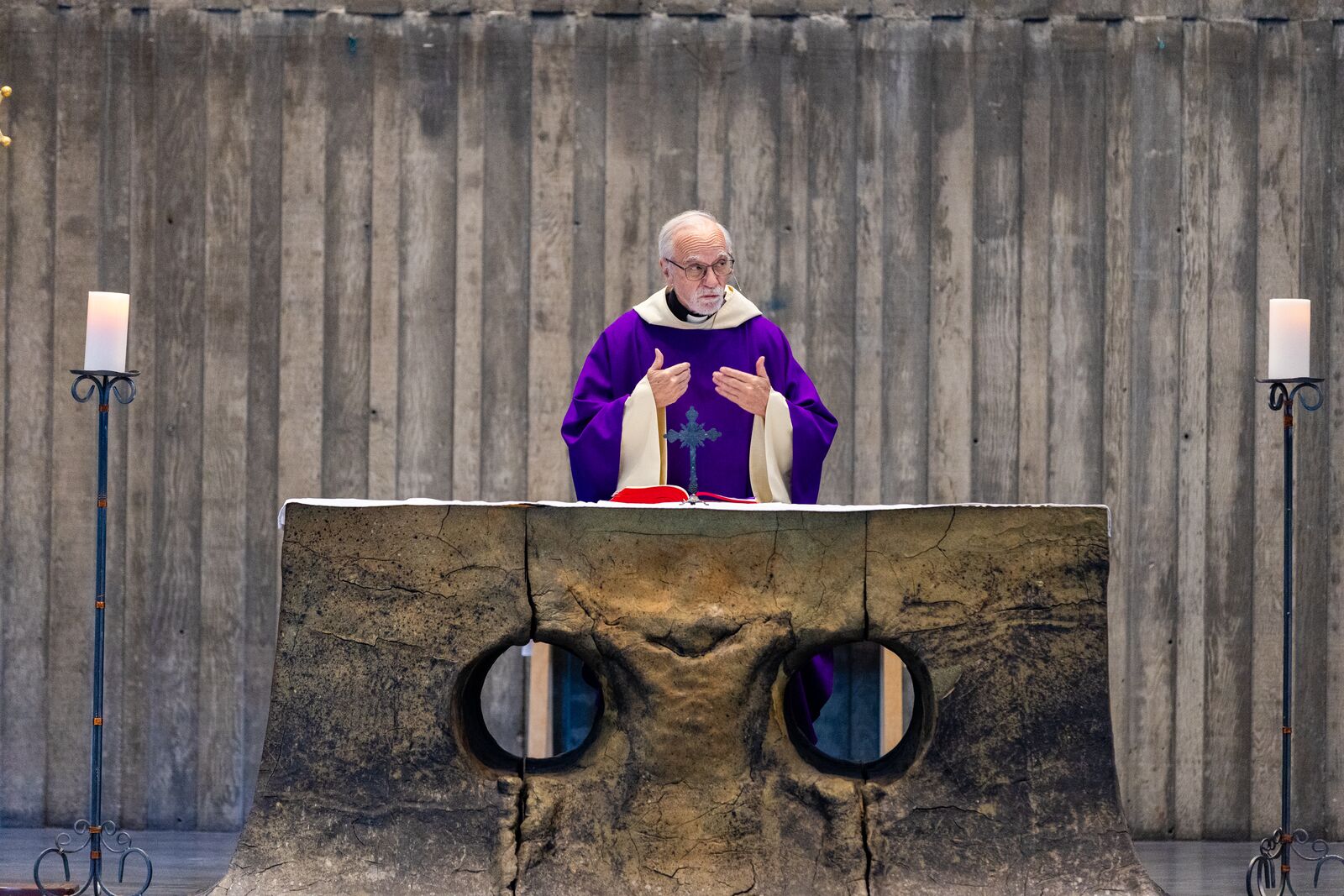 Lavagetto at the church’s altar. Sculptor Stephen De Staebler created the altar’s fixtures using clay he dug out of the East Bay Hills. Credit: Estefany Gonzalez for Berkeleyside
Campaign seeks to make repairs, but not change architecture
Newman Hall serves as the home base for Catholics at Cal — of the several dozen people in the pews for a mid-day mass last week, many were toting backpacks and seemed to have stopped by between classes — as well as Catholics who live permanently in the East Bay.
Holy Spirit Parish has long been known as a church that embodied the progressive streak of the city and university. But in 2014, the church was rocked when Bishop Michael Barber, appointed the year before to lead the Oakland Diocese, dismissed two Newman Hall priests and called for a “major redirection of ministry” there, according to the East Bay Express. Parishioners feared the move was Barber’s attempt to steer the church in a more conservative direction.
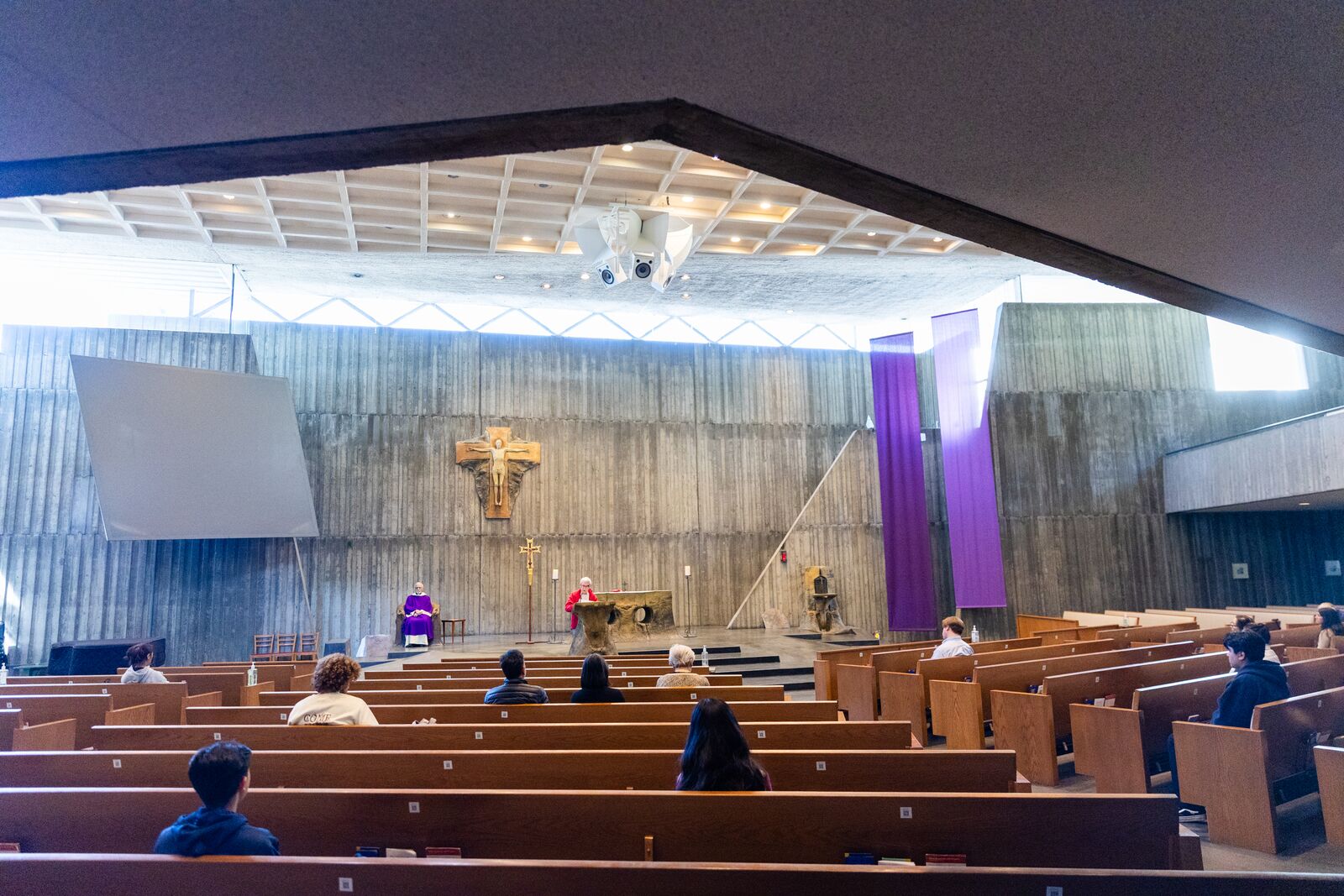 The walls of the sanctuary, seen here during a midday mass, reach to the ceiling but don’t touch it — instead, they let in a halo of natural light that shifts with the seasons. Credit: Estefany Gonzalez for Berkeleyside
Hopcke said he disagreed with Barber’s decision, which he regards as a “misstep” by a bishop who didn’t know the parish well at the time. Hopcke contends Newman Hall’s politics haven’t lurched to the right in the years since — the church still has its mix of “Berkeley social justice Catholics” and those with more traditional and conservative views.
“There’s a real breadth of belief here, and there is a sort of easy coexistence between those,” he said.
“Yeah,” Lavagetto added, “there’s no antagonism.”
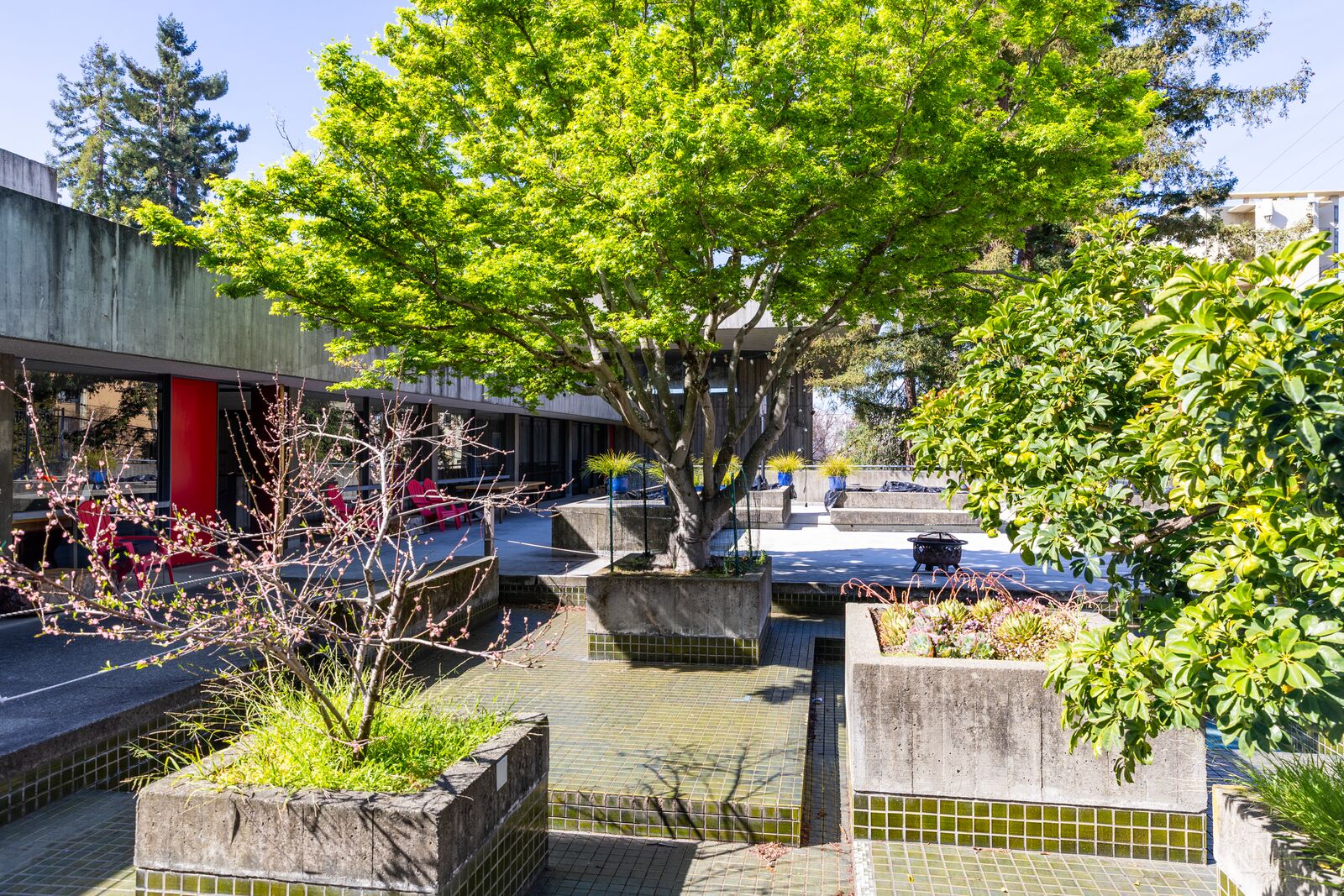 The second-story patio is a popular gathering space, but its baptismal pool has been empty and cordoned off for years. Credit: Estefany Gonzalez for Berkeleyside
Hopcke is now helping lead the fundraising campaign to replace Newman Hall’s boiler and windows, and address the mold problems by redesigning its rooftop patio space to eliminate leaks.
That aspect of the project will be the most significant change most people will see; there aren’t plans to redesign the building or change its distinctive architecture. Unlike Ciampi’s former Berkeley Art Museum, there isn’t a need for more seismic retrofits at Newman Hall, beyond the steel braces that are already in place at a handful of vulnerable areas.
And in another departure from its showy sibling, which in its current incarnation is closed to the public, Newman Hall’s doors will stay open for anyone who wants to stop in and admire it.
We’re opening comments on this story. Share your memories of the church or your views on the architecture.
Related stories
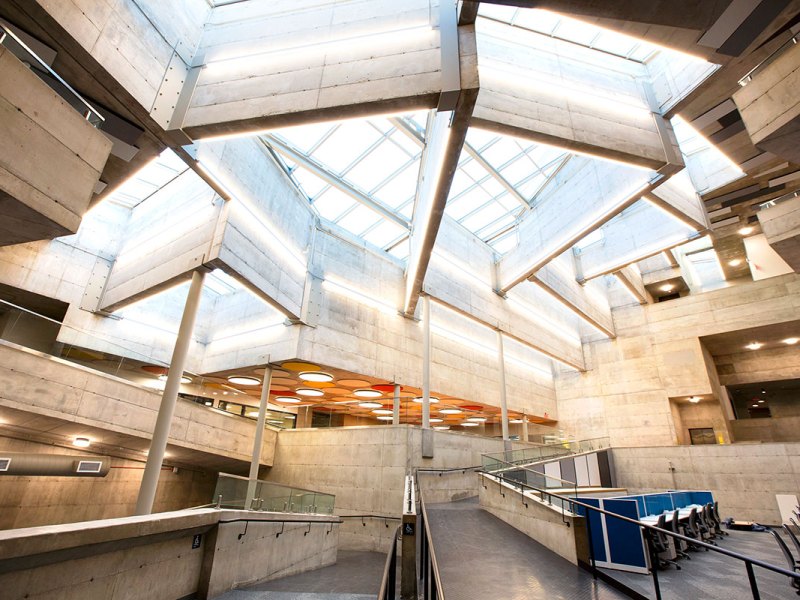
New bioresearch hub is sculpted from UC Berkeley’s brutalist former art museum
December 9, 2021Oct. 31, 2022, 11:45 a.m.
New ‘morality clause’ at Catholic schools prompts outcry
May 27, 2014Oct. 4, 2022, 1:14 a.m.
UC Berkeley has plans for its former, now empty, art museum
July 16, 2018Oct. 4, 2022, 1:46 a.m.
We know that most readers don’t get to the end of the article. But you did! To support our in-depth, rock-solid reporting, please consider making a donation to our nonprofit newsroom today. We rely on our readers — particularly the ones who read the whole story!
“*” indicates required fields