
As Iranians worldwide celebrate Nowruz amid somber times, one San Diego family bridges cultural gaps with their children’s book.
SAN DIEGO — On the first day of spring, millions of people around the world celebrate Nowruz—the Persian New Year, a holiday rooted in renewal, joy, and connection. But this year, for many Iranian families, that joy is intertwined with grief as war and unrest weigh heavily on their hearts.
In San Diego, families are doing their best to carry on traditions, even during a deeply emotional time.
For many immigrant families, sharing cultural traditions is deeply personal. “For many immigrant families, sharing traditions they grew up with is like sharing a piece of their soul,” said Zohreh Ghahremani, who moved to the United States from Iran nearly five decades ago, before the Iranian Revolution.
Growing up, Nowruz was the biggest celebration of the year. “You would walk in, wish them a happy new year, have a cookie, tea and if you were a child, you would get a bit of money and off to the next spot,” she recalled, describing visits to relatives that stretched across two weeks.
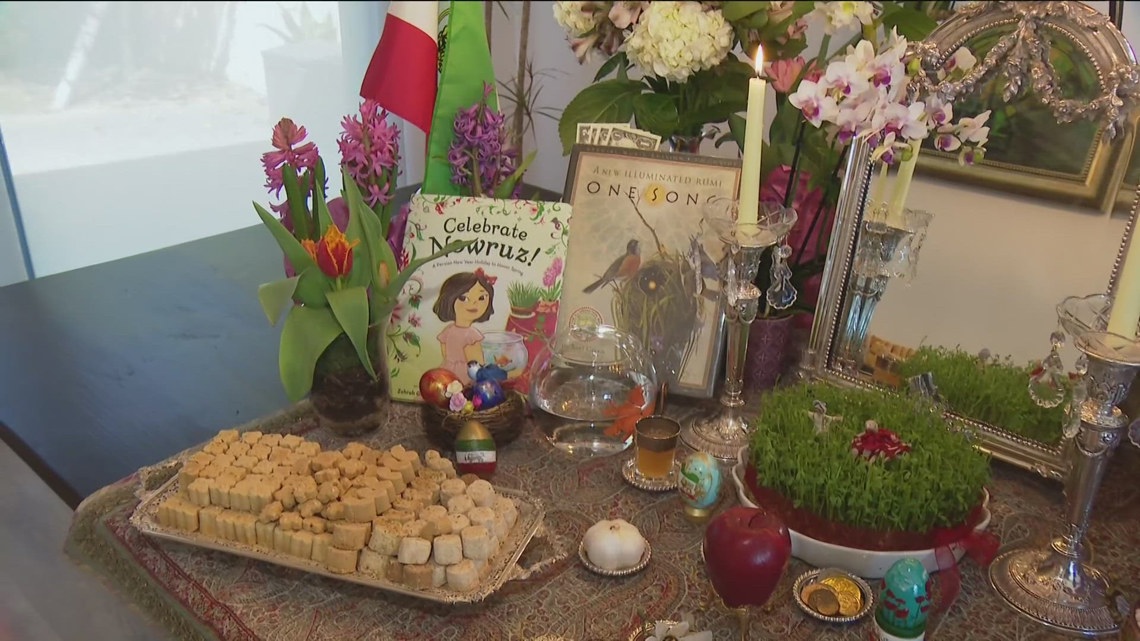
But recreating those traditions in the U.S. wasn’t easy. Items essential to the Haft-Seen table—like senjed and samanu—were difficult to find. “Little by little, I taught myself how to bake the baklavas and cookies,” Ghahremani said.
Now, with children and grandchildren of her own, she sees it as a responsibility to pass those traditions on. “It’s up to our generation… my generation, my children’s… to put it before them,” she said.
Her daughter, Susie Ghahremani, remembers what it was like growing up without a strong local Persian community. “As a kid, there’s so much joy in it, but I grew up in isolation, not knowing anyone celebrating in our immediate area,” she said. “Our closest friends who were Persian were like an hour away.”
Today, the two are sharing Nowruz with a broader audience through their children’s book, Celebrate Nowruz. The book explains traditions like lighting candles and filling homes with the scent of hyacinths, while pairing vivid storytelling with colorful illustrations.
“Kids are curious… they have heard about Nowruz, but to them it’s the holiday of that one child in class,” Zohreh said. “I try to explain… even though Nowruz started in Iran, it doesn’t belong to Persians. It is a universal moment that should be celebrated by all.”
Susie brought those ideas to life visually. “The thing my mom is so wonderful with her writing is giving these sensory details—that’s such a joy to illustrate,” she said. “There’s one page, for example, where rose water was used, and I was able to give aroma around them.”
She also added playful elements, like a recurring cat. “There’s a cat that shows up—we love seeing that cat. I wasn’t gonna include her,” she said with a laugh.
But behind the celebration, there is also sorrow.
The book’s release comes at a time when many Iranians are mourning lives lost to the ongoing conflict. “We have so many innocent children who are waiting for something to cheer them up,” Zohreh said, becoming emotional. “In honor of all of those innocent victims who will never see another Haft-Seen.”
For Susie, being surrounded by others who share that emotional weight is meaningful. “I find it comforting to be around people who have the complicated weight of this as well—and the hopes of what may come,” she said.
As an illustrator, she also feels a deep connection to Iran’s artistic heritage. “There are these incredible monuments, landmarks, art, music, all these things that I hope we can all experience someday in Iran,” she said, noting that many have been suppressed for decades.
Through their work, the Ghahremanis aim to show that Nowruz is about more than one country—it’s about resilience and renewal.
“No society stays the same, but no society deserves to go backward,” Zohreh said. “Hopefully, someday they’ll start going forward. Hopefully, there will be peace. And if there is ever a time to hope, that’s the vernal equinox.”
Even in a year marked by hardship, that hope endures—carried forward in stories, traditions, and the promise of a new beginning.