
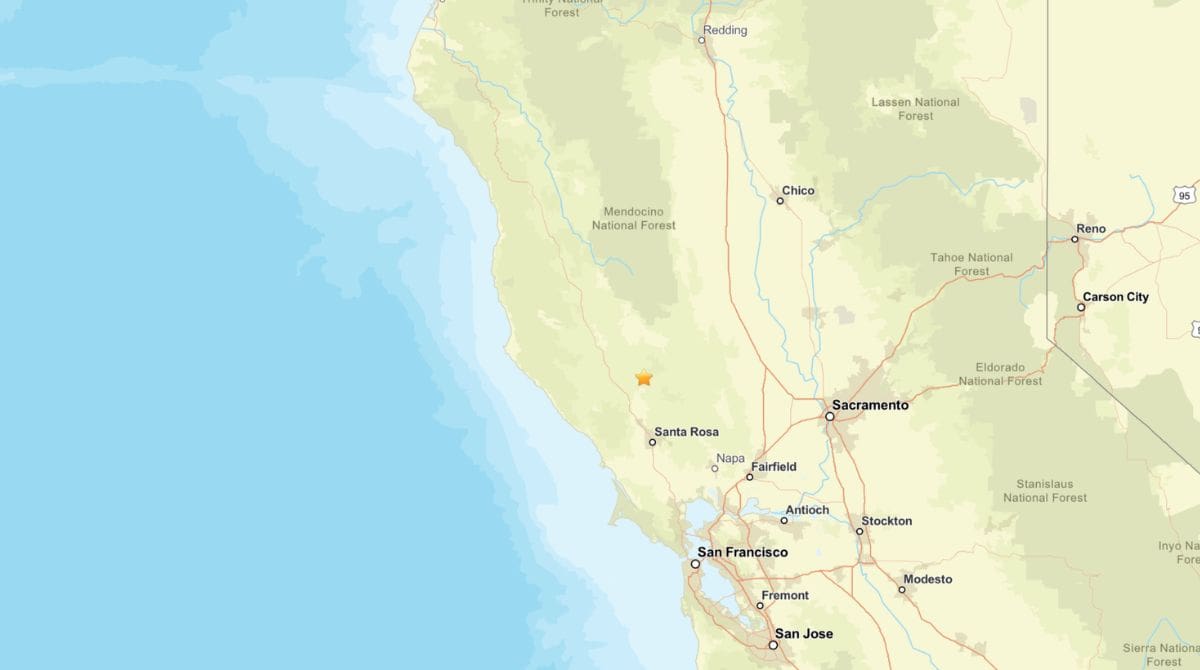
Earthquakes across California, in parts of Aromas and Geysers, were reported on Thursday morning, just minutes apart from each other, highlighting the region’s geothermal activity.
The tremors were followed by a cluster of smaller earthquakes continuing in the area the next day.
According to the USGS, the first earthquake of 2.3 magnitude was recorded near Aromas at around 11:02 a.m. PT on March 19, 2026. The quake originated at a depth of 1.2 kilometers, with the epicenter located at 3 kilometers east of Aromas.
Communities located near the epicenter include San Juan Bautista, Las Lomas, Pajaro, and Interlaken, according to the USGS.
The Geysers earthquake was recorded at a magnitude of 2.4 at a depth of 3 kilometers. The epicenter of the quake was located northwest of the Geysers.
This quake took place at around 11:18 a.m. PT. The communities near the epicenter were Cobb, Middletown, and Hidden Valley Lake.
No structural damage or injuries were recorded due to any of the quakes in the region.
Swarm Activity Near Geysers
Following the magnitude 2.4 event, a sequence of smaller earthquakes was recorded in the Geysers area, with tremors ranging between magnitude 1.0 and 2.0, according to the USGS.
These quakes occurred over several hours, continuing further into March 20, 2026.
Most of these quakes were shallow, with depths under 5 kilometers, and just a few events reached slightly deeper levels.
The repeated activities that happened within a confined area indicate a pattern identified as an earthquake swarm.
Unlike aftershocks, which follow a single larger quake, swarms consist of multiple small tremors without a clearly dominant main event. Such patterns can continue for durations, from hours to days, according to the USGS.
The Geysers region experiences frequent seismic activity due to its geothermal characteristics. It is recognized as a major geothermal field in the U.S., where underground conditions contribute to recurring low-magnitude earthquakes.
Seismic activity in The Geysers is closely linked to geothermal operations. Water is injected into hot rock formations to produce steam for energy generation. This process changes underground pressure levels and can trigger small earthquakes.
Preparedness remains essential, even during minor events. If indoors, individuals should stay inside, take cover under sturdy furniture, and avoid windows or heavy objects. Outdoors, moving to an open area away from structures and power lines is advised.
Drivers should pull over safely and remain inside their vehicles until shaking stops. In mountainous areas, caution is necessary due to the risk of falling debris or landslides.
After an earthquake, open flames and electrical devices should be avoided until it is certain there are no gas leaks.
Phone use should be limited to emergencies to keep lines available for responders.