
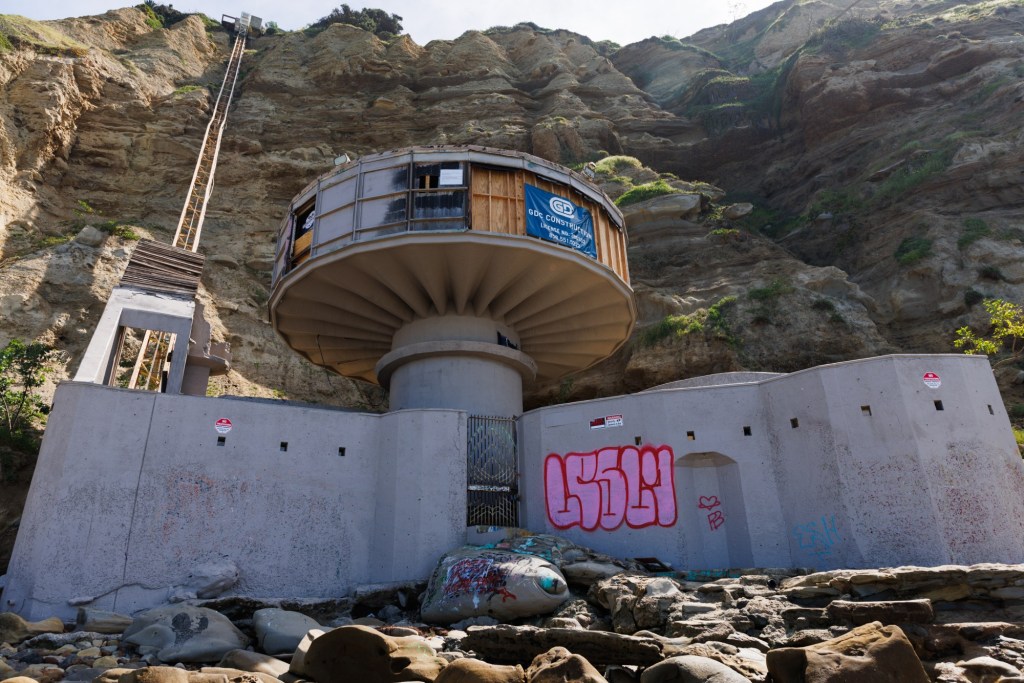
A coordinated effort to head off a planned pop-up rave party has given cleanup of the famed “Mushroom House” at La Jolla’s Black’s Beach added fuel.
The Mushroom House, so nicknamed for its shape, has become a tourist attraction as well as the subject of many social media posts and a hot spot for graffiti and vandalism.
A TikTok video promoting a “free sunset DJ set” at 3 p.m. March 7 near the house made the rounds recently on social media and came to the attention of GDC Construction, a La Jolla-based company that recently was tapped by current owner Buzz Woolley to clean up the property. Its banner has been seen near the top of the structure for more than a month.
GDC’s involvement, which began in early February, represents a more proactive approach to maintaining, cleaning and restoring the unique building.
With the planned party — the second in recent months — threatening to cause further damage to the house and surrounding area, the California Coastal Commission authorized GDC to do emergency work to further secure the property and prevent injury to the public, according to Joshua Smith, a spokesman for the Coastal Commission.
The emergency work authorization allowed GDC to re-weld hinges at the front gate, re-anchor the front entry door using concrete slabs, board up an opening in a back wall and add security cameras with motion activation.
The party ultimately didn’t happen.
The city of San Diego’s Building and Land Use Enforcement Division will “proceed to enforce vacant-property ordinances and address any violations” and work with the Coastal Commission to ensure compliance, according to city spokesman Richard Berg.
The Mushroom House, also known as “Bell’s Pavilion,” was designed and built by architect Dale Naegle in the 1960s as a guesthouse for Sam Bell of Bell’s Potato Chips and General Mills. It is down the bluff from the main house at 9044 La Jolla Shores Lane.
Conditions at the vacant seaside landmark worsened after a bluff failure in 2020 sent more than 100 cubic yards of material down around the house and damaged the tram system that connects it to the home above.
Cleanup crews started work last month by painting over graffiti, boarding up exposed windows and hauling out “load after load” of alcohol bottles, spray paint cans and food trash, said GDC Construction Vice President Heath Akers. Because of the house’s remote location on the beach, crews have had to do the work by hand.
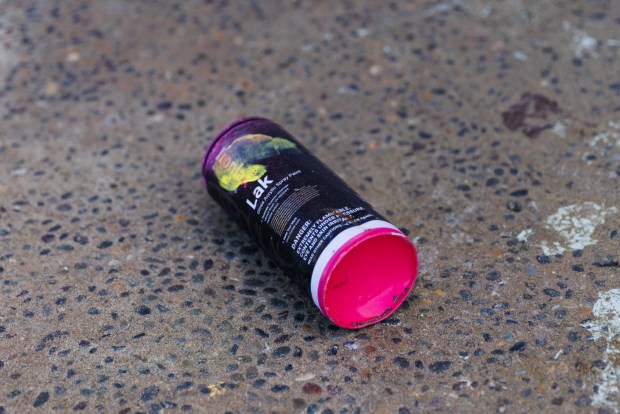 A spray paint can is pictured outside the “Mushroom House” this month. (Kristian Carreon / The San Diego Union-Tribune)
“We are bagging everything up, cutting things down into manageable sizes and then we have electric wheelbarrows that we’re loading everything into,” Akers said in February. “And we are trekking it in 600-pound loads at a time.”
Akers estimated this week that construction crews have used 30 gallons of paint, “or maybe more,” to clean up graffiti and cover repeated tagging. Workers are limited in that they cannot use pressure washers or sandblasting to remove the graffiti due to concerns about contaminating the beach or ocean, he said.
However, Akers said, since the work began, more extensive vandalism has been brought to a halt and graffiti has lessened.
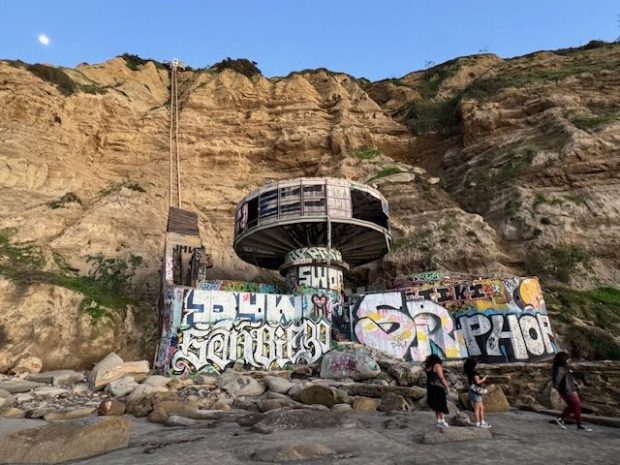 The “Mushroom House” was covered with graffiti when this photo was taken Jan. 29. (Mike McCormack)
“I think our efforts have been a significant deterrent to vandalism … but it’s been challenging because every day we go down and check it to see if they broke locks [or] cut locks and we put new locks on and keep it secure,” he said. “It’s a daily thing.”
“No one’s ripping apart the building materials any longer because of our presence, I believe,” Akers added. “And I made it harder to get in, so they can’t exactly get in and destroy it.”
Still, Mike McCormack, a trustee of the La Jolla Shores Association, said last month that “simply repainting the graffiti and relocking the building is unlikely to diminish public fascination or prevent continued attempts to enter and tag the structure.”
“Without a broader strategy, this may turn into years of repetitive cleanup and re-securing efforts,” McCormack said. “It may be more productive to make decisions that have a realistic chance of succeeding long-term.”
The scope of the project remains maintaining and securing the property. No active permit allows construction or other improvements there.
Akers said, however, that a second phase of work could involve renovations.
Such a phase is in its early stages and would require approvals, he said. What it would be has yet to be determined.
Woolley could not be reached for comment.
One rumor is that the house may be transformed into a lifeguard tower. But San Diego Fire-Rescue Department spokeswoman Candace Hadley said last month that the department, which includes city lifeguard services, was “not involved in any negotiations regarding the purchase or potential conversion of the Mushroom House into a lifeguard facility.” ♦