
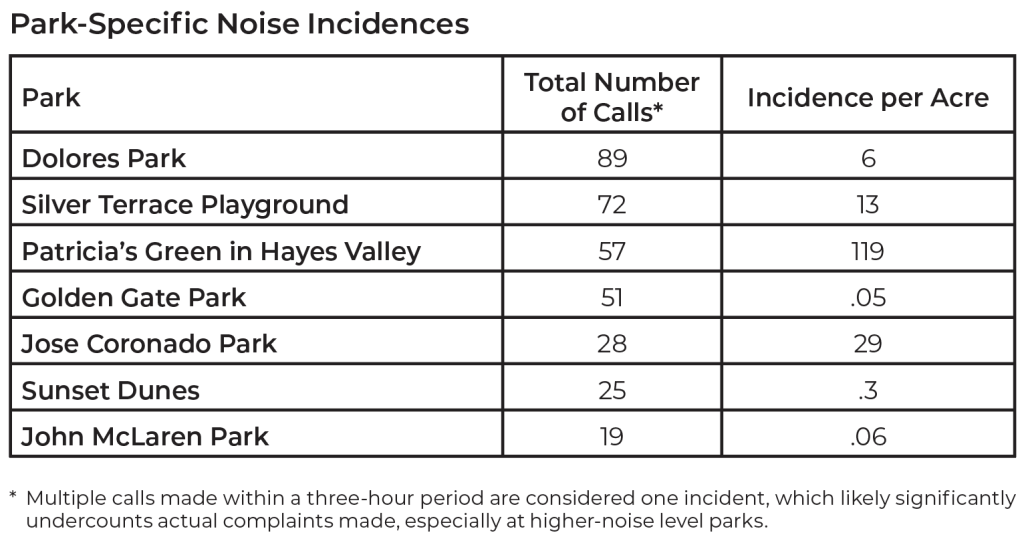
An analysis of 2025 calls to 311, San Francisco Police Department, and Department of Parks and Recreation revealed that Dolores Park, in the Mission, and Silver Terrace Playground, in the eponymous neighborhood, are often subjected to excessive noise levels after the commons are supposed to be closed, at 10 p.m. Nearby residents complain of frequent parties, amplified music, and fireworks.
In contrast, Dogpatch, Mission Bay, and Potrero Hill parks are relatively peaceful. There were just nine noise incidents related to Franklin Square last year, eight at Mission Creek Park, and six at Mission Bay Park.
Patricia’s Green in Hayes Valley, a tiny space located in “Cerebral Valley,” had the most complaints per acre, with Jose Coronado Park, in the Mission, also evidencing a high noise to size ratio.
According to Donovan Lacy, Dogpatch and Northwest Potrero Hill Green Benefit District (GBD) executive director, in 2024 and 2025 there were no noise complaints reported to the GBD related to parks and open spaces in which it’s involved.
Eric Young, Port of San Francisco director of communications, said the Port doesn’t maintain a comprehensive registry of noise complaints. As a result, it’s largely unknown how many late-night noise incidents occur at such places as Crane Cove Park, Islais Creek Park, and Warm Water Cove. However, when an event is held on Port property, the producer must provide a phone number that community members can call to complain, a log of which is reported to the Port after the occasion.
There’s modest noise complaint coordination between RPD, 311, and SFPD. Three-one-one forwards service requests made through its call line to RPD, which eventually reach park rangers. Rangers and police officers may communicate informally, but residents are generally left on their own to decide what line to call, and with whom to follow-up if the noise remains unabated.
“Rangers are responsible for addressing all noise complaints within parks. If a crime has been committed, they coordinate with the San Francisco Police Department for assistance. For parking and vehicle-related violations, rangers work in coordination with the San Francisco Municipal Transportation Agency, which issues any necessary tickets or citations,” said Daniel Montes, communications director for San Francisco Recreation and Parks Department. “A typical interaction begins with a ranger approaching a park visitor, explaining the issue, and working to resolve the situation calmly. Citations are reserved for more serious or repeated violations. If the situation warrants further action, rangers contact SFPD for support.”
Montes said rangers are public officers empowered to enforce municipal park and health codes. They don’t carry firearms but have the authority to make arrests.
Alec Fleischer and Jessica Zimmer contributed to this article.
Post navigation