
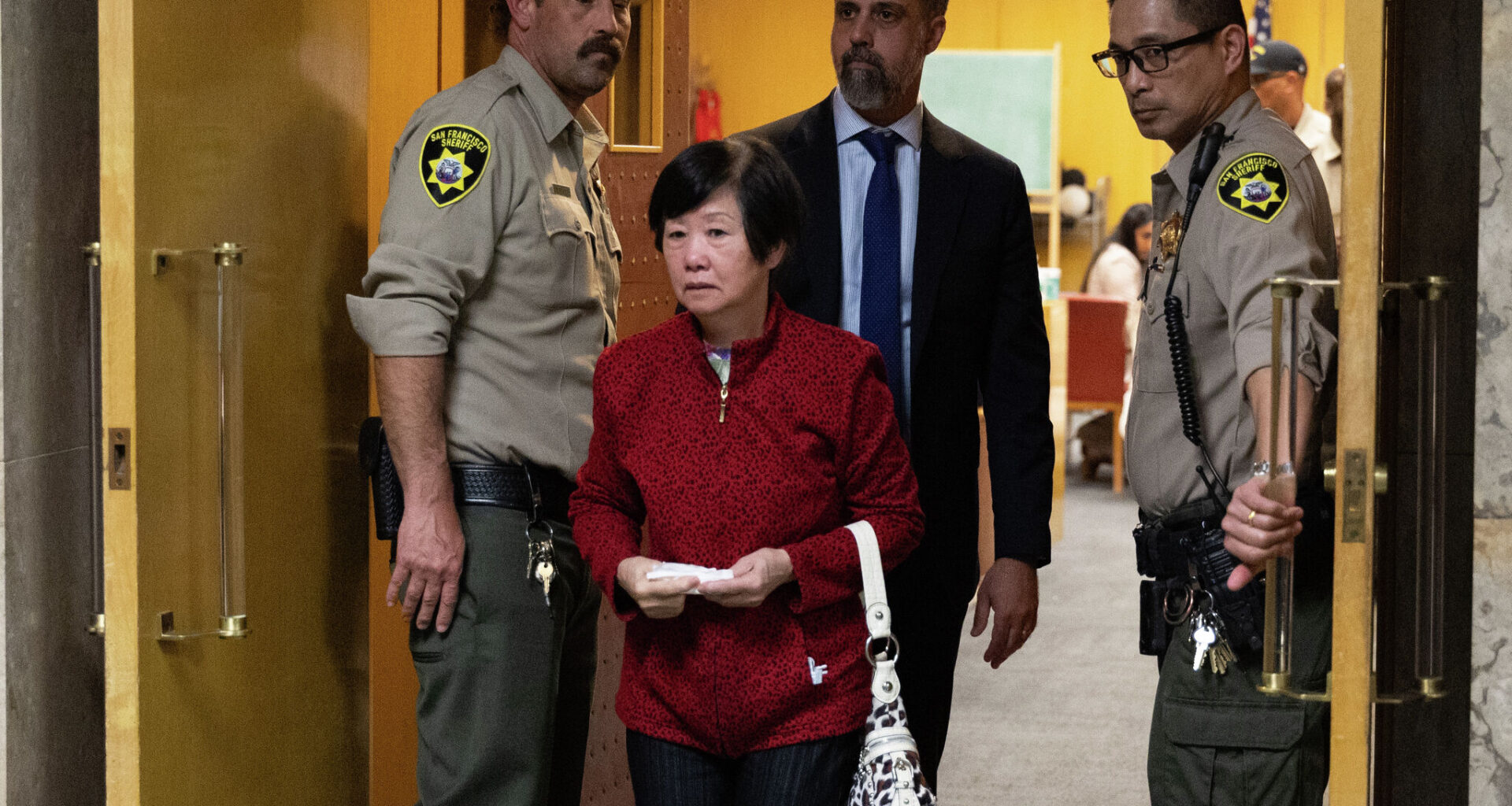
Mary Fong Lau walks out of court during a recess at the Hall of Justice in San Francisco on Friday, March 20, 2026.
Benjamin Fanjoy/For the S.F. Chronicle
Attendees of a vigil for Diego Cardoso de Oliveira, Matilde Moncada Ramos Pinto and their children Joaquin, and Cauê place messages to them on a memorial during a vigil in front of the West Portal Library in San Francisco, Calif., on Thursday, March 19, 2026. The family of four was killed two years ago when a speeding driver slammed into a bus shelter in front of the library where the family was waiting for a bus.
Laura Morton/Special to The Chronicle
Photos of Diego Cardoso de Oliveira, Matilde Moncada Ramos Pinto and their children Joaquin, and Cauê are seen displayed alongside messages written to them during a vigil in front of the West Portal Library in San Francisco on Thursday, March 19, 2026. The family of four was killed two years ago when a speeding driver slammed into a bus shelter in front of the library where the family was waiting for a bus.
Laura Morton/Special to The Chronicle
A sign is seen during a vigil for Diego Cardoso de Oliveira, Matilde Moncada Ramos Pinto and their children Joaquin, and Cauê in front of the West Portal Library in San Francisco. The family of four was killed two years ago when a speeding driver slammed into a bus shelter in front of the library where the family was waiting for a bus.
Laura Morton/Special to The Chronicle
A Superior Court judge said Friday that a woman who killed a family of four while speeding down a residential San Francisco street was sentenced to probation after saying she was ill-suited for incarceration and showed contrition for the 2024 crash.
Mary Fong Lau, 80, must complete 200 hours of community service and will have her driver’s license revoked for three years, but will face no jail time or home detention, San Francisco Superior Court Judge Bruce Chan ruled.
Lau pleaded no contest to four felony counts of gross vehicular manslaughter last month at a hearing in which Chan said he was inclined to sentence her to probation based on her age, lack of criminal history and her display of remorse. Chan also said his sentence would take into account the fact that Lau’s husband was killed in a car accident many years ago.
Article continues below this ad
Investigators found that Lau, driving a Mercedes SUV, reached speeds of up to 70 mph before she careened into the bus stop outside the West Portal Branch Library, where 40-year-old Diego Cardoso de Oliveira and 38-year-old Matilde Moncada Ramos Pinto — celebrating their wedding anniversary — waited for transportation to the San Francisco Zoo with their two young children.
The impact of the crash flung Diego Cardoso de Oliveira and 1-year-old Joaquim Ramos Pinto de Oliveira more than 100 feet from the bus stop. Both died immediately, officials said. Matilde Moncada Ramos Pinto died the following day.
San Francisco Chronicle Logo
Make us a Preferred Source to get more of our news when you search.
Add Preferred Source
After seeing that 3-month old Cauê Ramos Pinto de Oliveira would probably never recover — he had suffered days of seizures, neurological damage and brain hemorrhaging — his grandmothers made the decision to take him off life support, the family said.
Investigators said Lau was not having a medical emergency when the crash occurred and found that her vehicle did not malfunction.
Article continues below this ad
During court hearings in February, Seth Morris — Lau’s attorney — said his client expressed remorse “repeatedly” and sought psychiatric help in the aftermath. Chan’s inclination to keep Lau out of prison reflected a “measured and humane application of justice,” Morris said last month.
Several months after the crash, the victims’ family members filed a wrongful death civil suit against Lau. And last May, they filed another civil lawsuit against her after their attorneys alleged Lau transferred her ownership interest in several properties to new limited liability companies and sold properties to third-parties, including her son-in-law in an effort to protect her assets in the event she loses the civil suits.
On Friday, Chan handed down virtually the same sentence he had noted in his indicated ruling, with the exception of adding 200 hours of community service. In the preamble to his ruling, he described in detail the reasoning behind his decision — a message intended for those who could not understand why such an extraordinary loss of life could result in such little tangible punishment.
In his explanation, Chan noted that because both sides agreed Lau had not been under the influence of drugs or alcohol, engaging in distracted driving or a sideshow or a speed contest, it was difficult to prove the woman had been grossly negligent. Following that, he had to weigh whether incarceration would be anything other than pure retributation given Lau’s age, clean record, and her overall danger to the public.
And even though the issue of why she had driven at nearly three times the speed limit — in a straight line for multiple blocks, with no effort to brake — was still unclear, it was not enough to change his mind. He had read the multitude of letters sent to him, reviewed the mountain of documents, and looked at every picture sent to him of the young children and their parents. Their deaths, he said, were the most egregious part of all.
Article continues below this ad
“They will never have a chance to build a life, their potential forever unfulfilled,” Chan said.
Tension and incredulity pulsed through Friday’s sentencing hearing, which spanned more than two hours. The bulk of it included stirring victim statements from Denise Cardoso de Oliveira and Luis Ramos Pinto — the sister and brother of Diego and Matilde. In their statements to the judge, they expressed shock and outrage at the outcome that had unfolded before them, including the fact that the judge did not sentence Lau to one year of home detention, against the recommendation of the adult probation department.
When the judge asked whether outfitting an “octogenarian” with an ankle monitor was appropriate in the case, a chorus of “yes”es could be heard from the victims’ side of the courtroom gallery. Rebuking their outward display of dissent, Chan said they could disagree with him but “not in that fashion.”
Four photos of the young boys were projected during Ramos Pinto’s victim impact statement — the first and last time any photos of their family would be displayed on the courtroom’s screen. Ramos Pinto recounted the horror of Cauê Ramos Pinto de Oliveira’s final few days. Cardoso de Oliveira spoke afterwards, saying each criminal proceeding in her brother’s case had left their family feeling invisible and “deeply disrespected.”
“I would have wished for the defendant to see who she killed, because they were lives,” she said. “They had dreams. What remains for us is a different kind of life sentence.”
Article continues below this ad
Two friends of the family spoke last, expressing their devastation at the “erasure of an entire family” and their burning need for Lau to apologize.
In his final statements to the court, Morris said the “magnitude” of the loss had indelibly affected Lau herself. A woman who had once been vibrant and an active part of her community had now become a shell of herself, he said.
“The version of Mrs. Lau who sits before you today is a broken person,” he said. The magnitude of the loss could simply not be mirrored by criminal law. He said he believed the sentence to be fair and just, despite how “unpalatable” such an outcome might have seemed.
As for the question of whether his client felt remorse, he claimed Lau felt it inwardly, and on every occassion of speaking to him had expressed a desire to trade places with the family.
Article continues below this ad
The hearing was then bookended by unexpected gesture from Lau herself: a brief apology, the first time she had ever spoke in her own words. Morris said she was compelled to address the family even though he had advised her that anything she said could be used against her in future proceedings. Getting up from her chair, the small woman with close-cropped hair, turned her body to look over at the victims’ families. The interaction took all of ten seconds, maybe less.
“I want to say sorry for your family,” she said, in a quiet voice, as she bowed. She had a distressed expression on her face. “Sorry. Sorry.”