
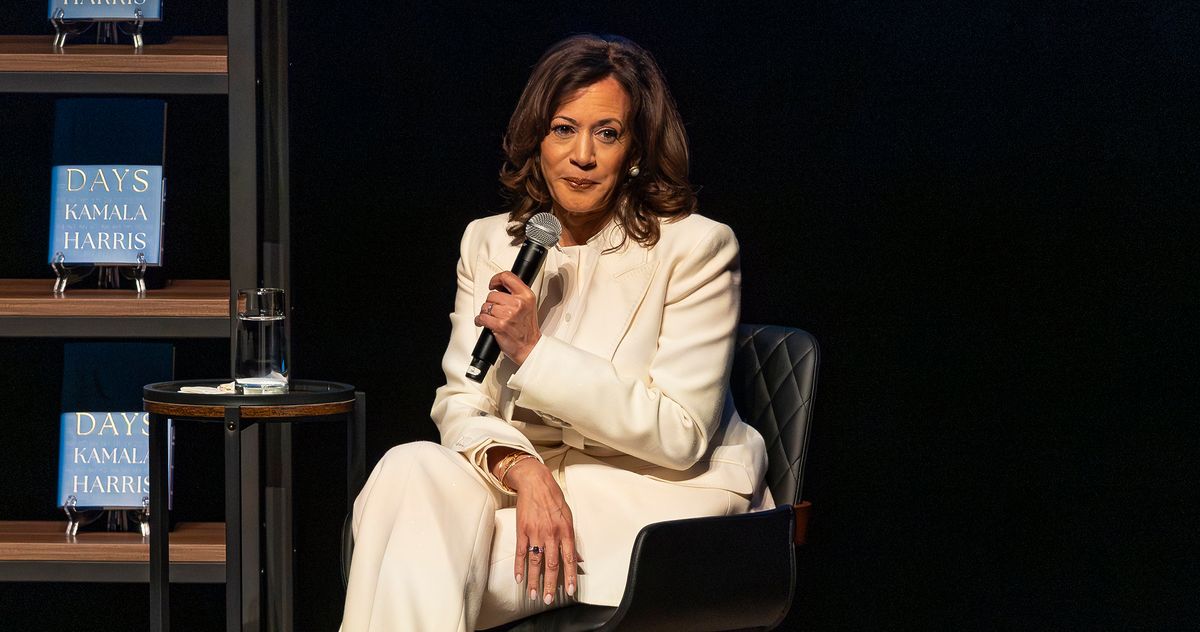
Not the best vibes at present.
Photo: Matias J. Ocner/Miami Herald/Getty Images
There’s an old tradition in American politics whereby the last presidential nominee is referred to as the “titular leader” of the party, to be displaced, if at all, only at the next party nominating convention. According to that tradition, Kamala Harris is owed considerable deference if she chooses to attempt a comeback in 2028. It’s hardly unprecedented for a losing major-party presidential candidate to win subsequent renomination: It’s happened eight times in U.S. history, most recently in the very election Harris lost. And anyone would have to admit that Harris’s defeat came with rather a large, Joe Biden–size asterisk.
Still, there’s a lot of merited skepticism about a Harris redo in 2028, aside from doubts as to whether she will even try it. It’s not like she’s actually won a contested presidential nomination before: In 2019, she dropped out of the race before voters voted, and in 2024, she inherited the nomination when it was too late for anyone to challenge her. Yes, she’s doing relatively well in early 2028 polls (though, suspiciously, her best showings invariably seem to be polls conducted by overtly pro-Republican outfits like Rasmussen Reports, I&I/TIPP and Harvard-Harris), but a lot of that is probably due to name recognition rather than a sober assessment of alternatives. But there’s one constituency that knows her very well: her home state of California, where she served in public elected office from 2002 until her elevation to the vice presidency in 2020. And initial polling there doesn’t look particularly golden for Kamala Harris.
A Politico survey of a Democratic presidential test ballot in California released on March 12 showed Harris trailing her friendly career-long rival Gavin Newsom by a 28 percent to 14 percent margin. Harris barely led Alexandria Ocasio-Cortez (12 percent) and Pete Buttigieg (11 percent) in the poll. And there was worse home-state news for the former vice-president:
She struggles even more in a concurrent survey of POLITICO’s audience of key political and policy influencers in the state, including political staffers, lobbyists, policy advisers and others — the kind of people most familiar with the former state attorney general and U.S. senator.
Harris, whose rise in politics had mirrored Newsom’s for decades back to their early days in San Francisco, until she was chosen as vice president, draws support from just 2 percent of political and policy influencers likely to vote in the Democratic primary, compared to 17 percent who back Newsom, according to the survey.
Actually, in the California “influencer” survey, Harris ran not only behind Newsom, AOC, and Buttigieg, but also Mark Kelly, Josh Shapiro, Andy Beshear, J.B. Pritzker, Gretchen Whitmer, Wes Moore, and Rahm Emanuel. That is some bad home cooking.
One poll could be an outlier, but now there’s another: A new survey from the respected Berkeley-IGS polling operation shows Harris running a mediocre fourth:
28% of the state’s Democratic voters now select Newsom
as their first choice to be their party’s nominee should he launch a bid for president in 2028. New York Congresswoman Alexandria Ocasio-Cortez places a distant second at 14%, followed by former
Secretary of Transportation Pete Buttigieg at 11%.
Former Vice President and California Senator Kamala Harris trails, receiving just 9% support among Democratic voters in her home state, while Arizona Senator Mark Kelly places fifth at 7%.
This kind of standing in a place where she has appeared on statewide ballots five times is concerning. Yes, you can argue that she has a national base beyond California, especially among Black and Asian American voters. But her lack of strong support in the largest state in the union, which happens to be her own, will be of considerable concern to donors, activists, and other power brokers with a role to play in 2028. If Harris wants to run again, she should mend some fences in California.
Sign Up for the Intelligencer Newsletter
Daily news about the politics, business, and technology shaping our world.
Vox Media, LLC Terms and Privacy Notice