
Questions and anxiety deepened in some of San Diego’s TV stations Friday, a day after the federal government approved a deal that puts the region’s FOX, CBS and CW affiliates, plus KUSI, under the same ownership.
It’s not clear what the ownership changes could mean for San Diego’s TV news landscape. It’s also unclear what the changes mean for viewers of the stations’ non-news programming. It appeared KUSI had aired some CW programming Thursday and Friday evenings, and the logo displayed on KUSI’s Friday afternoon newscast read “KUSI San Diego CW.”
Nexstar Media Group Inc. on Thursday closed a $6.2 billion acquisition of Tegna after the Federal Communications Commission and the Department of Justice approved the deal. The combination gives Nexstar and partners 265 television stations in 44 states and the District of Columbia, ultimately reaching 80% of households, the company said.
In San Diego, Nexstar already owned Fox affiliate KSWB and independent station KUSI. Tegna’s local stations included CBS affiliate KFMB and The CW. On Friday, leadership from the local stations either could not be reached for comment or did not respond to an emailed request for comment. One station referred questions to a Nexstar spokesperson, who did not respond to an email seeking comment.
A staffer at one of the local stations, who asked not to be named for fear of jeopardizing their job, said there has been a lot of uncertainty, and morale is low as people fear the possibility that layoffs could be looming.
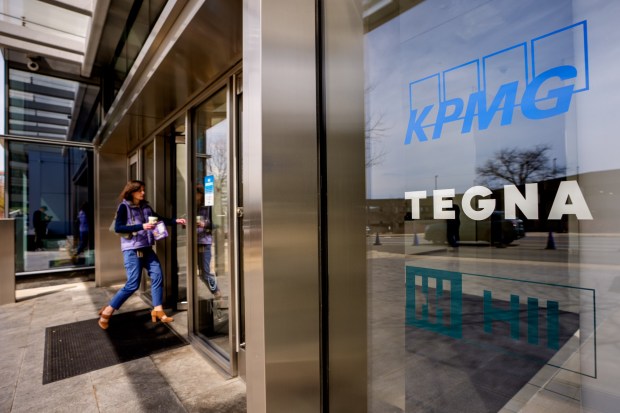 The Tegna Inc. headquarters on March 20, 2026 in Mclean, Virginia. (Photo by Andrew Harnik/Getty Images)
A memo Friday from Nexstar CEO Perry Sook to employees, viewed by the Union-Tribune, said the day marked “an important and historic milestone” for the company.
“Together, we have an exciting array of assets in the U.S. focused on creating and delivering local content to the communities we serve, backed by the resources and collective vision necessary to adapt to the realities of a rapidly changing media environment,” it reads. “Our future is filled with both threats to our business and opportunities to continue to evolve our company to not only survive those threats but to thrive.”
Point Loma Nazarene University journalism professor Dean Nelson said he sees the acquisition as “capitalism at work.”
“I personally would not set my hair on fire over this, but it does show there are fewer voices in the broadcast world than ever,” he said about local news. “But there are fewer viewers than ever.”
Such acquisitions have the potential to limit the number of legacy media voices, Nelson said, “but those voices were diminishing in their influence and importance anyway.” He noted that people are getting news from other places, primarily social media, and said that while legacy media works to vet and verify information, “social media sites have no such constraints.”
Fewer local journalists and smaller newsrooms are “out there telling us what is happening in our communities and holding powerful people accountable,” Nelson said. And having fewer journalists, “in my opinion, is a scary proposition. That allows for some real shenanigans — and that isn’t what a free society is based on.”
The consolidation mirrors a national trend, as such deals have ramped up over the past decade. About 40% of all local news-producing television stations in the U.S. are under the control of three large broadcast companies, Nexstar being one of them, according to a 2024 study led by a Stanford University researcher.
Three years ago, Nexstar, which already owned the local Fox affiliate, bought KUSI, long a San Diego staple, for $35 million. In the time since, the two TV newsrooms began sharing local content, with reporters’ stories appearing on both stations. However, the newscasts themselves were different and had different anchors. The stations also provided different non-news programming.
Mike McKinnon, who sold KUSI to Nexstar in 2023, told the Union-Tribune at that time he believed it was likely KUSI would become a CW affiliate.
In a news release announcing the new acquisition Thursday, Sook, Nexstar’s CEO, said in a statement that the transition was “essential to sustaining strong local journalism in the communities we serve.”
“By bringing these two outstanding companies together, Nexstar will be a stronger, more dynamic enterprise — better positioned to deliver exceptional journalism and local programming with enhanced assets, capabilities, and talent,” he said.
He also said the company was “grateful” to President Donald Trump, FCC Chairman Brendan Carr and the DOJ “for recognizing the dynamic forces shaping the media landscape and enabling this transaction to move forward.”
The Washington Post reported that the FCC waived a cap that barred station owners from expanding to reach more than 39% of American households.
The day before the deal was approved, eight states, including California, filed a federal lawsuit seeking to block it.
“This merger would cause incredibly high levels of concentration in local TV markets and is expected to raise cable and satellite prices across the country, causing irreparable harm to local news and consumers who rely on their reporting as a critical source of information,” California Attorney General Rob Bonta said in a statement late Wednesday.
Bonta’s office noted in a news release that the combined entity would own half of the “Big Four” (FOX, NBC, ABC and CBS) network-affiliated stations in the state, including the local FOX and ABC stations in the Sacramento area and the local FOX and CBS stations in the San Diego area.
Staff writer Kristina Davis contributed to this report.