
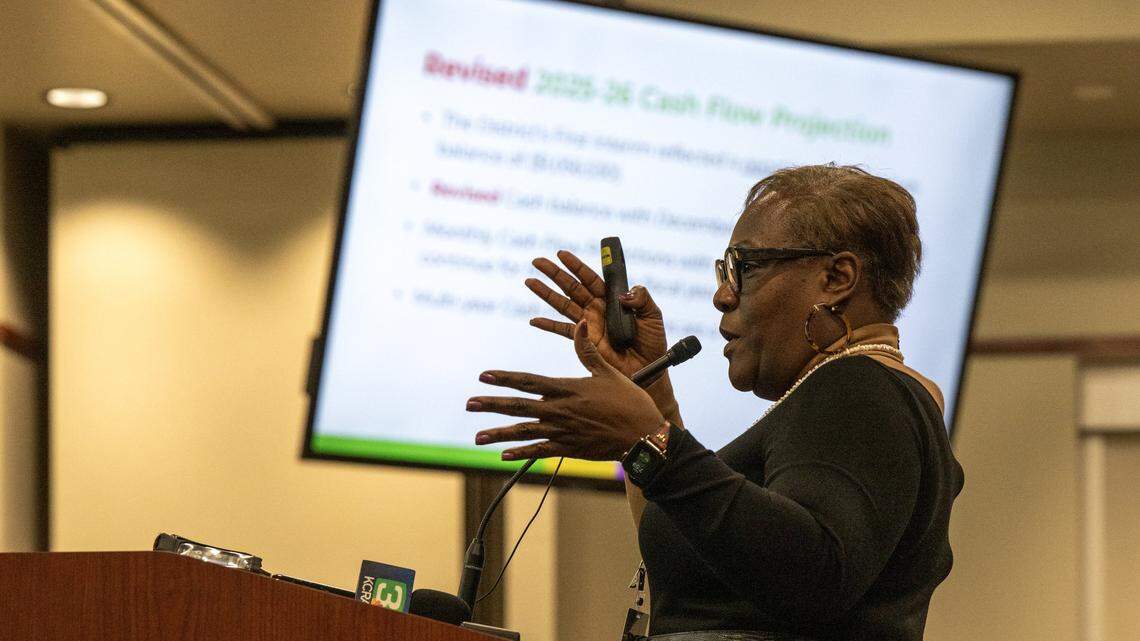
Sacramento City Unified Interim financial officer Lisa Grant-Dawson provides a fiscal solvency plan update during a board meeting at the Serna Center In February.
JOSÉ LUIS VILLEGAS
jvillegas@sacbee.com
The Sacramento City Unified School District board did not take well Thursday night to news that the district’s financial situation looks worse than it did earlier in the year despite the adoption of a fiscal solvency plan back in November.
When last updated on the budget, board members were told that $63 million in fiscal solvency plan savings put them about $71 million from making up a $134 million deficit.
But the second interim budget update showed that the district was another $37 million in the hole, meaning that it is still looking at a deficit of $108 million by the end of June. The district also has to make up additional money to account for the state required 2% reserve.
SCUSD will also bring in outside help, including former chief business officers from other school districts, to untangle the budget situation.
Despite the harrowing shortage, the district will remain cash solvent through the end of the school year. In essence, the district will have money in its checking account while it waits for a large credit card bill to arrive in the mail.
But cash is running out quickly. New projections show the district running out of spendable funds by the fall — an event that would trigger a takeover by the state.
Slow path to fiscal solvency
Interim Chief Business Officer Lisa Grant-Dawson presented the findings of the second interim budget Thursday night.
“Why is the deficit still here?” she asked, “Because we needed a concentrated plan some time ago in order to prevent us from getting here in 2026.”
Grant-Dawson said that a $100 million deficit has been “chasing” the district for years, and pointed out increased costs due to the labor contract signed in September with the teachers union.
Trustee Taylor Kayatta defended the board’s actions to address their fiscal situation in the past year, pointing to an adopted plan to reduce administrative positions that he says was not implemented by staff in a timely manner and $80 million in unexpected spending that wasn’t identified until after the contract was ratified.
“Looking back a little bit further, we approved a series of bargaining agreements in this year and in the previous year that we knew were going to make our budget be tight, but we had a plan to fund it,” he said.
Board President Tara Jeane shared frustration about the district’s path to fiscal solvency. She urged Grant-Dawson to accept additional support to hurry the process.
“Your job is to bring us numbers — and we can be very upset about the numbers — but I hope it’s clear that for us, it’s not just the numbers, it’s the process,” she said. “A month ago, I made a request that we would be able to look at a potentially qualifying budget, and the budget we have in front of us is definitely, obviously negative.”
Earlier in the evening, Interim Superintendent Cancy McArn said that the district will recruit the services of two recently retired chief business officers from other school districts and the board voted to hire for the previously frozen chief business operating officer position.
“I‘m excited to see that we’ll have a right hand and a left hand for you, additional CBO supports, so that we can uncover things faster, so that we can get to decisions faster,” she said. “Because the team needs the info it needs to be able to work collectively on the fiscal solvency plan that’s going to get us not only qualified, but back to positive.”
Spending still out of control
The second interim budget presentation also revealed that spending with third party contractors has not gone down as much as was projected at the first interim update. The district is set to spend about $34 million more than expected on contracts, most of which are related to special education.
Special education costs continue to skyrocket — the district expects to spend $172 million on special ed this year. Last year the district contributed $134 million to special ed, which was $13 million over budget.
Carl Pinkston of the Black Parallel School Board, which sued the district over its treatment of Black students with disabilities, voiced his concern about these figures in a public comment.
“I’m really concerned in the sense that in the past, it’s never been this high,” he said. “Then all of a sudden, one year it exploded. So is it because non-public services got out of hand? Is it because nobody’s not watching the shop as they’re just spending money all over the place? I’m just deeply concerned.”
In an effort to get its finances under control, Sacramento City Unified School District is looking at hiring a consulting firm to help fix its fiscal crisis that will put it in a $394 million deficit by 2027-28.
“We need help helping ourselves,” McArn said.
McArn presented the district’s “multi-layered” approach to fiscal solvency at a board meeting Thursday night, which included the prospective contract for the consultant among several other concurrent strategies and the addition of several additional support positions for the budget department.
The district recently issued pink slips to every member of its central office, a move to entirely restructure the central office amid the financial crisis.
The Serna Center will not be empty come July 1, but it will look entirely different. In the next few months, leaders will not only lay off dozens of employees but reorganize remaining workers into new departments and teams.
Trustees also opted to hire an external auditor to evaluate its financial practices in the 2024-25 school year.

The Sacramento Bee
Jennah Pendleton is an education reporter for The Sacramento Bee. She previously covered schools and culture in the San Francisco Bay Area. She grew up in Orange County and is a graduate of the University of Oregon.