

With his roundhouse kicks, tough-guy one-liners and a formidable moral compass, Chuck Norris delivered kick-ass heroes for years on screens large and small, cementing himself in pop culture back in the 1980s. Decades later, in the aughts, he earned new legions of millennial and Gen Z fans with the rise of “Chuck Norris Facts,” like “When Chuck Norris arrived at the gates of Heaven, St. Peter showed his ID to Chuck Norris.”
The martial artist and actor known for “The Way of the Dragon” and the long-running series “Walker, Texas Ranger” died Thursday morning in Hawaii, his family confirmed Friday. He was 86.
“It is with heavy hearts that our family shares the sudden passing of our beloved Chuck Norris yesterday morning,” the family said in a statement. “While we would like to keep the circumstances private, please know that he was surrounded by his family and was at peace.
“To the world, he was a martial artist, actor, and a symbol of strength. To us, he was a devoted husband, a loving father and grandfather, an incredible brother, and the heart of our family. He lived his life with faith, purpose, and an unwavering commitment to the people he loved. Through his work, discipline, and kindness, he inspired millions around the world and left a lasting impact on so many lives.”
The family said it was thankful to Norris’ fans, who to him “were not just fans, you were his friends.”
Last week, the star posted a martial arts video on Instagram in which he hit a sparring partner with a combo before saying to the camera, “I don’t age, I level up.”
“I’m 86 today!” Norris wrote in the caption. “Nothing like some playful action on a sunny day to make you feel young. I’m grateful for another year, good health and the chance to keep doing what I love. Thank you all for being the best fans in the world. Your support through the years has meant more to me than you’ll ever know.”
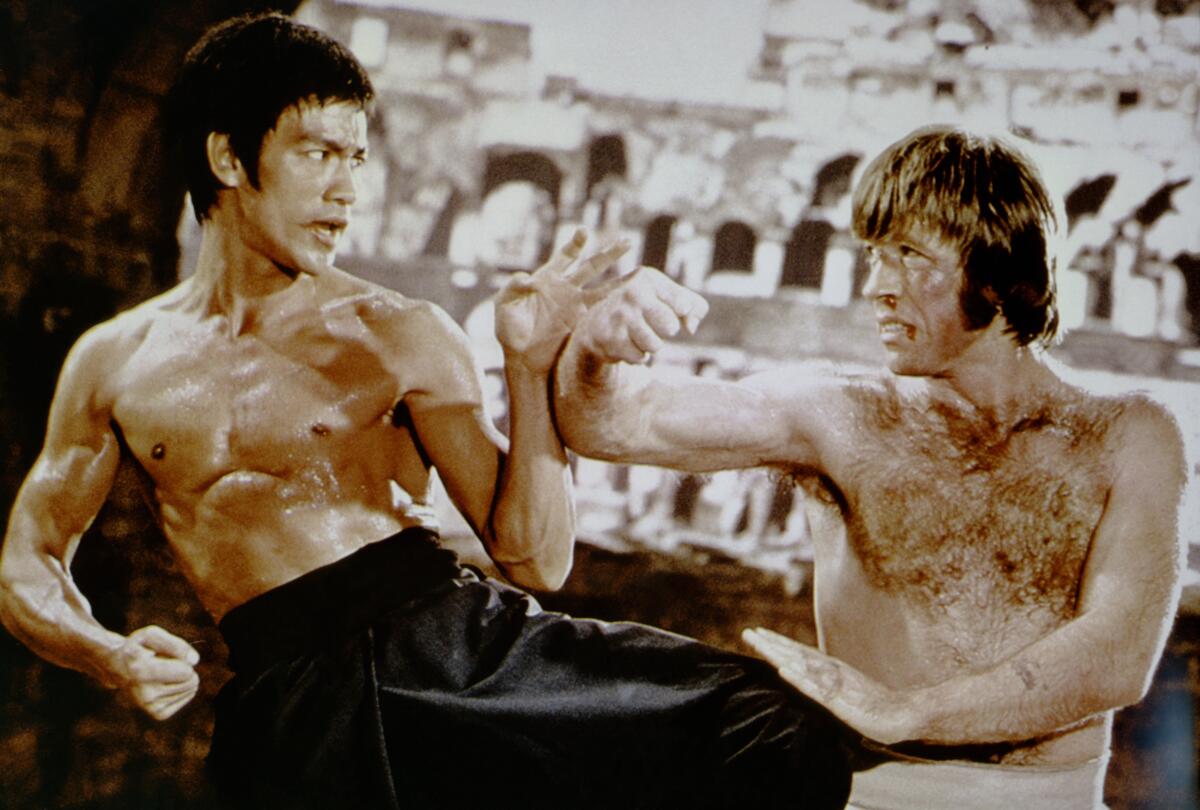
American martial artist Chuck Norris with Chinese American martial artist, actor, director and screenwriter Bruce Lee on the set of his movie “Meng Long Guo Jiang (The Way of the Dragon).”
(Sunset Boulevard / Corbis via Getty Images)
One of America’s most famous martial artists, and certainly the most frequently memed, Norris leveraged his black belt skills to build a successful television and film career. Although his action-star status ultimately made Norris a household name, he told Sharyl Attkisson on a 2017 episode of the newsmagazine show “Full Measure” that he was a true martial artist “who dabbles in acting” rather than the other way around.
The world champion held black belts in karate, taekwondo, tang soo do, Brazilian jiu-jitsu, judo and the martial arts discipline he founded himself, chun kuk do.
He acted in more than 30 action films and numerous television projects, but it was the 1972 film “The Way of the Dragon,” in which he starred alongside Bruce Lee, that put Norris on the map. Norris went on to star in action films including “Missing in Action” in 1984 and its sequels, “Firewalker” in 1986 and “Sidekicks” in 1992, as well as the 1986 film “The Delta Force,” the 1990 sequel “Delta Force 2: The Colombian Connection” and 1991’s “The Hitman.”
Perhaps his best-known project, the television series “Walker, Texas Ranger,” which he starred in and executive produced, was inspired by the 1983 American neo-western “Lone Wolf McQuade,” also starring Norris. The series ran from 1993 to 2001 and followed Ranger Cordell Walker, a Texas lawman who battles crime with a black belt and strong personal code. Walker, like Norris himself, was half-Cherokee and half-Irish, a cornerstone of both the character and the actor’s backstory.
“While our hearts are broken, we are deeply grateful for the life he lived and for the unforgettable moments we were blessed to share with him,” the family said. “The love and support he received from fans around the world meant so much to him, and our family is truly thankful for it.”
Norris, born Carlos Ray Norris on March 10, 1940, in Ryan, Okla., was the son of Wilma Scarberry and Ray Dee Norris, a truck driver and World War II Army veteran who struggled with alcoholism. The family moved to Torrance when Norris was 12 and his parents divorced when he was a teenager. He helped his mother raise his two younger brothers, Wieland Clyde Norris and Aaron Norris; the former was killed in action in Vietnam in 1970, while the latter would go on to direct his older brother in episodes of “Walker, Texas Ranger” and more.
“Nothing ever came easy for me, not even being born,” Norris wrote in his 1988 autobiography, “The Secret of Inner Strength: My Story.”
He told The Times that year that one of the reasons he wrote the book was to clear up any misconceptions that he had come by his karate champ and movie star status naturally, when really he was a shy kid who felt debilitating insecurity through his youth.
“[It] was extremely difficult,” he said. “Remember I was a non-athlete. I jumped into the karate world, but I didn’t have the natural attributes that so many of the fighters had. And because I didn’t have those natural attributes, I had to train a lot harder than anybody else. But I knew I had to in order to win.”
After earning his diploma at North High School in Torrance, Norris wanted to become a lawman but he was too young to join the police force. He opted to join the Air Force instead. While serving in South Korea, he tried his hand at martial arts as a way to avoid the boozing that happened around the barracks, and after a year, he earned his first black belt.
“For the first time in my life, I had accomplished something difficult on my own,” he wrote in his autobiography. “I had belief in myself and the strength to accomplish more. I also found that working toward a goal was more rewarding than achieving it.”
Norris spent the late 1960s and early 1970s teaching karate, competing and opening schools that grew with the popularity of the martial arts, first in Torrance, and then other locations in the South Bay and San Fernando Valley. Steve McQueen, TV host Bob Barker, Priscilla Presley and Donny and Marie Osmond were among his more notable students.
His dojos would ultimately shutter because of financial issues. After winning nearly every major title possible, including that of world professional middleweight champion, Norris officially left the ring in 1974 and — with a nudge from his student McQueen — made a pivot into acting. He would be a fixture onscreen through 2005, with only a few roles in the years that followed.
“I jumped into films when I was in my mid-30s,” he told The Times in 1988. “I had no experience, I’d never even done a high school play. And here I’m trying to jump into the acting field. If I looked at it in a negative way, I would have … given up. But from training myself over the years to think positively and to realize that if there was a will there was a way, I was able to achieve success.”
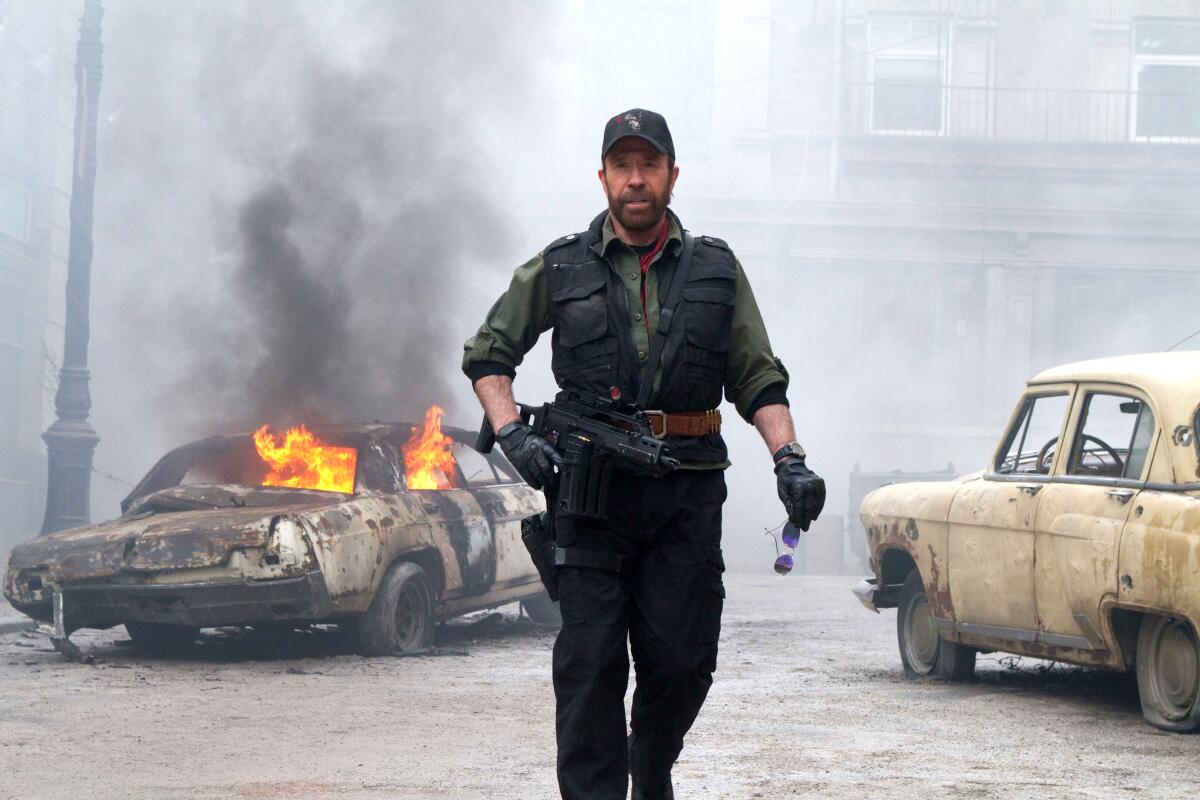
Norris started to attract widespread attention for his 10th movie, “Lone Wolf McQuade,” but it was his character Danny O’Brien, a Los Angeles cop, in the 1988 film “Hero and the Terror” whom Norris related to most.
“‘Hero’ is the closest to my character than any I’ve ever done,” he told The Times. “In most of my films, you see Chuck Norris, the man in the arena, always dealing with the conflict and having to deal with it physically. In ‘Hero’ you see the man outside the arena as well. When I used to fight I would walk down the aisle smiling and shake hands with the audience on the way to the ring. But once in the ring my whole demeanor changed. I’d become very intense, focused and aggressive. But when the fight was over I’d go back to my lighter side.”
Norris’ tough-guy demeanor propelled him in the early aughts from martial arts savant and action-film star to an internet sensation. Norris was a favorite on the late-night talk circuit, and then dramatic “Walker, Texas Ranger” clips of him fighting gun-wielding gangsters with a menacing stare, corny quips and, of course, karate became a regular bit on “Late Night With Conan O’Brien.”
O’Brien would pull the “Walker Lever” to play a clip, and Norris even joined in the fun with a cameo on the show in which he pulled his own lever and roundhouse-kicked a switchblade out of the host’s hand.
In 2005, “Chuck Norris Facts,” penned by Ian Spector, then a high school student, showed up on the internet forum Something Awful. The “facts” were actually jokes that touched on the actor’s superhuman strength and stoicism.
Even Norris got a kick out of them and posted videos on Instagram of himself doing readings: “Chuck Norris was once bitten by a king cobra; after five days of agonizing pain, the cobra died.”
But those “Chuck Norris Facts” weren’t just your run-of-the-mill internet fad — they became a cult phenomenon. College dorm rooms had posters of the facts tacked to walls. “Chuck Norris was in a knife fight and the knife lost” was plastered across hoodies, tees and coffee mugs and slung to the far-reaching fandom. Spector went on to publish multiple books filled with hundreds of facts. Memes abounded.
Norris told Attkisson of “Full Measure” that during a trip to Iraq — he said he went in 2006 and 2007 to visit with more than 20,000 troops — a young soldier pulled up the sleeve of his jumpsuit to show off a tattoo.
“He’s got a picture of me on his arm!” Norris said. “I go, guy, that’s on there for the rest of your life!” According to Norris, even tanks and carriers displayed his name, something he found “mind-boggling.”
Norris didn’t shy away from the attention, and through his life he connected with fans, often sharing updates to his Instagram, which included videos of him reciting “facts” about himself with a chuckle, practicing martial arts in his 80s, riding horseback at his Lone Wolf Ranch in Texas or relaxing on the beaches of Hawaii with his family.
“Philosophy is the most important tool,” Norris told TV host Dick Cavett during a 1993 appearance on his show. “The kicking and punching is only the vehicle to strengthen the individual as a person. To raise their self-esteem, raise their self-worth, teach them how to focus their lives in the proper way, in the most positive way.
“It teaches them the philosophy of goal-seeking and realizing that there’s obstacles in any goal you want to pursue, and to have the determination to overcome those obstacles, to reach those goals.
“This is all part of the training of the martial arts. It’s been my philosophy in life and that’s really been the secret of me succeeding to the extent that I’ve succeeded.”
Norris is survived by his five children and his wife, Gena O’Kelley.