
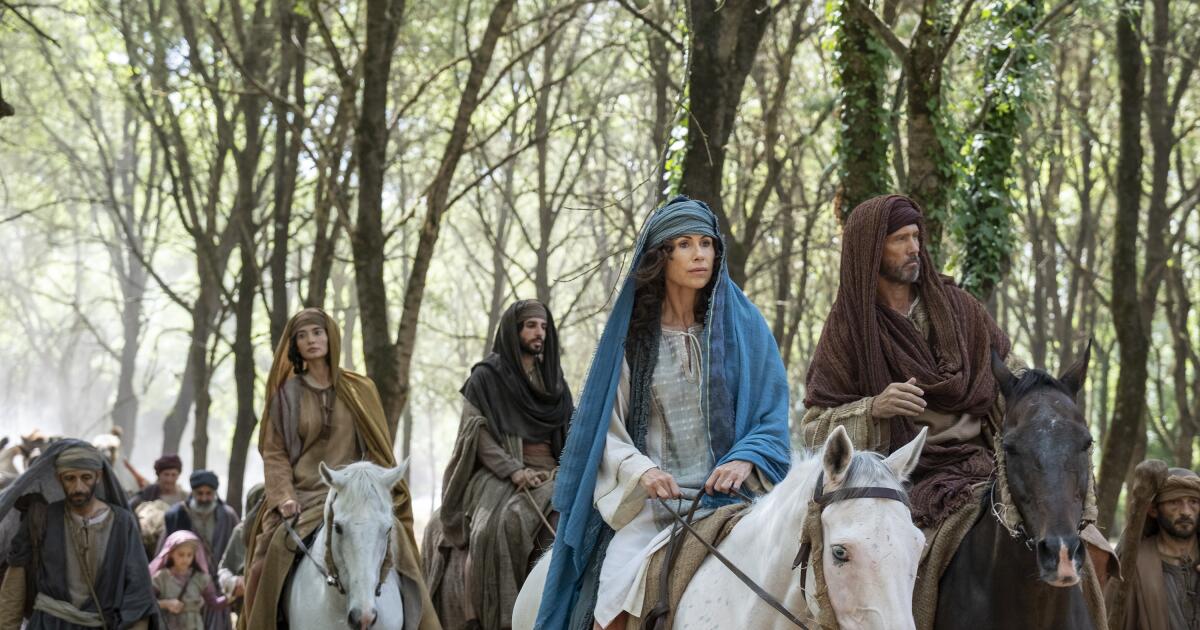
A loving husband and wife desperately want to start a family but struggle with infertility. A mother bears the weight of twin sons who are destined to be at severe odds with one another. Two sisters fall in love with the same man.
These stories may sound like soapy twists in a Taylor Sheridan drama or cable TV movie, but they actually come straight from one of the bestselling books of all time — the Bible.
The sacred text is jam-packed with compelling and highly relatable stories, but Fox’s “The Faithful: Women of the Bible,” a three-part event series, aims the spotlight on the primary matriarchs of the Book of Genesis — Sarah, Hagar, Rebekah, Leah and Rachel. The first installment consists of two episodes airing Sunday, with subsequent double episodes airing over the next two weeks, and begins with the story of Sarah (Minnie Driver), who is regarded as the first matriarch for building the nation of Israel with her husband, Abraham (Jeffrey Donovan), the first patriarch.
“These are three generations of women who passed the baton of what was set in motion by Sarah and Abraham and the episodes are all in a way portraits of different types of marriages,” says René Echevarria, who wrote the first installment and is the series’ showrunner.
However, like the Bible’s many miracles, “The Faithful” coming together in the first place is divine considering executive producing partners Carol Mendelsohn and Julie Weitz were actually not planning to pitch it when they were in a meeting with Fox TV executives on one fateful day.
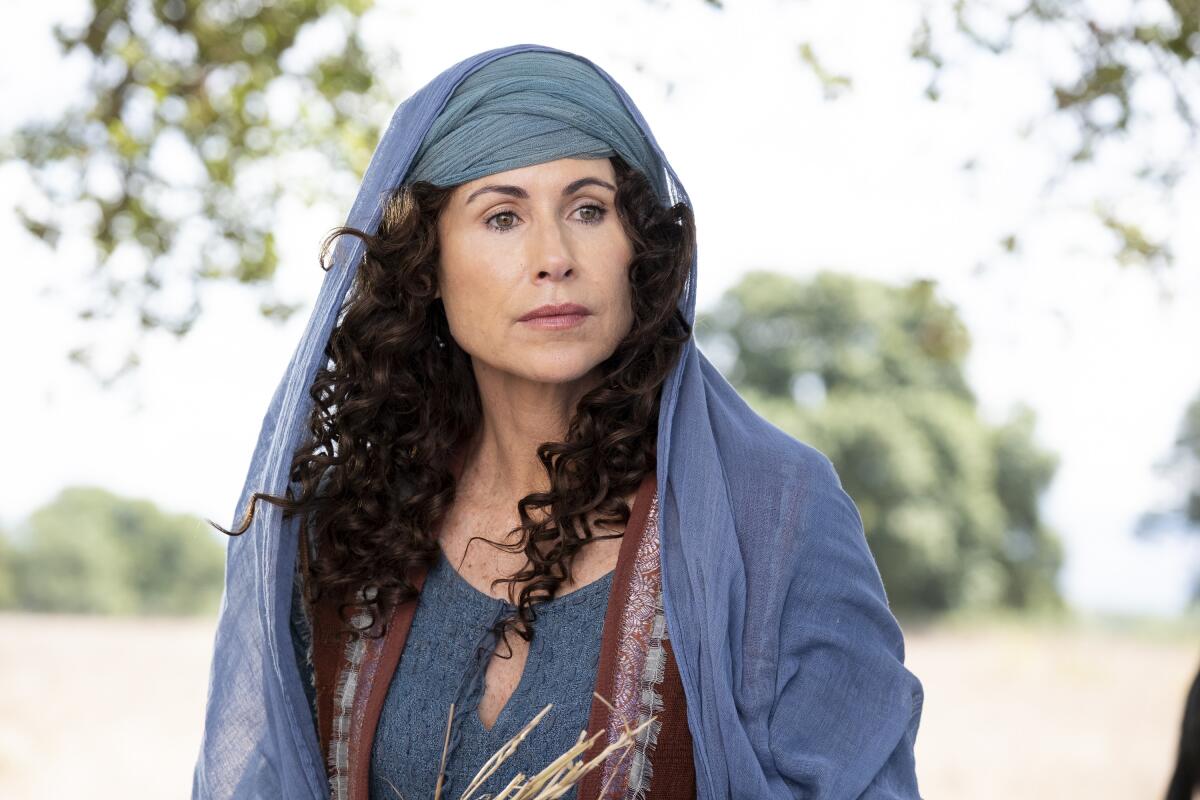
“The Faithful” begins with the story of Sarah (Minnie Driver) and Abraham.
(Moris Puccio / Fox)
“Julie gave me one instruction, ‘We can talk about all of our projects but do not talk about the Bible,’” recalls Mendelsohn. But then Fox President Michael Thorn asked Mendelsohn what her passion project was and “It was like I was hit by the burning bush!”
So “The Faithful” was pitched and a green light was given for the show. “I guess it was divinely ordered,” Mendelsohn says, laughing.
Crafting a Bible-based event series may initially seem like a stretch for Mendelsohn, known for producing the massively popular “CSI” crime drama franchise and, since partnering with Weitz over a decade ago, contemporary dramas where God wasn’t a part of the story. However, with “The Faithful,” the common thread with their previous projects was very clear. “Everything that we do together comes from characters that we fall deeply in love with and we love to do stories about women,” says Weitz. “We were thinking of doing something in this world when “The Chosen” [the Prime Video series about Jesus Christ] came out and became a huge hit.”
Mendelsohn and Weitz brought Echevarria on board and once they dug into the respective stories of these influential women, “it became clear that we should give two hours to each of these matriarchs and tell that story, which is the genesis of not just Judaism, but Islam and Christianity, the three largest, most prominent religions of mankind,” says Weitz, who is also grateful for Fox’s programming strategy for the episodes. “It worked nicely because they are giving us Sunday Nights leading right through Passover and into Easter so it just made sense to [Fox] too.”
For varying perspectives, the show utilized both Christian and Jewish scholars, which backed up their storytelling objectives, given that these age-old stories traditionally didn’t always flesh out women as much as men, so leaning into an interpretation of text was not taboo. “Our Jewish scholar mentioned, ‘what you’re doing is called midrash, an ancient tradition in Judaism to look at these stories and read between the lines,’” says Echevarria.
That interpretive freedom can be seen in the show’s first installment, which explores Genesis 16 where Sarah, barren for years despite God having told Abraham that she would bear a child in her older age, enlists former Egyptian slave Hagar (Natacha Karam) to sleep with her husband in the hopes she’ll give them a child. Driver says Sarah’s story is one that many women can connect with, but as far as who the real woman was, there’s a lack of true definition. “Who knows what Sarah was like? We don’t know. She doubted and, to some people, she thwarted God, but actually to me, she was just a woman who wanted to have a baby, loved her husband very much and was very strong,” she says.
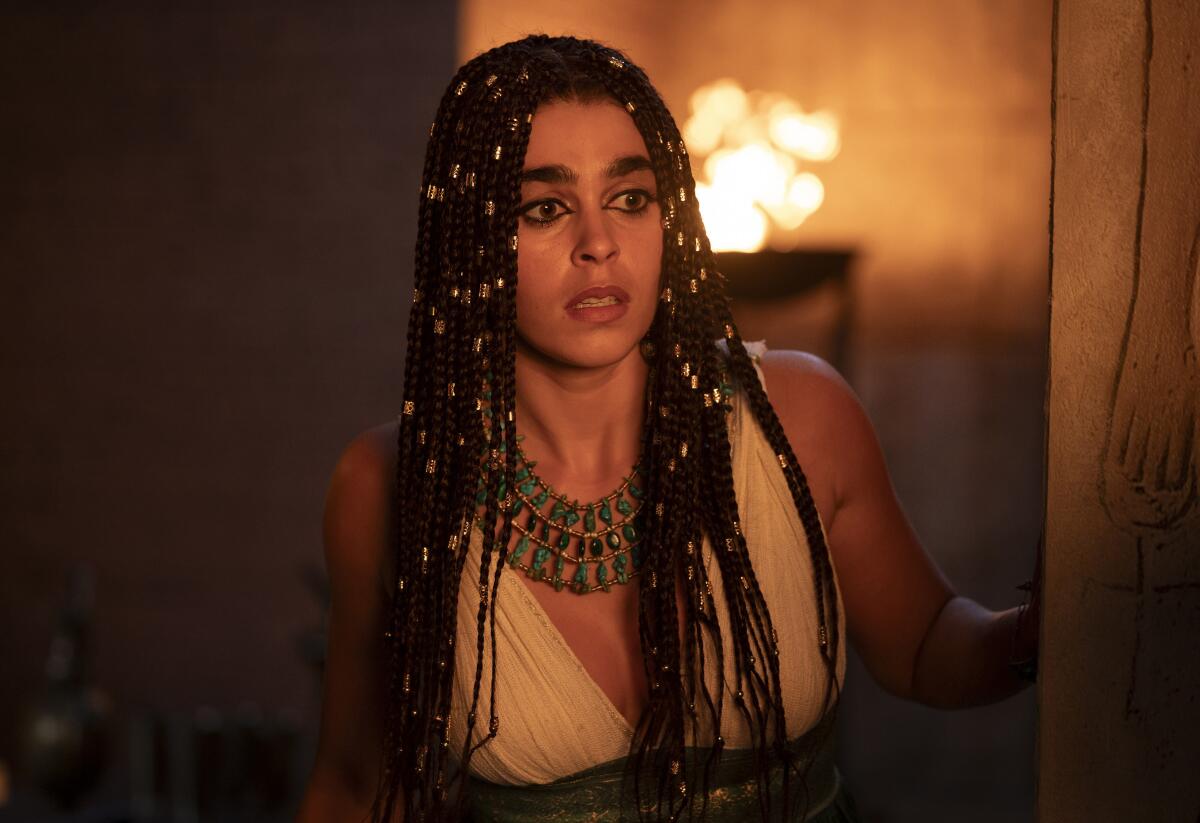
Natacha Karam plays Egyptian slave Hagar, who bears Abraham’s child.
(Stefano Cristiano Montesi / Fox)
Donovan notes that Sarah suggesting Abraham lie with Hagar in Genesis 16 initially comes across as a straightforward and simple sentence. “But there’s so much to unpack in that one line from the Bible,” he says. “The complex struggles that these three people must have had that people today are still having 4,000 years later? We’re still going, ‘I can’t have a baby. Let’s have her have our baby. But do you like her? Is she better than me?’”
But as much as Sarah’s plight with infertility is relatable, other moments in the story took more work to get there, like the moment where Abraham talks with God. “I can only imagine what it would feel like to speak to God,” Donovan says.
To grapple with that notion before shooting this particular scene, the actor, dressed in his character’s tunic and waiting on the crew to set up, found a spot to sit on under a tree and thought about Abraham’s daily life and how impactful a message from God would be. “He’s a shepherd that got up with the sun and watched his flock and tried to survive,” Donovan says. “‘How do I not die today? How do I feed my family?’ For me to give the respect to the character, that deserves a couple of hours of solace and solitude.” He calls it the most difficult scene in the series for him.
And while the show explores Sarah and Abraham’s marriage, it also dives into the relationship between Sarah and Hagar, which begins when a captive Sarah is freed and she takes slave Hagar with her to give her a better life.
“Hagar finds herself pulled into this story that’s far larger than anything that she could ever have imagined for herself,” says Karam, adding that the two women grow close but conflicts also arise. “Originally, the relationship is defined by hierarchy and necessity and then there’s this complicated dependence that bounds them together for life.”
The actor expressed her satisfaction that the story of Sarah and Hagar is given a positive portrayal since that’s not always been the case. “There are versions of that story that are read through a lens of reprimanding both of these women, which I want to say is shocking but it was actually quite predictable to spin it so that it ends up being, ‘Oh, look what these two women did when they tried to take control,’” she says.
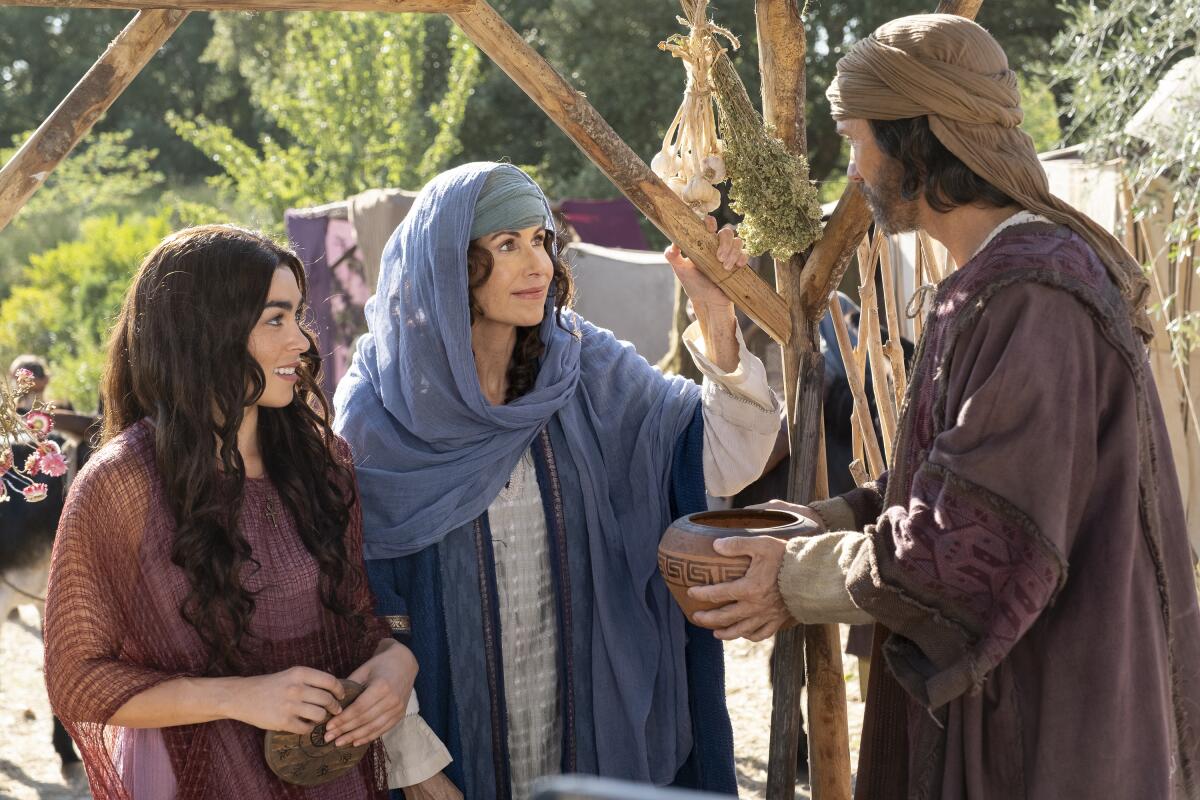
“Hagar finds herself pulled into this story that’s far larger than anything that she could ever have imagined for herself,” says Natacha Karam, left, with Minnie Driver and Jeffrey Donovan.
(Moris Puccio / Fox)
The spin from the cast and crew on the production itself was that with all “The Faithful” episodes filming in the ancient city of Rome, the series benefited from what the city had to offer in terms of scenic authenticity. Also, the unforgiving heat while shooting outdoor scenes wasn’t fun but also wasn’t a total negative, says Driver. “I’ve never been outside in 100-plus degree heat for 10 or 11 hours a day. It was brutal, but it definitely lent to the veracity of the story like where you were so beyond hot and exhausted,” she says. “There’s a generosity of its history that you’re invited in. It was this fever dream, the whole experience of being there.”
And while the Sarah-Abraham-Hagar story fills out the first episode, the March 29 installment continues the drama with the introduction of Rebekah (Alexa Davalos), who marries Sarah and Abraham’s son, Isaac (Tom Mison). Also barren for many years, she eventually receives a message directly from God that she will have twin sons and that her youngest son will one day rule. With the arrival of Esau (Ben Robson), who is born first, and Jacob (Tom Payne), she’s faced with a burden to ensure God’s message stays on course at any cost. “The story becomes about how she almost destroys her family because she’s been told that this is the way, this is the destiny,” says Weitz.
The April 5 finale, airing on Easter Sunday, moves forward as a now-exiled Jacob returns to his hometown and meets two sisters, Leah (Millie Brady) and Rachel (Blu Hunt), and sparks fly. Teases Echevarria, “tonally the episode is a little bit different and it’s a little more scandalous but certainly contemporary.” Adds Weitz, “Jacob falls in love with both of the sisters for different reasons and at different times so it becomes a story about sister rivalry for the love of the same man.”
Love is something audiences have been feeling in recent years for faith-inspired programs, which keeps this three-week event from feeling like a television anomaly. For example, Prime Video’s “The Chosen” has been exploring the life of Jesus Christ (Jonathan Roumie) for five seasons with a sixth season centered on Jesus’ crucifixion coming later this year. Also, on March 27, Prime Video launches the second season of “House of David,” which follows the journey of young shepherd David (Michael Iskander) from slaying a certain giant named Goliath to becoming the king of Israel. And earlier this month, faith-centric streamer the Wonder Project wrapped the first season of its contemporary drama series, “It’s Not Like That,” starring Scott Foley as a widowed minister raising his kids and finding love again. Plus, no Easter holiday would feel right without ABC’s annual broadcast of the 1956 classic film “The Ten Commandments,” airing April 4.
Why is faith TV having a moment now? The appetite for this kind of programming by audiences could reflect the often-bleak world of the 21st century we live in, offers Karam. “These are stories about people who are in the middle of impossible circumstances, who can’t see what the lesson is yet, or whether there’s light on the other side,” she says. “But historically, there always was and there always is [light on the other side] so I think that’s what people are hungry for right now is a framework to make sense of things.”
As long as this hunger continues and audiences show up for “The Faithful,” the producers have a wealth of stories to tell beyond the great matriarchs.
“The difference from a regular TV show is that we do have this extraordinary IP and this different perspective,” says Echevarria. “Our hope is that ours will always be a little different and we’d come at it from a different angle.” Sounds like the faith is definitely being kept.