
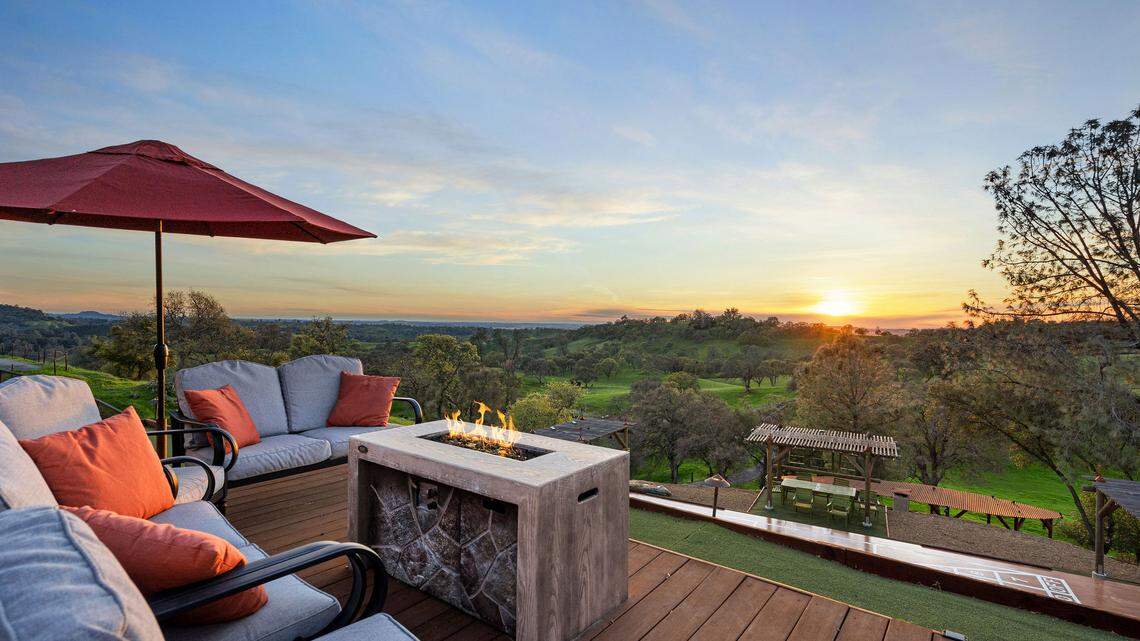
A luxury estate and private safari sanctuary — complete with zebras, tortoises and long views over the Sacramento Valley — has quietly taken shape over the last two decades in the rolling hills near Ione.
For the first time in 18 years, the 137-acre property 40 miles southeast of Sacramento is on the market. The spectacular compound at 7270 Sutter Ione Road, known as Oak Hill Preserve, is listed for $5.1 million.
The preserve includes a 4,200-square-foot lodge , multiple guest accommodations and a private collection of animals — east African plains zebras, 75-year-old sulcata tortoises, African Watusi cattle, ostriches and more — that are available to transfer with the sale.
For owner Brian Kraft, a Sacramento commercial real estate broker and investor, the starting point wasn’t a desire to build a luxury retreat so much as wanting to recreate a feeling he and his family found halfway around the world.
“I love animals, I’ve always loved animals,” he said. “My wife and I were married in Nairobi, Kenya, and went on safari, and we fell in love with Africa. You can’t not. They say your heart never leaves once you’ve gone to Africa, and that’s kind of true.”
A later trip with their children — and the grueling journey home — pushed him from daydream to blueprint.
“A few years ago, we took our three boys down to South Africa and on safari,” Kraft said. “We came back, and it took 42 hours to get from Victoria Falls to our front door in Sacramento.”
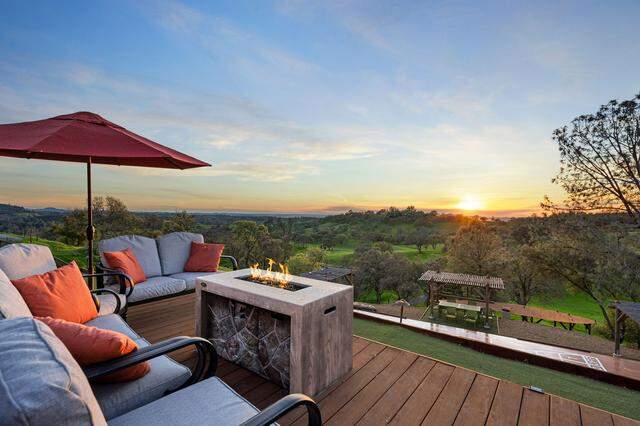 The Ione property’s sight lines stretch to Mount Diablo and the coastal range, and at night include “the blinking red lights of the high-rises in Sacramento,” according to owner Brian Kraft. Andrea Gunn
The idea that followed, he said, became the guiding concept of the preserve.
“Thus began the process of making this thing look like you’re literally out of Africa,” Kraft said. “I love the movie ‘Out of Africa.’ I love the theme song; it brings tears to my eyes. So I kind of recreated our mini ‘Out of Africa.’”
Oak Hill Preserve was designed for a “high-security family legacy,” functioning as a private wildlife conservatory built to blend into the landscape rather than dominate it, according to the listing company.
“What we’re seeing in Northern California right now is a deliberate move by the most disciplined buyers toward sovereignty,” listing agent Tim Allen of Coldwell Banker Realty said in an email. “At a property like Oak Hill Preserve, you aren’t just buying a residence; you’re acquiring 137 acres of absolute environmental control. In today’s market, that scale of privacy is a finite asset.”
The preserve is packed with recreational opportunities, including:
Golf driving range with a 100-yard pond and island green.Shooting range and archery range.Outdoor half-court lit basketball court.Full-size lit shuffleboard court.18-hole disc golf course.Two bocce courts and a horseshoe pit.Five ponds across the property.
When Kraft bought the land, he said, there was nothing remotely safari-like about it.
“Nothing there. It was a cattle ranch,” he said. “Thousands and thousands of acres of rolling hills and oak trees all the way around.”
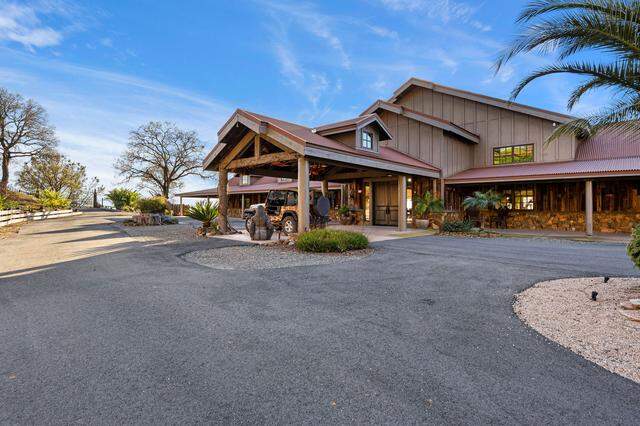 Oak Hill Preserve, a 137-acre estate near Ione, is listed for $5.1 million and includes a 6,500-square-foot lodge, plus guest bunkhouses and other overnight spaces designed for group getaways. Andrea Gunn
That setting — still largely unchanged beyond the gates — was the entire point.
“And that’s the beauty of the place: You’re 35 minutes from Sacramento — but on the property, you don’t see any housing. You don’t see any subdivisions,” Kraft said. “And that’s really what drew me to it.”
Kraft said he searched for years across Northern California counties, passing on properties that failed a list of personal deal-breakers. Some were practical: He wanted paved-road frontage and the ability to build a “nice stone gate, big tall iron gate entry,” rather than relying on easements or dirt roads.
Other requirements were about silence and immersion.
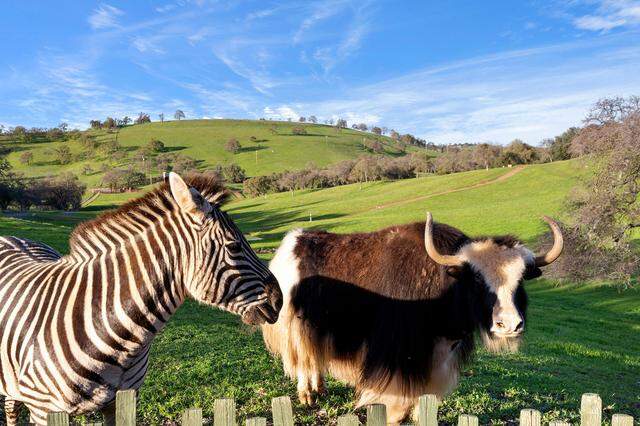 The property’s private animal collection includes east African plains zebras, African Watusi cattle and sulcata tortoises — and the animals are included in the sale. Andrea Gunn
The property is marketed as having “zero light pollution” with naked-eye views of planets and the distant Sacramento skyline. The landscape also drops to Sutter Creek along the southern border, where a spring waterfall is located.
“Criteria number two, I didn’t want to be anywhere near a flyover, where you’ve got airplanes leaving from Sac airport or other airports around that fly overhead. That would be terrible,” Kraft said. “I didn’t want to be near any railroad tracks. Didn’t want to be near any freeway noise.”
The lodge, he said, also had to face west to catch sunsets.
“I wanted to face west so I could build a lodge and get incredible sunsets,” Kraft said. “(Facing east) is great if you want a sunrise. But who sits around and enjoys cocktails at sunrise? So I wanted to face west.”
From a hilltop he calls “lookout,” Kraft said the sight lines can feel improbably expansive for a property within commuter range of the capital.
“From what we call ‘lookout,’ the highest hill we have, you can see Mount Diablo. You can see the coastal mountain range,” he said. “At night, you can see the blinking red lights of the high-rises in Sacramento. You can see the Antioch bridge.”
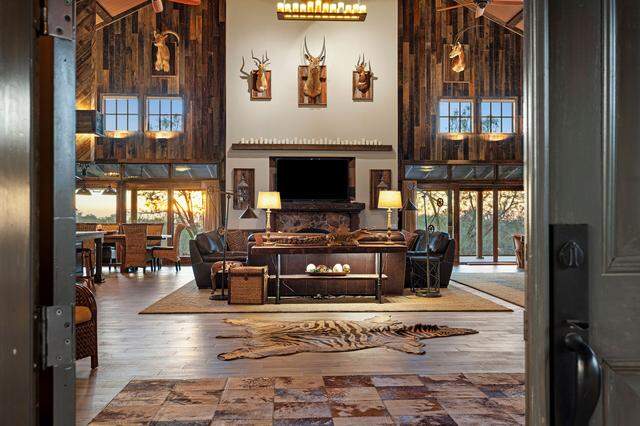 The lodge’s great room — a 1,600-square-foot gathering space — combines kitchen, dining and living areas. Andrea Gunn
To get from ranchland to retreat, Kraft said he had to create the basic infrastructure before anything else. There was no well and no electrical connection when he bought it.
“I had to do wells, and I had to bring power from across the street over to me,” Kraft said.
The property now includes solar power plus PG&E service, a backup generator and three wells, along with about a mile of buried water lines and one-third mile of buried power to avoid visible utility poles and stay true to the look of Africa. The preserve has “three miles of no-climb fence,” Kraft said.
Kraft remembers the early days as intentionally rough.
“When we started going out — there was no power — and we would hang out at ‘tabletop’ where it looks like a pavilion (with) that round stone table … and literally stay up with kerosene lanterns,” he said.
Over time, he said, the structures evolved to support longer stays and more guests. The compound includes a guest bunkhouse, which sleeps six; a luxury guest bunkhouse, sleeping two; a separate cigar bar with power and a wood-burning fireplace; and a covered 1974 Silver Streak vintage mobile home that is electric-powered and sleeps three to four.
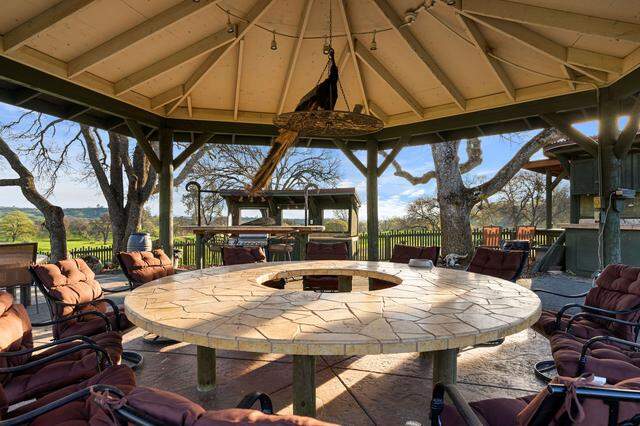 At the tabletop pavilion, property owner Brian Kraft said friends once stayed up under kerosene lanterns around the round stone table, using the outdoor setup for barbecues before the property had power. Andrea Gunn
The Silver Streak, he said, has become a favorite for overnight guests — in part because of who lives outside.
“When you go out the door of the Silver Streak, there’s a nice little enclosure where there are two huge sulcata tortoises. They’re about 120 pounds each,” Kraft said. “It’s retro. It’s 1974 vintage — lime green and lemon on the interior, perfect condition.”
The animals are not a side note in the marketing; they are a selling point. Kraft chose species he believed could thrive on their own, without constant human management.
“They’re all self-sustaining,” he said. “That’s why we picked these species.”
He also framed the collection as falling on the more manageable side of “exotic,” at least compared with animals that might require heavier oversight.
Design choices were meant to keep the property from reading as a standard American ranch with wildlife added on. Kraft said he avoided right angles and straight lines in many of the structures.
“All the buildings are in the round, because in Africa there are not a lot of right angles in their barns and in their houses,” he said.
Inside the main lodge is what Kraft calls the great room, a large, multipurpose space designed for groups.
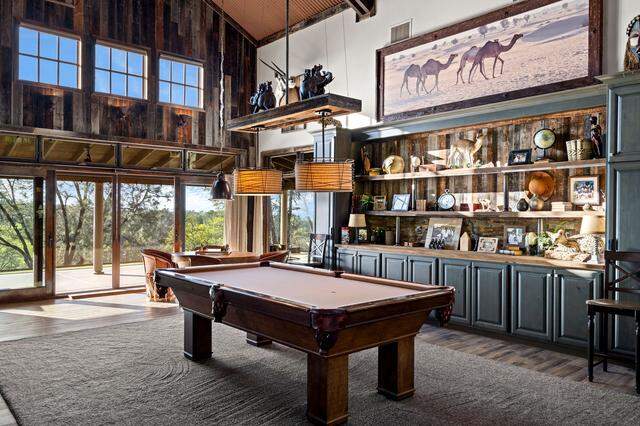 The property has plenty of spaces to hang out, including the lodge’s game-and-gathering area, with a pool table set at the north end of the 1,600-square-foot great room, and a separate cigar bar. Andrea Gunn
He described a kitchen, dining area, living space and pool table arranged around views and a fireplace, with corrugated metal overhead and massive trusses that required on-site fabrication.
Kraft’s helipad — another unusual detail in the foothills — sits about 10 minutes from Westover Field Airport for private aviation. Kraft said he built it with two scenarios in mind.
“If you needed medical assistance, a helicopter could land there and take you to the hospital,” he said. “Second, I always thought in terms of someday when I go to sell, perhaps the buyer is going to be a very Santa Clara–based venture capitalist who’s got a lot of money.”
The property is co-listed by Cheryl Nightingale of House Real Estate.

The Sacramento Bee
David Caraccio is a video producer for The Sacramento Bee who was born and raised in Sacramento. He is a graduate of San Diego State University and a longtime journalist who has worked for newspapers as a reporter, editor, page designer and digital content producer.