
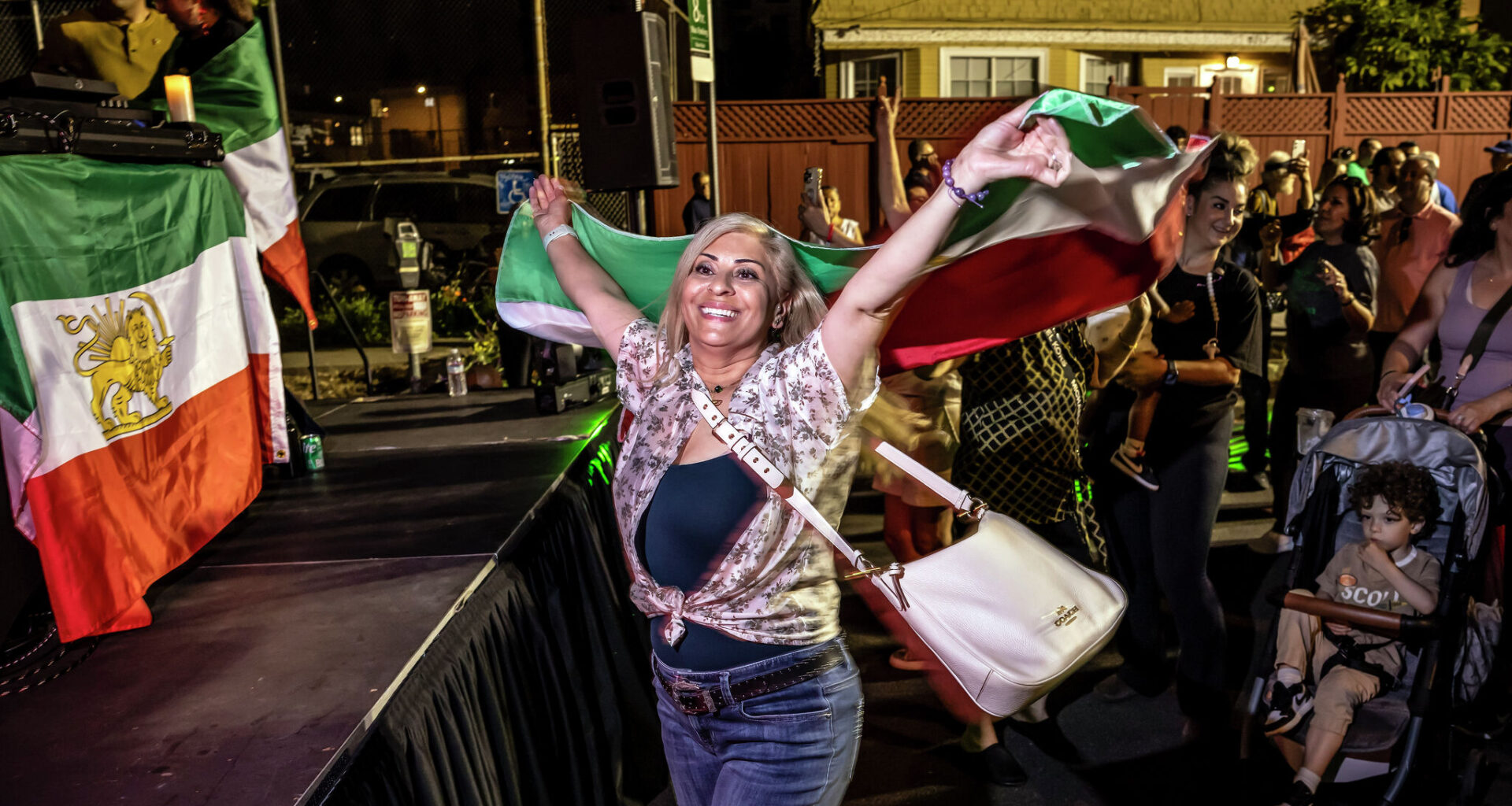
Narges Kashani dances holding the Persian flag during the Persian community’s celebration of Chaharshanbe Suri at the Persian Center in Berkeley.
Carlos Avila Gonzalez/S.F. Chronicle
One by one, people took turns jumping over low flames Tuesday night in the parking lot of the Berkeley Persian Cultural Center, part of a festival of fire celebrated several days ahead of the Persian New Year, Nowruz. The lively atmosphere included children playfully darting through the crowds as adults perused homemade jewelry sold on the street. Families sampled seared kabobs sold from nearby vendors, the woodsmoke fragrant in the air.
This festival was Chaharshanbeh Suri, a party held before Nowruz, which began Friday. Each year for the past two decades, thousands of Bay Area Iranian Americans have honored Chaharshanbeh Suri in block-party form on Durant Avenue in Berkeley.
Families gathered at the Berkeley Persian Cultural Center to celebrate Chaharshanbe Suri
Carlos Avila Gonzalez
The holiday is built around a simple ritual: leap over flames, and call for them to burn away the darkness of the old year before the new one arrives. For many Iranian Americans in the Bay Area, the plea this year carried added sadness and yearning for better days amid the U.S. and Israeli war in Iran. Some people said it was also an opportunity to come together to honor the Iranian people’s resilience.
Article continues below this ad
“This, to me, is bittersweet,” said Sam Mahani, a 35-year-old Pleasant Hill resident, after jumping over three wood-burning logs inside aluminum pans. “Here I am, able to enjoy life and freedom, while friends and family are having a rough time.”
Mahani’s sentiments are echoed by many Iranian Americans who say they have been struggling with complicated and sometimes conflicting emotions as the war escalates.
San Francisco Chronicle Logo
Make us a Preferred Source to get more of our news when you search.
Add Preferred Source
Many Iranians said they remain in shock after the regime brutally killed thousands of people — by some estimates up to 30,000 — who took to the streets in January in anti-government protests.
In February, Iranians worldwide celebrated after the U.S. and Israel launched airstrikes that killed Supreme Leader Ali Khamenei. Iranians felt a surge of hope on Tuesday after Iranian State Media reported that Ali Larijani, a top security chief in the Islamic regime, was also killed.
Article continues below this ad
The Persian Center is lighted with the colors of the Persian flag during the Persian community’s celebration of Chaharshanbe Suri.
Carlos Avila Gonzalez/S.F. Chronicle
Those who support the war see outside military intervention as the only way to rid the country of a regime that has brutally attacked its own people, but they also feel dread about the destruction of the country and the loss of life.
Critics of the war say that President Trump and leaders in Israel don’t have a clear plan and question whether their attempts to remove the regime will be successful and whether the fighting will grow into an even broader regional conflict. The regime so far has survived while striking at neighboring countries and choking off U.S. allies’ oil shipments in the region. But on Tuesday, many people were holding onto hope that the regime would fall.
That includes Parisa M., a vendor at the Berkeley festival who declined to share her full name due to safety concerns. She was thrilled to hear about Larijani’s death, but said she continues to feel conflicting emotions.
“We are hoping on top of this rubble and once this war is over, we can build Iran again and make it glorious the way it was before the Islamic regime took over,” Parisa said.
Article continues below this ad
A teacher observes the haft-sin set up to represent aspects of Nowruz or Persian New Year at Woodroe Woods School in San Leandro.
Jessica Christian/S.F. Chronicle
While thousands of Iranian Americans showed up on Tuesday in Berkeley, other Nowruz events have been cancelled due to the ongoing conflict. Nowruz, which marks the first day of spring and the start of 13 days of festivities, is a tradition rooted in Zoroastrianism, an ancient religion that predates Christianity and Islam.
The Pars Equality Center cancelled its annual Nowruz Gala in Burlingame last weekend, saying that given the “painful events affecting our community … we felt this is not a time for celebration.”
Persian Women in Tech hosted a Friday afternoon Nowruz observance at San Francisco City Hall, but canceled its traditional gala “out of respect for the grief and hardship many within our community are carrying,” the organization said.
At Stanford University, Mobina Riazi, president of the Persian Student Association, said her organization decided to hold a Nowruz party this year “as an act of resilience to bring our community together, to show how strong we are in the face of adversity.”
Article continues below this ad
Riazi, an Iranian graduate student at Stanford, said the event would pay tribute to the lives lost in the January protests and the group would collect donations to support telecommunications in Iran amid Internet blackouts.
A commemorative bracelet presented to guests during the Persian community’s celebration of Chaharshanbe Suri.
Carlos Avila Gonzalez/S.F. Chronicle
“Nowruz has always been about the resilience of the Iranian community and the culture and holding onto the traditions that have been taken away from us,” she said.
Bijan Sartipi, one of the co-founders of the Persian Center in Berkeley, said the center decided against cancelling Tuesday’s event despite some pressure from the community.
“This is something that brings people together,” Sartipi said. “These are challenging times but at the same time this helps people heal.”
Article continues below this ad
That’s how Shokoufeh Hanjani felt while she sat on a bench enjoying pistachio ice cream with saffron on the unseasonably warm evening.
“I’m staying positive — I’m hopeful,” she said of the military intervention in Iran. “I never had that feeling before.”
Hanjani, a Davis resident who moved to the U.S. for college, said it has been difficult to communicate with family and friends in her homeland. When Hanjani did get through, she learned that her cousin had narrowly survived a bomb that struck the building she lives in.
“People are so frustrated in Iran that these bombs are not scaring them how the regime is scaring them,” she said. “War is not good, but to get rid of this regime, what was our alternative?”
The mood was more somber among others. As night fell, Mohammad Zabolzadeh and his wife stood eating bowls of Ash Reshteh, a comforting, velvety soup with noodles, legumes and herbs that is traditionally served for Persian New Year.
Roya Winner, right, hugs teacher Kristie Leo as first grade and kindergarten students jump over fire as per tradition to celebrate Nowruz or Persian New Year.
Jessica Christian/S.F. Chronicle
Zabolzadeh, a 71-year-old Concord engineer, said the holiday seemed quieter as painful events in Iran were top of mind for many attendees compared to last year, when there was more dancing and music.
His brother-in-law, a doctor in Iran, told Zabolzadeh that soldiers with guns pushed him aside while he was treating patients who had been wounded in the January protests. According to his brother-in-law, the soldiers shot the patients and carted the bodies away in a trash truck, Zabolzadeh said.
“That’s why nobody wants to celebrate,” he said.
Mehdi Azadani walked down Durant Avenue hoisting a pre-Islamic Iranian flag in the air, heading toward a pulsing crowd of people dancing in front of a DJ booth. He said he was putting on a smile, but underneath, he felt worried and anxious but also cautiously optimistic.
The January massacre struck close to home, Azadani said. His sister was protesting in the area of Tehran where people were killed, but escaped with her life. Iranians are still mourning and “haven’t processed how any government can do something like that,” he said.
Despite the anxiety, many Iranian Americans are finding ways to focus on joy.
Cyrus Winner, 7, shows his classmates pictures from a book explaining the Nowruz Persian New Year celebration at Woodroe Woods School in San Leandro.
Jessica Christian/S.F. Chronicle
Roya Winner’s two sons shared their Nowruz traditions with their class on Friday.
“It’s a new day, you get to tidy up your home and clean your garage like we did,” Winner’s 7-year-old son, Cyrus, told his class.
Winner, her husband and sons shared with the class the meaning behind the Haft Sin table, an arrangement of seven items that symbolize different hopes. For example, sprouted wheat or barley, which represents rebirth and renewal; apples, which stand for beauty and nutrition; and garlic, symbolic of medicine.
Winner then took the nearly dozen school children to the playground to jump over fake fire and dance to Iranian music.
“Nowruz at school,” she said. “This is the only way we make sense of the world right now.”