
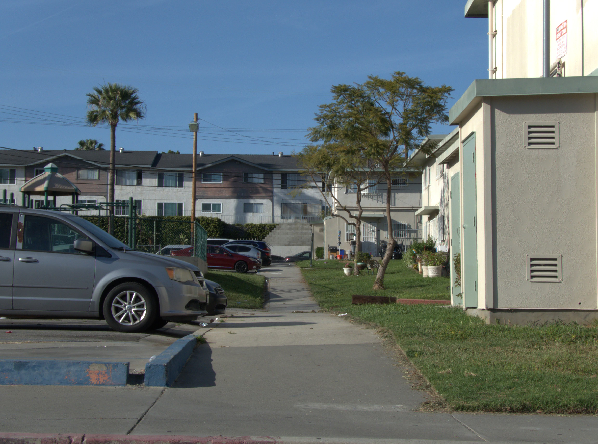
 A view of the apartments in the Rancho San Pedro Pubic Housing. Photo by Devonte Barr. The Complex Future of Rancho San Pedro
By Devonte Barr, Columnist
City decisions are often made in planning documents and council chambers far from the neighborhoods they will reshape. In San Pedro, one of those decisions could soon transform the Rancho San Pedro housing complex—478 public housing units built during World War II—into a redevelopment more than three times its current size.
Supporters say the One San Pedro Project will modernize aging housing and bring new investment to San Pedro. But redevelopment projects of this scale inevitably raise difficult questions for the communities they touch. How many of the roughly 1,400 residents who live in Rancho San Pedro today will realistically return once redevelopment is complete? Who ultimately benefits from the more than 1,500 housing units proposed for the site? What kind of San Pedro is being built for the future?
The Rancho San Pedro complex occupies 21 acres near downtown and contains 478 public housing units operated by the Housing Authority of the City of Los Angeles (HACLA). Built during World War II to house harbor workers, it remains one of the largest public housing sites in the area. Residents pay rent based on a percentage of their income, while HACLA manages the property directly.
The proposed One San Pedro redevelopment would replace the existing complex with a mixed-income development of up to 1,553 units over roughly 20 years, including affordable housing, market-rate units, retail space, and public areas. If built to capacity, the project could eventually house more than 4,000 residents—tripling the site’s current population. The project is structured as a public-private partnership between HACLA and the One San Pedro Collaborative, a development team including the Richman Group, Century Housing Corporation, and National Community Renaissance. HACLA would retain land ownership while leasing portions to the development team under long-term ground leases, with financing from federal and state housing programs, including the Low-Income Housing Tax Credits and the Community Development Block Grants. Environmental review documents identify soil contamination requiring remediation before construction begins.
The current 478 units house roughly 1,200 to 1,400 residents. While HACLA has promised current residents the right to return once replacement units are built, the lengthy construction timeline means many may not be able to.
To better understand how residents themselves see the future, I spent an afternoon walking through the Rancho San Pedro complex and speaking with people who live there today.
Walking through the complex, it becomes clear this is not simply aging buildings awaiting demolition—it is a living community of more than a thousand residents forming a neighborhood with its own rhythms, relationships, and daily routines.
Those who spoke openly expressed a wide range of perspectives about the redevelopment.
One family of three, who asked to remain anonymous, told me, “It’s easy to see the negative, but for some people it might actually be a blessing to relocate.”
Ms. Ward, who lives near W. 1st Street, struck a more cautious tone. “I don’t know much, but I know the plans are big,” she said. “I’ll believe it when I see it. The relocation seems disorganized. Four or more people live in each unit—we’d have more space, but at what cost to residents?”
Another resident, Maira, was among the few who expressed excitement about the project. “We’re happy,” she said. “We’re one of the first families that will be relocated. It’s not like we didn’t have the option either—we do. And we have the option to come back after the redevelopment is finished.”
Still, she noted the challenges facing the neighborhood today. “It’s hard to try and be part of the community when public transportation has decreased routes through this neighborhood.”
The physical environment showed its age—dated buildings and worn landscaping that redevelopment plans aim to replace.
Yet the streets were largely clean, and the small front yards told another story. Many were tightly packed with outdoor furniture, children’s toys, and the small signs of everyday life.
That became clear in an unexpected way as I was leaving the property. While taking a photo of the Rancho San Pedro sign on the corner, I stepped backward into the street to get a wider shot. Across the road, about thirty yards away, a shirtless man casually called out to someone nearby.
“Yeah, he’s by your car, taking pictures.”
Not thinking much of it, I walked over toward my car—black, parked near the sign—and opened the driver’s door.
At least, I thought it was my car.
The front door of the unit behind the corner suddenly flew open, and another resident hurried across the grass toward me.
“Hey—what’s up, you good?” he asked, eyeing me carefully.
I started explaining. “Yeah, sorry if I look like a creep. I’m taking pictures for a story—I write for the local paper.”
He squinted for a moment, then asked the only question that mattered.
“Is that your car?”
I looked down at my keys, then at the car door, halfway inside. It wasn’t my car. I hit the lock button on my key fob—beep—and my actual car chirped right in front of me.
The two men burst out laughing. My hurried apologies were met more with amusement than anger. An older woman who had appeared behind them—likely the rightful owner of the car—looked equally relieved and entertained.
The moment was revealing. Neighbors had noticed a stranger by their car and stepped in immediately.
For a place often described only through statistics and redevelopment plans, it was a small reminder that Rancho San Pedro is still a neighborhood where residents watch out for one another—where the future being planned will ultimately reshape their very real community.
Like this:
Like Loading…
Related