
Three years ago, Rep. Darrell Issa and numerous other Republicans endorsed an “all of the above” energy plan.
The idea was that in further pursuit of U.S. energy independence, the country should embrace all viable options: oil and natural gas, ethanol, wind, solar, hydro and nuclear power.
“An all of the above energy policy is the only policy choice that will unleash and advance the full range of innovation and promote our clear national interest in a reliable and resilient energy supply,” Issa, who represents portions of San Diego and Riverside counties, said in a 2023 statement.
Their resolution was heavy on fossil-fuel production, particularly oil and natural gas. But they also agreed carbon-free sources should be in the mix. Today, President Donald Trump does not.
That’s too bad, because, among other things, it conflicts with some of the president’s energy and foreign policy goals.
As the war in Iran continues and oil prices spike, there’s been a lot written about how much U.S. reliance on fossil fuels, domestic and foreign, has decreased. “America depends less on oil than ever,” according to The New York Times.
A main reason, the Times and others agree, is energy efficiency and growth of renewable sources. A central component of Trump’s energy policy is to undermine both, doing away with tax credits for electric vehicles and expanding renewable energy sources while rolling back automobile fuel economy standards.
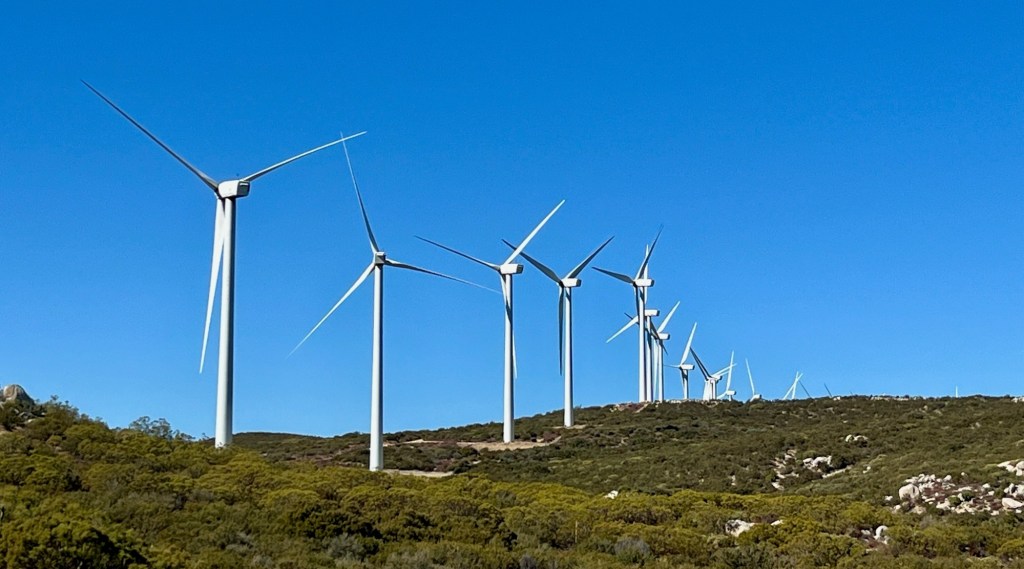
His crusade against offshore wind farms has run into legal roadblocks, so the administration is reportedly offering $1 billion in taxpayer money to stop projects off New York and North Carolina. The two planned wind farms would have the capacity to power about 1.3 million homes and businesses.
Under the deal, the French energy company TotalEnergies would give up their leases in federal waters and invest in natural gas works in Texas. Ironically, politically-red Texas is the nation’s leader in developing solar power.
For the moment, let’s put aside the fact that more carbon-free energy could help combat global-warming greenhouse gases by reducing the use of fossil fuels. Trump doesn’t believe in that.
But his opposition to alternative energy seems to conflict with his stated goals of energy independence and robust economic activity. Not only have solar and wind power become more cost-efficient over the years, the whipsawing of federal policies under Trump can stifle investment in those growing sectors — and lead to uncertainty, something business generally doesn’t like.
Putting the kibosh on certain renewable energy is counter to another Trump pursuit: expansion of artificial intelligence. The AI boom has boosted the economy and stock market, along with triggering fears about how the technology may shape the future.
One of the big issues with AI is its voracious appetite for energy, which has led to concern about supply, the adequacy of electrical grids and higher electric costs for average households.
AI leaders are investing in existing nuclear power plants and next-generation small modular reactors (SMRs). They’re also pouring big money into solar power and storage.
Though Trump has vowed not to approve any wind or solar projects, he’s changed direction before on other priorities. He’s rolled back some of his earlier tariff proposals and continues to consider immigration carve-outs for agriculture and the hospitality industry.
The end of electric vehicle tax credits hit some of Trump’s perceived enemies hard (California and Gov. Gavin Newsom, in particular), but also drivers and car makers who invested heavily in EVs. The administration contends relaxed gas mileage requirements will help the auto industry and lower vehicle prices for consumers.
The actual cost of driving is another matter, according to John Raymond Hanger, a former commissioner at the Pennsylvania Public Utilities Commission. He recently laid out the advantages of EVs (though costs in states such as California can differ) in a social media post.
“A typical electric vehicle uses about 7.5 kWh of electricity to travel 25 miles…charging with household electricity, that power costs about $1.30 on average, far less than a gallon of gasoline.” Americans pay ~$2.1 billion more per week to fuel their autos,” he wrote.
Now, there’s a big caveat. The purchase cost of many EVs put them out of reach for some lower-income individuals. Still, the erstwhile tax credit made the cars more accessible. In any case, gasoline prices hit people of lesser means harder.
The typical U.S. driver travels around 1,000 miles each month, according to The New York Times. The higher gas prices from the Iran war (as of March 16) mean it costs an extra $32 to drive that distance in a car that gets 25 miles per gallon, according to nationwide averages. Oil prices have risen since then.
There’s no question people are feeling it. The uncertainty about the point of this war and whether it was a good decision to launch it doesn’t help the public mood.
But the country has weathered spikes in gas prices before, such as after Hurricane Katrina (2005), Russia’s invasion of Ukraine (2022) and the Great Recession (2008).
For now, there seems to be little panic over cost or supply, certainly nothing like during the Arab oil embargo of the 1970s. That can change, of course, depending on how the war turns out.
Nevertheless, the U.S. economy is more energy-efficient and less reliant on fossil fuels than in the past. The country is producing more crude oil than ever before and more than any other country, yet alternative sources are an increasing part of the energy picture.
Renewables hit a record 26 percent of all electricity generated in 2025, up 10 percent from the prior year, despite Trump administration policy opposition, according to the Los Angeles Times.
The falling costs of solar and wind technology have made renewable installations cheaper than fossil fuel alternatives, driving continued private investment.
Nearly 80 percent of new power generation capacity planned for the next decade is renewable, with renewables expected to account for one-third of all electricity by 2030, according to Cleanview.co, an energy data company.
The economics of renewable energy seem to guarantee growth, though Trump may slow it down some.
Regardless, it seems he’s tilting at windmills.
What they said
Pope Leo XIV (@Pontifex)
“In the dramatic circumstances of war, information must guard against the risk of turning into propaganda. It is every journalist’s duty to verify the news, so as not to become a megaphone for power. They must show the suffering that war always brings to populations, which entails showing the face of war and recounting it through the eyes of victims.”