
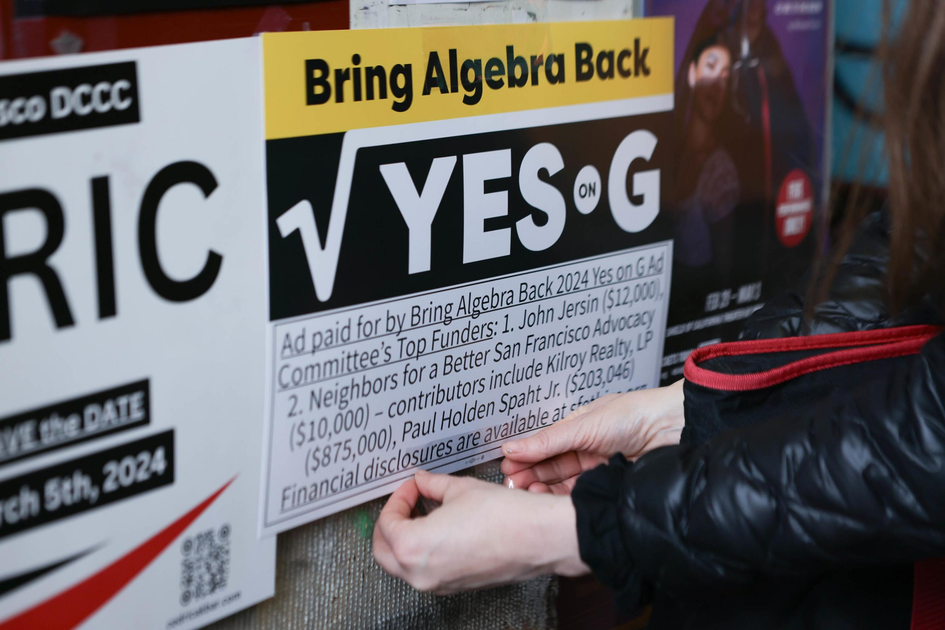
Since San Francisco’s school district removed Algebra 1 from all public middle and K-8 schools in 2014, families have pushed for its return.
Starting next school year, the math course is set to be an option for all 8th graders again for the first time in more than a decade. But after two years of piloting different options for the course’s implementation, there’s still internal and external debate on exactly how Algebra 1 should be offered. Think of it as solving for x after it took twelve years to solve for y.
On Thursday, the district emailed families with last-minute changes to its proposal, which will be presented and put up for a vote at Tuesday’s Board of Education meeting.
Here’s what we know now — and what it means for students and families.
How is Algebra 1 being offered?
At 19 of its 21 middle and K-8 schools, the district plans to offer (opens in new tab) Algebra 1 as an additional elective course. All students would be automatically enrolled in Math 8 — the final class in SFUSD’s current K-8 math sequence — while some could also choose to take Algebra 1 if deemed academically eligible.
Previously, the district suggested that (opens in new tab) students who wanted to take Algebra 1 had to be enrolled in both classes, which would mean giving up an elective like art or music. Now, eligible students would be able to opt out of Math 8 and solely take Algebra 1 after meeting with a counselor and receiving written consent from their parents.
Additionally, students who are not deemed academically eligible could still choose to enroll in Algebra 1. However, those students would not be allowed to opt out of Math 8 and would have to use one of their elective class slots.
Who will qualify as “academically eligible”?What about those other two schools?
At Herbert Hoover Middle School and Alice Fong Yu K-8 School, the district is piloting a new math curriculum approach. Incoming 6th-graders will follow an accelerated math pathway of three courses that are meant to cover four classes worth of curriculum: Math 6, 7, and 8, along with Algebra 1.
These schools were selected due to their size, language programs and instructional schedule, according to the district. Incoming 8th graders at those schools will take a compression course with both Math 8 and Algebra.
The district said it will monitor student outcomes to evaluate the effectiveness of this approach.
Some advocates of increasing access to Algebra 1 hope this accelerated model will be offered more broadly. “It’s a partial victory,” said Steven Bacio of GrowSF, a political advocacy group that organized parents to push for the ability for Algebra students to opt out of Math 8.
One concern from some teachers is that offering an accelerated curriculum to just some could recreate the very system SFUSD tried to dismantle a decade ago that sorted into higher and lower math tracks.
How did we get here?
SFUSD eliminated Algebra 1 in middle school in 2014 to reduce academic “tracking,” which sorted students into higher and lower math tiers. The goal was to address racial disparities in achievement, but the actual results fell short. (opens in new tab)
Research into the policy’s impacts found it did not significantly reduce inequities. Instead, it was associated with a districtwide drop of up to 15% in AP math enrollment in high school.
Critics alleged the policy held back advanced students and pushed families with means toward schools with earlier access to Algebra 1. Over the past decade, parents have repeatedly pushed leaders to reinstate Algebra 1, even suing the district (opens in new tab) to bring the class back.
In February 2024, the school board voted 6-1 to bring Algebra 1 back for 8th graders and launched a two-year pilot program across 10 schools. The goal: figure out how best to offer Algebra 1 (opens in new tab) at all middle and K-8 schools by the 2026–27 school year. The move would bring SFUSD back in line with most Bay Area districts.
How did the pilot go?
Aside from the Algebra 1 as an elective model — which was eventually selected — the district tested two other approaches: having all 8th graders take Algebra 1 and offering a course that combined Math 8 and Algebra 1.
The compressed model — tested at just one school — was quickly dropped from consideration.
A Stanford University evaluation found that students (opens in new tab) in the “Algebra for all” model were more than twice as likely to repeat the course in 9th grade compared to those in the elective model.
At the six schools offering the elective model:
36% of students enrolled in Algebra 174.4% of those students were deemed academically eligibleBoth eligible and ineligible students showed significant learning gains
However, only 13% of underrepresented minority students at those schools were deemed academically eligible to take Algebra 1 — highlighting continuing equity gaps.
What do parents want?99% supported offering Algebra 1 in 8th grade About 43% of respondents raised concerns about losing electives like art and music if Algebra 1 is added as a second math class18% preferred replacing Math 8 entirely with Algebra 1 to preserve elective timeWhat happens next?
If approved at Tuesday’s meeting, the changes would take effect in the 2026–27 school year, returning Algebra 1 to all SFUSD middle and K-8 schools.
In the meantime, key questions remain — including how eligibility will be determined across schools, how students will balance math with electives, and whether the new system can expand access without recreating the inequities it was designed to fix.