

Jack Tempchin has seen the brave new world of recorded music, and it doesn’t involve him. At least it doesn’t as a singer, guitarist or a performer of any kind.
Never mind that this 2019 Songwriters Hall of Fame inductee has just released two new studio albums and contributed seven songs to the San Diego-centric new movie, “Swami’s Vibe,” which Tempchin co-produced and premieres Saturday at La Paloma Theater in Encinitas. And never mind that he counts the Eagles, Emmylou Harris, Ringo Starr and Johnny Rivers among the million-selling artists who have recorded his songs.
Songwriters Hall of Fame inductees include Missy Elliott, Cat Stevens, San Diego’s Jack Tempchin
Witness Tempchin’s two new albums, “The Magic Mirror” and “All Kinds of Love,” which both came out last month and feature nine and eight songs, respectively, all written by him. Asked how many of those 17 numbers he performs on, the 78-year-old troubadour offered a startling response: “Zero.”
Come again?
The man who has played countless concerts since the late 1960s — and who has written such classics as the Eagles’ “Peaceful Easy Feeling” and Johnny Rivers’ “Swayin’ to the Music (Slow Dancin’)” — is a willing virtual bystander on his two new albums.
How is that possible?
In a word: Suno.
That is the AI music creation platform app Tempchin used to make everything on his two new albums. Everything that is, except for the lyrics, all of which he wrote himself.
“What I really like to do is to write the songs,” said the bearded troubadour, who lives in Encinitas with his wife of 54 years, Sheryl. “And if you write a song, you want to make a record, so either you have to get some other artists to perform it or you have to go in and do the whole record-making process yourself, which takes a long time.
“But with Suno’s AI, that’s my band. And I’d like to make it very clear that Suno — and AI in general — can write songs. You can have it write a song about anything and it can do a good job. But I don’t do that. I write the whole song, 100 percent by myself.
“Then, I put it into Suno and the AI sings, plays, arranges the music and makes the record of the song, just as if it was a band recording my song. The only difference is the people in ‘the band’ are not real. With Suno. Within two minutes, it pops out a finished record that’s well-produced and sung, with vocal harmonies and all the instruments. It’s mixed, it’s mastered, it’s ready to go, because that’s the miracle of this technology.”
 In addition to having released several new albums, acclaimed singer-songwriter Jack Tempchin co-produced and wrote seven songs for the new movie, “Swami’s Vibe.” The film is a valentine to Swami’s beach, a northern San Diego County landmark that longtime Encinitas native Tempchin visits nearly every day. (Jack Tempchin)
High-tech and ‘Ancient’
Tempchin is not alone in embracing Suno.
But he is surely the first established musician of his generation — late alone the first Songwriters Hall of Fame inductee — to release not one, but two Suno-generated albums. And he is the first to do so concurrently with the release of a half-century-old archival solo acoustic live album, his utterly charming “Ancient Artifacts.”
It features such wonderfully earthy Tempchin songs as “Stingaree,” “Turn Up Texas Street Baby,” “Fifteen Days Under The Hood” and “One More Song.” The “Ancient Artifacts” album also includes the timeless “Peaceful Easy Feeling,” which Tempchin famously completed writing while waiting for his order at the now-defunct Der Wienerschitzel in Hillcrest. Sounding almost as fresh as yesterday, “Ancient Artifacts” was recorded largely at the San Diego Folk Festival in 1973.
That was 53 years ago.
Richard Nixon was still president. Gas cost 36 cents a gallon. The first karaoke machine debuted in Japan. It would not be until 1997 that the world’s first commercially available mobile app, which was created by Nokia, was introduced — nearly 20 years before Suno was unveiled in 2023.
In the three years since its inception, Suno has grown so quickly that its users now churn out an estimated 7 million Suno-generated songs a day. That’s the equivalent of an entire Spotify catalog’s worth of music every two weeks.
A growing number of professional musicians use AI as a songwriting tool that enhances and complements their work, although only a few have been as forthcoming about it as Tempchin. But the Massachusetts-based Suno’s target demographic appears to be people who have never written songs before and who may have no musical abilities or background.
Or, as a recent online ad put it:
With Suno, anyone with an idea can turn it into a song — no instruments, no training, just imagination. Whether it’s a vibe, a memory, or a random thought, Suno brings it to life in seconds. It’s never been easier — or more fun — to make music that feels like you.
Whether anyone can make music that “feels like” them when they have no idea how to make music is subject to debate. But that sonic democratization is a large part of Suno’s allure for neophytes, who welcome the opportunity to have AI do most — or all — of the work for them, almost instantaneously.
One of Suno’s online ads trumpets the elimination of gatekeepers, stating: iPhone made everyone a photographer. Now Suno (@SunoMusic) is doing the same for music. Wave goodbye to production barriers — anyone can be a musician.
But does enabling anyone and virtually everyone to make songs help music and the way it’s made and consumed? Or do Suno and other AI music-generating companies dramatically diminish the value of music by creating a monsoon of AI-produced songs that favor computer-generated technical polish over emotion, human creativity and the “happy accidents” that can make a good song even better?
That conundrum is concisely captured in the headline to a March cover story in the leading record-industry magazine Billboard: “Is Suno the Music Industry’s Biggest Nightmare — Or Greatest Hope?”
Tempchin is optimistic about the prognosis, at least for now. He regards Suno as a new vehicle to make his music available on a platform that, for better or worse, dramatically levels the playing field for the makers and consumers of music.
“For the first time, people who don’t play and don’t sing, but love music, can make their own records,” he said. “And they can take my songs, or any songs, and redo it in their own way.”
If all this sounds too easy to be true, guess again.
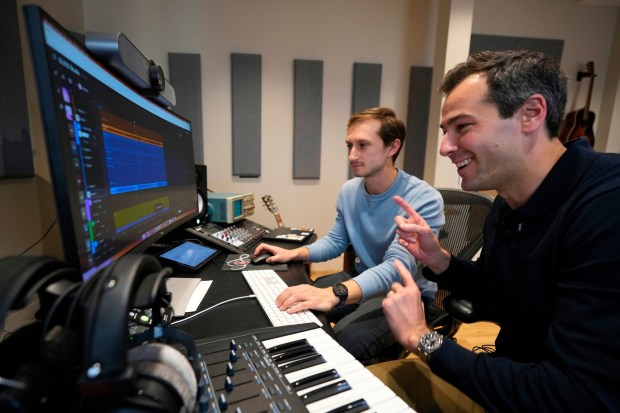 Mikey Shulman, at right, is one of the founders of the AI music generator company Suno. He is shown with research scientist Christian Steinmetz as the two collaborate on creating a song at Suno’s headquarters in Cambridge, Mass. (AP Photo / Robert F. Bukaty)
‘Artists you enjoy’ prompts
All Suno users have to do to create a song is to click on a series of prompts. The prompts they choose indicate the genres of music they have in mind and the moods of the songs they want Suno to make for them.
Up until late last year, Suno users couldn’t use prompts to sound like a specific artist. The platform instead offered a “prompt list” — which Suno still offers — of “famous artists and their associated music styles. Use this as a guide to help inspire your own music-related prompt based on artists you enjoy.”
Those prompt options include Bruno Mars (Funk, Dance Pop, Groovy, male vocals), Taylor Swift (Pop, Alternative Folk, Emotional, female vocals), Flying Lotus (Electronic, Experimental HipHop, Fusion, male vocals), Shakira (Latin, Dance Pop, Festive, female vocals), San Diego’s blink-182 (Emo pop rock, male vocals) and a good number more.
It’s no surprise, then, that several of the biggest record companies in the world — Sony, UMG and Warner Music Group — each sued Suno and a similar AI music company, Udio, for $550 million in 2024 for copyright infringement.
The lawsuits accused Suno and Udio of unlawfully copying the three companies’ sound recordings as training models for their AI models. These models, the suits charged, generate music that could “saturate the market with machine-generated content that will directly compete with” human artists.
In a related development, the French online music streaming service Deezer last year issued a report that nearly 40 percent of the music downloaded each day to streaming services was AI-generated.
And last November saw the iHeartRadio network launch its “Guaranteed Human” initiative, which guarantees iHeart will not “play AI music that features synthetic vocalists pretending to be human.” (The intriguing issue of human vocalists who sound synthetic will have to be explored another day in another article.)
Last November also saw Warner Music Group settle its suit against Suno. The two companies then signed off on a partnership that will let users create AI-generated music on Suno using the voices, names and likeness of any Warner artists who agree to participate.
One month earlier, in October, Universal Music Group settled part of its lawsuit against Udio and agreed to create a new licensed AI music creation platform. As a result, Udio will this year begin enabling its users to make remixes and mash-ups of fully licensed, pre-existing songs. It remains to be seen if Universal and Suno will reach a similar agreement.
Yet, even if Suno users opt not to use a prompt to emulate a specific artist, they can still choose 11 examples of song styles, which range from “hip-hop and urban” to “classical and orchestral” and from “jazz and lounge” to “rock and metal.” The options provided by those song style prompts are quite detailed, as demonstrated by Suno’s “Dance and Electronic” suggestions, which include:
• “Energetic tropical house, vibrant melodies, calypso percussions, relaxed vocal styles, and a chill tempo.”
• “Dynamic Balkan electro swing, spirited brass sounds, syncopated beats, ethnic tunes, and dance-inviting tempo.”
• “Underground minimal techno, looped beats, slow evolutions, trance-inducing rhythms, and a deep bass presence.”
• “Drum and bass with rapid breakbeats, heavy bass, and complex, choppy drum tracks, Synthwave, evoking 1980s nostalgia with lush synthesizer melodies and retro-futuristic vibes.”
The variety of options on Suno appeals to Tempchin, who in the mid-1970s led the highly regarded country-rock band Funky Kings and released his self-titled debut solo album in 1978. However, he often prefers not to use any of Suno’s prompts, the better to hear what the app devises on its own.
“Song for J.D.,” the melancholic, country-tinged opening track on Tempchin’s new album, “The Magic Mirror,” stylistically sounds the most like the songs on his dozen-plus, pre-Suno solo albums. (It’s a heartfelt tribute to his longtime songwriting pal, J.D. Souther, who died in 2024.)
The vocal harmonies on “Great Big Heart” — none of which are done by Tempchin— have a 1950s doo-wop flavor. The singing on the jaunty “Balancing Act” sounds like an AI-generated synthesis of James Taylor and Jason Mraz.
The wah-wah guitar-tinged “Back in the Sixties,” set to a percolating beat, evokes Bill Withers, while the sly “I’m in Good Shape for the Shape I’m In” suggests Tim McGraw, by way of Garth Brooks. And on “Sunset in My Heart,” a lilting song Tempchin wrote for the “Swami’s Vibe” movie, the female vocals provided by Suno bring to mind an AI iteration of Emmylou Harris.
“It does a bit, but I didn’t ask for it to sound like Emmylou,” said Tempchin, who wrote the title track for Harris’ 1983 album, “White Shoes,” and was her opening act on a tour several decades ago.
Perhaps the most unlikely and surprising of his new Suno songs is “Only Love Knows.” It’s a swinging, big-band ditty with a sleek lead vocal that should draw in fans of Michael Bublé and Harry Connick, Jr.
 Jack Tempchin’s live performances are completely AI-free. (Sarah Reingewirtz / Pasadena Star-News / SCNG)
No string beans!
“Working with AI is kind of like working with a person; you don’t always get what you want! It’s like if Suno is making your dinner and you ask it not to put in string beans, it might put them in any way!” Tempchin said with a laugh.
“I wanted to do a folky version of ‘Only Love Knows’ and I asked Suno to do in the style of my song ‘The Swing’ from my (2025) album ‘More Is Less.’ All Suno heard was ‘swing,’ so it made this big-band version. It misinterpreted what I asked for. But when I heard it, I thought: ‘Hey, this is great!’
“Some of the musical arrangements Suno does are terrific and are not things I would come up with myself. It’s a thrill for any songwriter, even if you just use prompts (to make the song).”
To make his two new studio albums, which are now available for purchase on all major streaming platforms, Tempchin sang his lyrics and played acoustic guitar on fewer than half of the 17 songs as reference points for Suno.
For the other numbers he wrote, he simply sang the lyrics into his Suno app and let AI do the rest. The end result showcases his lovingly crafted lyrics on sleek, uniformly tasteful songs that contain none of his vocals or guitar work
“Theoretically,” Tempchin said, “I could take the Suno voice off and add my voice on. But I tried that and it just didn’t feel right to have me singing with those Suno arrangements.”
That is a key reason why Tempchin won’t include any selections from his two new Suno albums when he performs a three- or four-song mini concert prior to each of Saturday’s “Swami’s Vibe” screenings at La Paloma Theater in Encinitas.
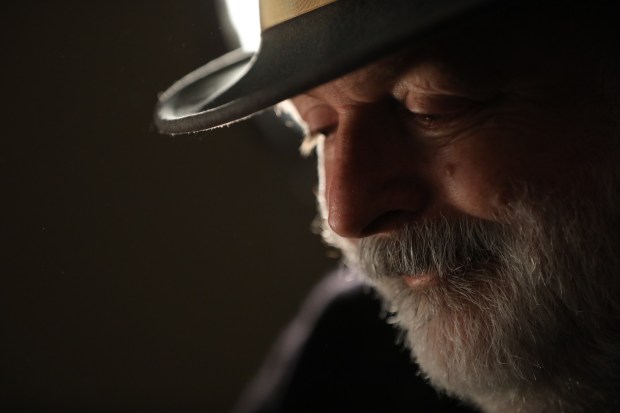 Songwriters Hall of Fame inductee Jack Tempchin embraces AI on his two new studio albums. (Jim Shea)
Rustic vocals
Suno’s homepage bills it as “the creative platform built for musicians. Generate infinite stem variations — vocals, drums, synths that flow with your audio. Upload your own samples or start from scratch. Edit in a multitrack timeline with full control… Amplify your creative process with Suno.”
There are, of course, few or no expectations for Suno-users who are dabbling in songwriting — or some other AI-generated derivation of songwriting.
But veteran fans of Tempchin’s music savor his rustic, conversational vocals and well-honed acoustic guitar playing almost as much as they do his heartfelt songs. And apart from his lyrics, his Suno albums are, well, Tempchin-free.
“People wouldn’t recognize these are my songs and it doesn’t sound anything like me singing,” he agreed.
“But I’m in the songs because I wrote them. I wrote ‘Peaceful Easy Feeling,’ but I didn’t make the record of it — the Eagles did. I struggled really hard to figure out how to present myself through these Suno songs. I don’t want to hide myself through AI. So, I am making sure everyone knows I wrote these songs, but that the recordings are sung, played and produced by AI.
“I feel there’s a common thread if I keep making Suno records, and the thread is they are my songs. They’re me talking. That’s where the human person is in this.”
But what if a Suno-user is not a songwriter, let alone an accomplished music veteran? What should their song, or songs, be about, especially if they’ve never written any lyrics before?
Suno’s website offers several helpful possibilities. They include: “Make a jazz song about watering my plants”; “Make a house song about quitting your job”; and: “Make a country song about Jess being late.” (As yet, there is no prompt suggesting users create songs on Suno using lyrics created with ChatGPT.)
Tempchin also used Suno for the songs he contributed to the new film, “Swami’s Vibe,” which he co-produced with its director and photographer, J. Stuart Edmondson. It’s a valentine to Swami’s beach and its adjacent Self Realization Fellowship, both of which Tempchin visits almost daily to write songs and paint.
Edmondson, who befriended Tempchin after they met at Swami’s, credits the singer-songwriter as the influence and inspiration for the film.
“It’s a documentary about the community of people who show up at that beach every day and about who they are and why they come,” said Tempchin, who became a Swami’s regular during the pandemic shutdown.
“We may do a sequel to the movie. As for my other future plans, there’s no money at the end of the music rainbow. All I’m trying to do is write the songs and I just want people to hear them. So, I’ll probably keep making Suno records and that’s all I have planned for the moment.”
He laughed.
“If I’m still alive when I’m 90, I’ll probably be bigger than ever! I always figured I was a slow learner and would peak later. As long as I can keep singing and playing, I’ll keep on doing it and whatever happens happens.”
‘Swami’s Vibe’ movie premiere, with a live mini-performance by Jack Tempchin
When: 6 and 9 p.m. Saturday, March 28
Where: La Paloma Theater, 471 South Coast Highway 101, Encinitas
Tickets: $23.18
Online: eventbrite.com/e/swamis-vibe-tickets-1981973671605?aff