
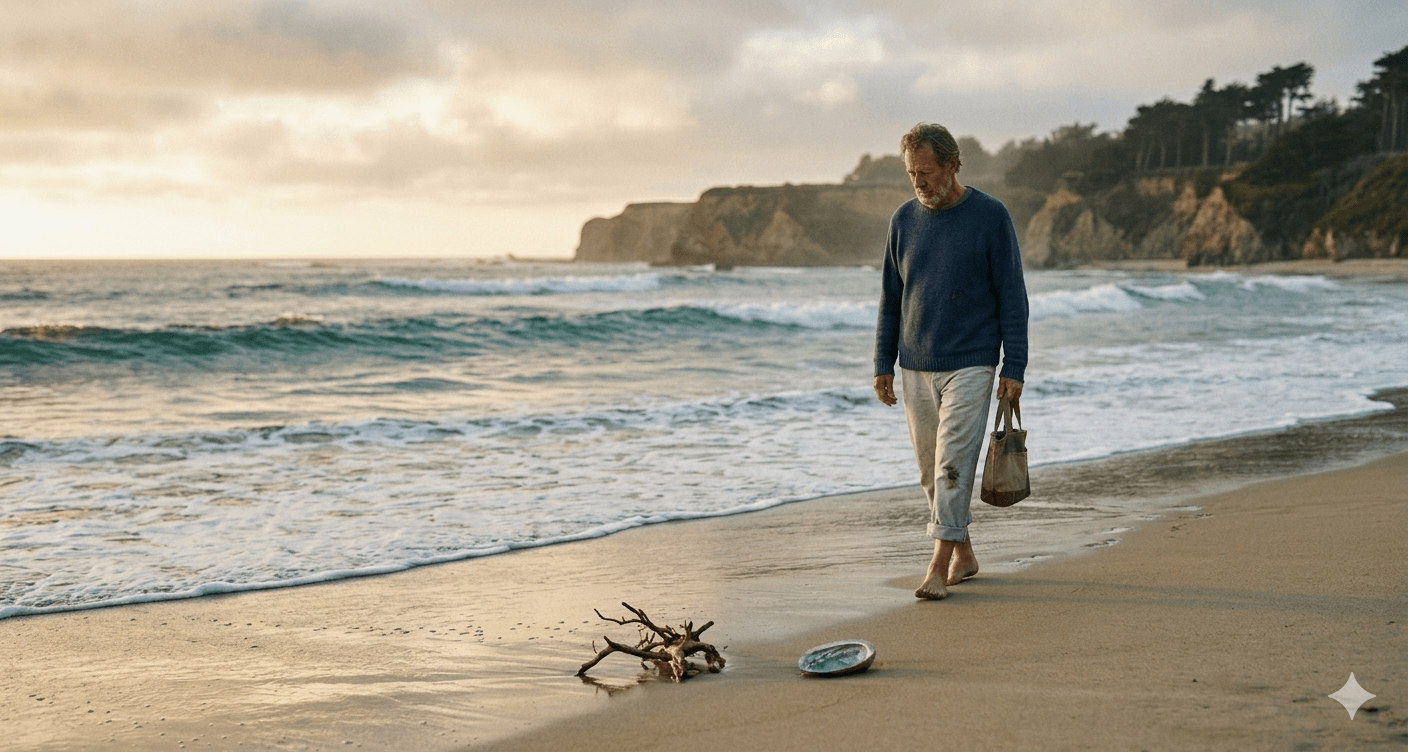
 Richard Bode left the “safe route” to find an authentic life by the shore. Image via Gemini.
I’ve spent most of my life living in the Northeast, and this time of year I get antsy. By the middle of March, we’ve been teased by a few sunny, 60-plus degree days, the kind of weather that get me thinking about my happy place: the beach. But just as day turns to night, the warm days are followed by chilly ones. This morning, it was 27 degrees.
Don’t get me wrong, I love where I live. (In case you’re wondering, I currently reside on the Eastern Shore of Maryland.) I enjoy the laid-back vibe, the friendly people, the superb seafood, my proximity to both the ocean and bay. My only wish is for shorter winters. Which causes me to envy those who have moved to warmer climes full-time, like Richard Bode.
Bode shed his old life and started a new one.
His story is an interesting one. Richard Bode began his career as a speech writer and editorial director for two major publics relations firms in New York City. He was highly successful, was making good money, but felt that something wasn’t right. He had taken “the safer route” and abandoned his dreams for the security of a paycheck.
That’s when his second act began. He quit his job and began working as a freelance writer for publications like Sports Illustrated and Reader’s Digest. Still, something wasn’t right. He left his marriage of 30 years, got rid of most of his possessions and retreated to a small beach cottage near Miramar Beach, just north of Half Moon Bay, in Northern California.
Bode became a self-described “beachcomber.”
Beachcombing is defined as a person who walks along the beach looking for valuable or interesting items. Bode would spend most days walking up and down the beach near his home Only much of the searching Bode did was internal. Instead looking for lost trinkets, Bode mined his own soul.
At the age of 68, he wrote his first book First You Have to Row a Little Boat: Reflections on Life and Living. His next and final book, Beachcombing at Miramar, The Quest for an Authentic Life, was released when he was 71 years old. In the latter book, he talked of his life of solitude, the rhythm of the tides, and the people be encountered on his works. He contemplated his own life, including what had worked and what hadn’t.
What follows are five of my favorite passages from Beachcombing at Miramar, lightly edited. Bode’s words appear in quotes, my thoughts follow.
5 Life Lessons from a Beachcomber
Pay attention to the voice within. “Not all men are born to be saints, but I believe we are all born with a voice within that we tend to ignore until it becomes so indistinct we barely know it’s there. The voice doesn’t come from an almighty God in the sky; it comes from an in-dwelling God in the soul.” We live our best lives when we find the time and space to listen to it.
Don’t let others run your life. “Remote rulers generally exert less power over our lives than the ordinary people do, the people we live and work with every day. The latter are always present, with their own agendas and their own demands, which can oppress us unless we find the will within ourselves to resist.” You need to get out of the backseat and drive the car that is, in the words of Michael Meade, ‘your own damn life.’ It’s a right you can’t give away to others.
Listen to the inner clock. “There is a clock within me, a living clock, and it keeps pace with the pulse beat of the world. I hear the slow ticktock of the planet when I stand in a salt marsh or walk the sands of Miramar. The instant I slip behind a steering wheel, I lose the tempo of the natural world and become like a singer who has lost the rhythm of his song.” Sometimes you just need to lower the volume. Like me, Bode finds his inner clock on the beach, but it can be found anywhere there is quietude.
Forgive yourself for past sins. “The impoverished in spirit have no chance but to bless themselves. We must bless ourselves; there is no other way. If we don’t, there is no telling how far we will go to prove our worthiness.” Forgive yourself for any past transgressions, what’s done is done. Today, and each day moving forward, is a new opportunity to get it right.
It’s okay to now know all the answers. “I do not have an answer to every question that comes my way; I am confused. To be confused is to be strong. Confusion forces me to assess my situation, to move with care, to evaluate my progress and correct my course as I go along.” When we don’t know the answer, sometimes it’s best to feel our way forward, one moment, and one step, at a time.
After Bode moved to California, he would occasionally hear from his old contacts in the corporate world. They would reach out to him and ask when he was going to return to “the real world.” A friend once wrote him, “This idleness, this drifting, when will it all end? Where will it all lead?” While walking on the beach, gazing at the waves breaking along the shoreline, he realized:
I am more sure of my destination than ever before. I am not drifting. I am moving by design, aware of the teeming life about me and the choices I must make-–when to resist, when to accept, when to bide my time.
Bode had come to live on his own terms. His life suggests that our “happy place” isn’t just a destination on a map, but a state of being we carry with us. He reminds us to listen for that inner clock—the one that keeps perfect time regardless of the temperature outside. Because whether you’re on a California beach, the Maryland shore, or anyplace else, the most important “beachcombing” happens within.