
In the Curator’s Words is an occasional series that takes a critical look at current exhibitions through the eyes of curators.
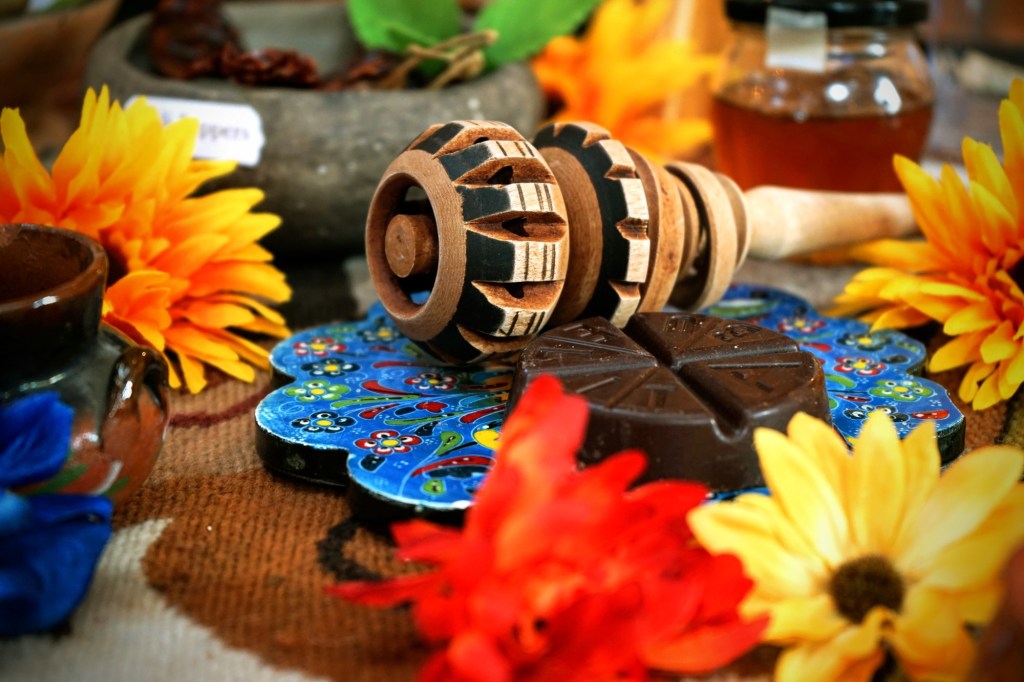
Chocolate lovers, rejoice! An exhibit at the Heritage of the Americas Museum, on the campus of Cuyamaca College, takes an up-close look at chocolate and its place in history.
“Long before chocolate became a beloved treat, cacao held deep cultural, economic and ceremonial importance across the Americas,” the museum says.
Indeed, it’s that significance across disciplines that is widely explored and examined in this exhibit, which opened in February.
Bob Bordelon, the museum’s director, took some time to give us a taste of the exhibition.
 The Heritage of the Americas Museum’s current exhibit — “Chocolate in the Americas” — came out of a desire “to look at the roots of chocolate in the Americas through a wider lens,” says Bob Bordelon, museum director. (Maribell Fregoso)
Q: Tell us more about this exhibit, and how it came to be.
A: This exhibit grew out of a desire to look at the roots of chocolate in the Americas through a wider lens. Our museum features one of the largest collections of pre-Hispanic artifacts south of Los Angeles, with many related to chocolate. For many people, chocolate is comforting and familiar, something we associate with pleasure or celebration. But its story is far richer and far older than most realize. Chocolate has been part of human culture for thousands of years, shaping rituals, trade and social relationships long before it became a modern treat.
As the exhibit developed, we focused on tracing chocolate’s journey — from its origins in Mesoamerica, where cacao was first cultivated and revered, to its spread across cultures and continents. Along the way, chocolate shifted in meaning and use, moving from sacred beverage to luxury item and eventually to a global staple. The exhibit brings these transformations to life through objects, images and storytelling that connect the ancient past to the present.
Q: Chocolate has much deeper meaning beyond the culinary world. Can you share an example of how chocolate has deeper cultural significance through history?
A: In ancient Mesoamerican societies, cacao held profound cultural and symbolic importance. Among the Maya and the Aztec, cacao was used in rituals, religious ceremonies and important social gatherings. Drinking cacao was not an everyday activity; it was reserved for moments of significance and often associated with fertility, renewal and the sacred.
Cacao beans also functioned as a form of currency, giving them both symbolic and practical value. This made cacao unique — it was at once spiritual, social and economic. When chocolate later arrived in Europe, it entered a very different cultural framework, but it retained its association with status, ceremony and exclusivity. Understanding these early meanings helps us see chocolate not simply as food, but as a cultural substance layered with history and meaning.
 The Heritage of the Americas Museum’s current exhibit — “Chocolate in the Americas” — came out of a desire “to look at the roots of chocolate in the Americas through a wider lens,” says Bob Bordelon, museum director. (Maribell Fregoso)
Q: What did you find most interesting and surprising about chocolate while this exhibit was coming together?
A: One of the most surprising aspects was how consistently chocolate has been linked to emotion and human connection. Across time and cultures, chocolate has marked important moments — celebrations, relationships and rituals of sharing. Even as its form and flavor changed, people continued to treat chocolate as something special rather than ordinary.
It was also striking to see how adaptable chocolate has been. Different cultures reinterpreted cacao to reflect their own tastes, technologies and traditions, yet it never lost its sense of intention and value. That balance between continuity and change is a central theme of the exhibit.
Q: What do you hope the viewer takes away from seeing this exhibit?
A: Above all, we hope visitors leave with a new perspective on something they thought they already knew. Chocolate is part of everyday life for many of us, yet its deep cultural roots often go unnoticed. This exhibit invites people to slow down, look more closely and recognize chocolate as a cultural artifact shaped by centuries of human experience.
If visitors walk away curious — asking where everyday objects come from and what stories they carry — then the exhibit has done its job. Chocolate becomes not just a treat, but a bridge between past and present, connecting us to people and traditions across time.
 The Heritage of the Americas Museum’s current exhibit — “Chocolate in the Americas” — came out of a desire “to look at the roots of chocolate in the Americas through a wider lens,” says Bob Bordelon, museum director. (Maribell Fregoso)
Heritage of the Americas Museum presents “Chocolate in the Americas”
When: Through the end of April
Where: Heritage of the Americas Museum, Cuyamaca College, 12110 Cuyamaca College Drive West, El Cajon
Admission: $6 adults 18 and up; $4 adults 55 and up; free for youth 17 and under; free for students with I.D.
Phone: 619-670-5194
Online: heritageoftheamericasmuseum.com