
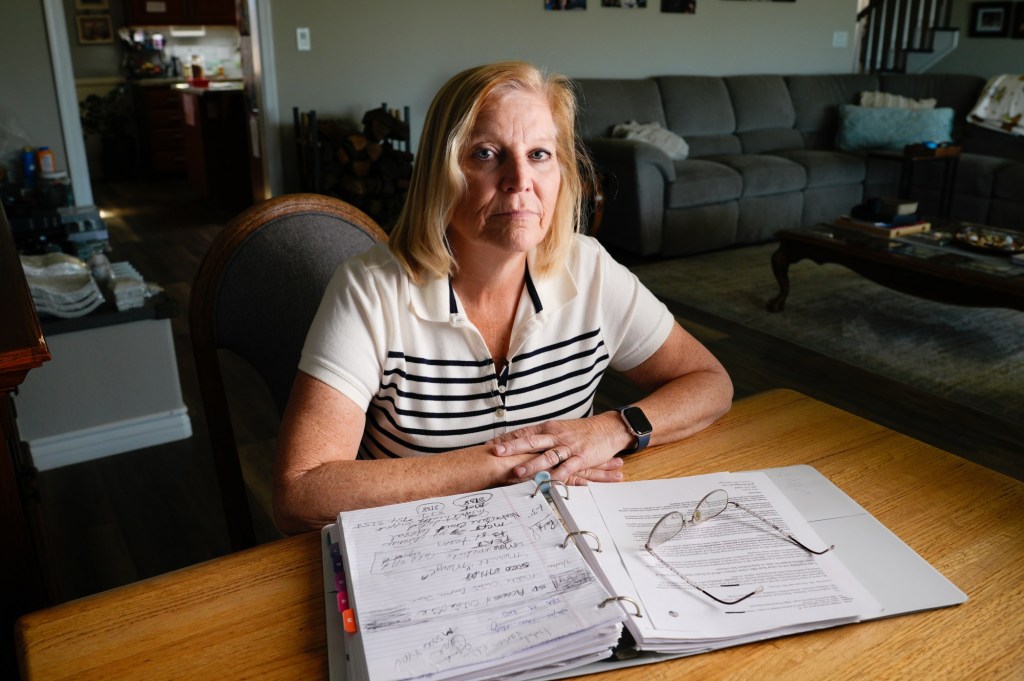
A little-known state law is getting new attention as families and advocates for people with serious mental illness look for more ways to reach those who refuse help.
For June Dudas, the issue took on new urgency last week.
Concerned that her cousin, Ed, was about to be discharged from jail, she emailed San Diego County officials, asking them to pursue a court-ordered mental health evaluation that she hoped would get Ed the services he needs.
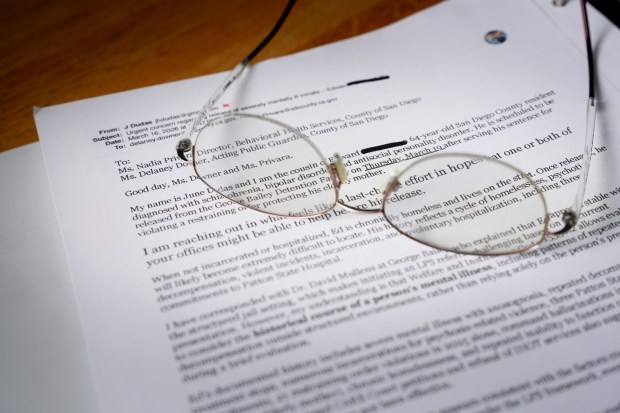 June Dudas maintains printouts of emails she has sent to numerous offices and agencies regarding her cousin, Ed, and the physical threat he poses to his mother, June’s aunt. (Nelvin C. Cepeda / The San Diego Union-Tribune)
Otherwise, she feared, he would return to his mother’s house in San Diego. In November, Ed, who was diagnosed with schizophrenia in his 20s and has spent much of the last 30 years in jail, prison or the state psychiatric hospital, was sentenced to 140 days in jail after a jury convicted him on multiple counts of violating a restraining order that forbids him from visiting her home.
Ring video cameras had captured Ed returning 21 times to his mother’s house over several months, and she lived in fear that he might break in.
He had threatened her life in the past, at one point telling her, “the voices were telling me to kill you.” The judge who sentenced Ed to jail agreed that he “does present a danger” to his mother’s safety.
The San Diego Union-Tribune detailed his family’s struggles in December 2025.
Section 5200 of California’s Welfare and Institutions Code allows “any individual” to request a comprehensive mental health evaluation of a person who is believed to be a danger to themselves or others, or is gravely disabled.
Counties are gatekeepers of the process, but Section 5200 is rarely, if ever, used — despite California’s ongoing struggle to help people who refuse to engage in treatment and end up homeless, in jail or worse.
A recent report by Quarter Turn Strategies, a Sacramento-based mental health care consulting firm with ties to San Diego, described 5200 as “(t)he lost legal pathway to mental health care.”
Despite being law since 1967, 5200 is “largely unavailable in practice,” the report says, and most counties lack “written policies, procedures, or publicly accessible processes” for handling petitions.
This gap has real consequences, the authors argue. The mental health system is largely crisis-driven, with interventions happening in response to an emergency need.
People with complex needs may stabilize briefly, only to return to crisis. Others, said Dr. Aaron Meyer, a San Diego psychiatrist and one of the report’s authors, know how to “present well” during quick assessments, known as 5150 evaluations — they know the right things to say in the moment, even if they’ve cycled through hospitals, jails and homelessness for years.
“He would say, ‘I know where to get food, I know where to get shelter. I would never hurt anyone,’” Meyer said. “They can give a superficial plan for self care, but nobody digs any deeper and looks at are they actually following through with any of those statements.”
Holds under 5150 can occur when a law enforcement officer or other first responder suspects someone is a danger to themselves or others, or is gravely disabled. They generally last for 72 hours and are intended to stabilize the individual before releasing them back into society.
The authors found plenty of evidence that counties, including San Diego, previously allowed requests for 5200 petitions. But in a written response to a public records request from the report’s authors, county officials said 5200 was an antiquated approach.
Petitions “may have been a useful tool in a time of fewer community resources, or when people didn’t come in contact with mental health clinicians, medical facilities, or law enforcement. But the community mental health system has evolved significantly since 1967.”
“There are now many community interventions and entry points into the local mental health system — particularly in large urban areas like San Diego,” the response says. “As a result, these types of petitions are redundant and would lead to slower linkage to services. We are not aware of any jurisdictions where they are still regularly used in practice.”
Meyer said the petitions are not redundant. A 5150 assessment is typically brief, often conducted in an emergency or crisis setting and focused on whether someone meets the criteria for an involuntary hold at that moment. The assessment does not need to be conducted by a mental health professional and often doesn’t lead to a full evaluation.
But 5200 requires a comprehensive evaluation by a “properly qualified professional” that looks at a person’s history and overall situation, not just how they’re doing right then.
“This is why 5200 exists, in my opinion,” he said. “It’s to avoid these cursory evaluations that just cycle the individual through the system.”
Advocates also say it’s one of the only ways for families or first responders to directly ask the county to intervene.
A county spokesperson did not respond to questions about why the county stopped accepting 5200 requests. A similar request sent to the County Behavioral Health Directors Association of California also received no response.
Dudas agrees there are more mental health resources available now than in the past, but the current system has not worked for people like Ed.
“I don’t dispute that there is a community that is able to take advantage of all the myriad programs they offer,” she said. “Unfortunately, for people like my cousin who are severely mentally ill, most of them suffering from anosognosia, which means they don’t understand they are ill, they are never going to seek out those services, and they are going to be resistant to anyone who tries to offer them help for a condition they don’t believe they have.”
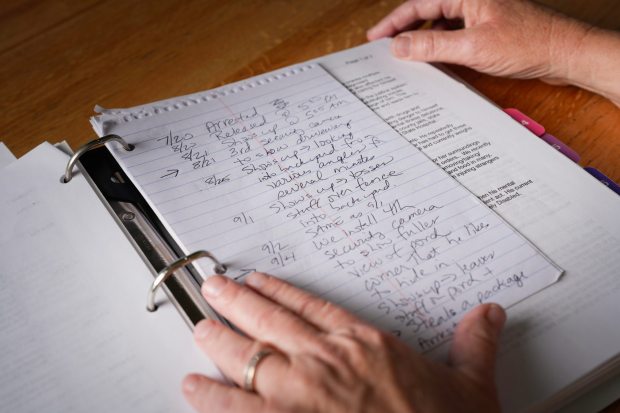 Frustrated that the system doesn’t work, June Dudas maintains a detailed binder full of handwritten notes, letters, and printouts of emails she has sent to numerous offices and agencies regarding her cousin, Ed, and the physical threat he poses to his mother, June’s aunt. (Nelvin C. Cepeda / The San Diego Union-Tribune)
Dudas has done everything she can to help her aunt, Jo, since Ed was released from prison last March after serving a six-year sentence for assault.
Calls to 911 resulted in three arrests, but no 5150 hold, Dudas said.
She petitioned for Ed to participate in CARE Court twice last year, with his public defender offering it a third time during his October trial. A state program created to link people with serious mental illness to treatment, CARE Court offers wraparound services, including housing, to those who agree to participate. But Ed refused, Dudas said.
She doesn’t know what kind of treatment Ed received in jail, but she spoke to a psychiatrist at the jail who said Ed seemed to be doing well in the structured setting.
Jail records show Ed had been housed in the general population at George Bailey Detention Facility, a dorm-style unit, suggesting he was stable enough to follow rules and get along with others.
But at least a week before his scheduled March 16 release, he was moved to administrative separation — a housing status for people who violate rules and pose a risk to others — and his release date was moved to March 19.
In her email to county behavioral health director Nadia Privera and Delaney Downer, the county’s acting public guardian, Dudas noted that Ed had refused voluntary treatment, including attempts to enroll him in CARE Court, and he refused to engage with the county’s In Home Outreach Team, a program created to reach people with serious mental illness who decline treatment.
She noted he’d spent three decades cycling in and out of jail, prison and a state psychiatric hospital.
“Before his release, I respectfully ask whether his documented history could be considered in determining whether an LPS evaluation — including a possible 5200 hold — might be appropriate,” Dudas wrote. “Once he returns to homelessness, the opportunity for intervention may be lost.”
Dudas said Friday that Privera acknowledged receiving her email but had not formally responded.
But Ed did not return to the streets Thursday.
“My pestering paid off,” she said in a message to a reporter.
Ed’s parole officer picked him up from jail and took him to the county’s psychiatric hospital on a 5150 hold, which means he will be assessed and held for at least 72 hours.
“I called and conveyed to staff the situation,” Dudas said, “so they should at least give it a second thought before releasing him too quickly.”
Despite all the times Ed returned to his mother’s house last year — so terrifying the 84-year-old that she would hide in her bathroom until law enforcement arrived — Dudas doesn’t think he was ever assessed for a 5150 hold.
Dudas is grateful the parole officer intervened. But Ed was on parole only because he had been in prison for threatening someone with a knife amid a mental health crisis — in other words, help came only because things had already gone dangerously wrong.
Dudas said she will continue requesting that Ed receive a 5200 evaluation. She believes he needs to be placed under a conservatorship — a court-ordered arrangement in which a judge appoints someone to make decisions for a person who is unable to care for themselves.
A conservatorship could provide Ed with a case manager who would make sure he was taking his medication, in a safe housing situation and receiving other services to keep him stable.
“If Ed gets out, I will be at the next county Board of Supervisors meeting with the state code in my hand, holding it up in the room, and I will say, ‘This says right here that anyone can ask for a 5200 evaluation … explain to me why it’s not being done,’” Dudas said.