
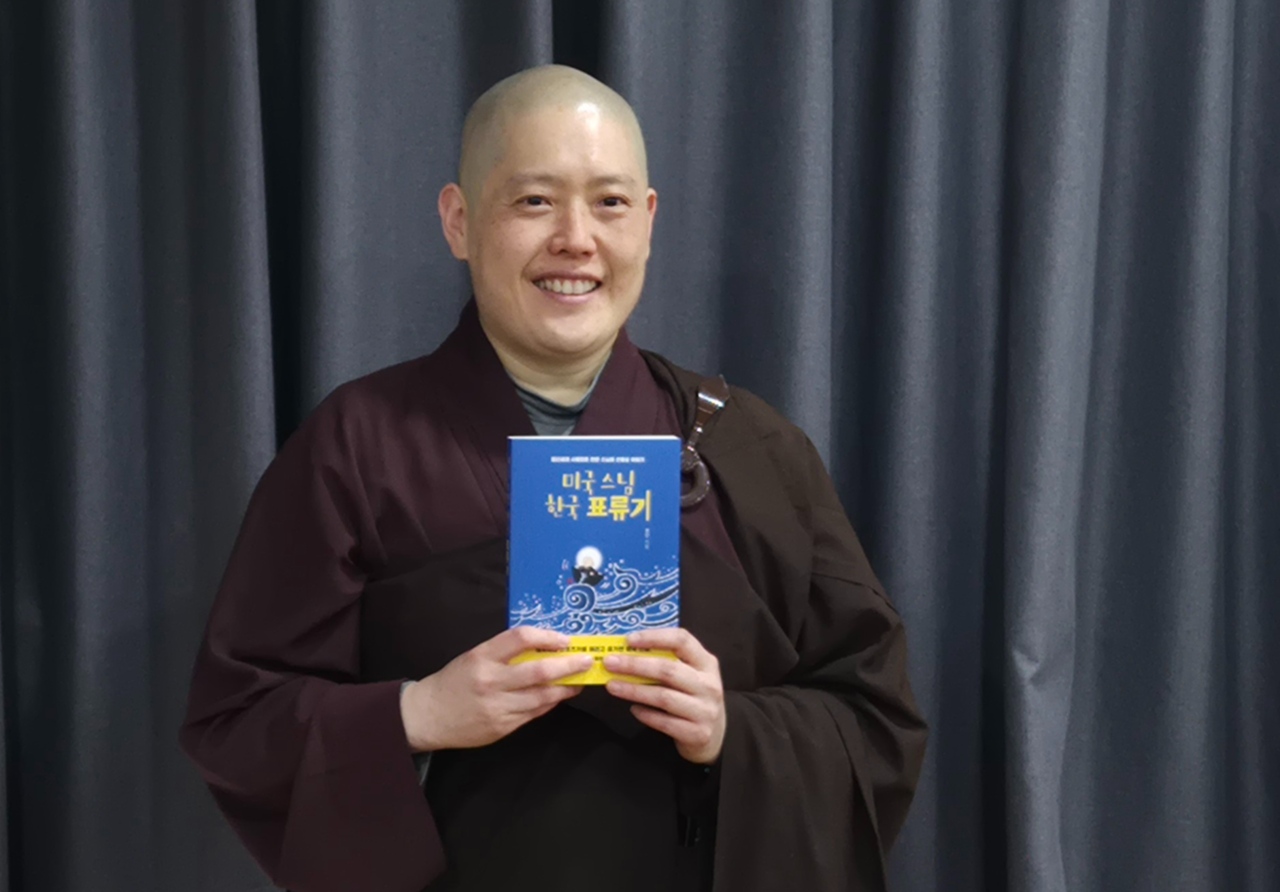
 The Ven. XianAn holds her latest book, “An American Buddhist Nun’s Journey in Korea” (unofficial translation), on March 13 in central Seoul. (JF Seon Center)
She once managed a thriving medical skin care business in California, drove a sports car and owned a home.
Today, The Ven. XianAn, also known as Hyunan in Korea, runs a modest 20-pyeong (66-square-meter) meditation hall in Korea, translating Buddhist texts and guiding a growing community of young practitioners.
“I’d experienced plenty of worldly pleasures,” XianAn said at a recent press briefing in Seoul to mark the release of her second book, “An American Buddhist Nun’s Journey in Korea (translated).”
“But when a good teacher is in front of you, learning from them matters more.”
Born and raised in Korea, XianAn left for the United States in the early 2000s — not out of spiritual calling, but out of exhaustion. After years at a Korean pharmaceutical company, she quit and boarded a plane to California with no connections and no job lined up.
There, unable to find work, she founded a company that sold dermatological treatments to clinics and physicians across the US.
The turning point came in 2011 or 2012, when XianAn, a businesswoman at the time, stumbled across a free meditation session listed on Meetup. The teacher was the Ven. Yongwha, a Vietnamese American monk trained in the Chinese Guiyang Chan tradition. At the time, his tiny, cash-strapped operation had barely any students.
Her reasons for walking into that first meditation session were, by her own admission, entirely practical.
“I thought my knowledge and experience were good enough to make money — my IQ is pretty high. But my temper kept costing me points with people.”
She went looking for a fix and became a regular.
“(The Ven. Yongwha) didn’t say unnecessary things. He just taught what needed to be taught, and he was fun,” she recalled.
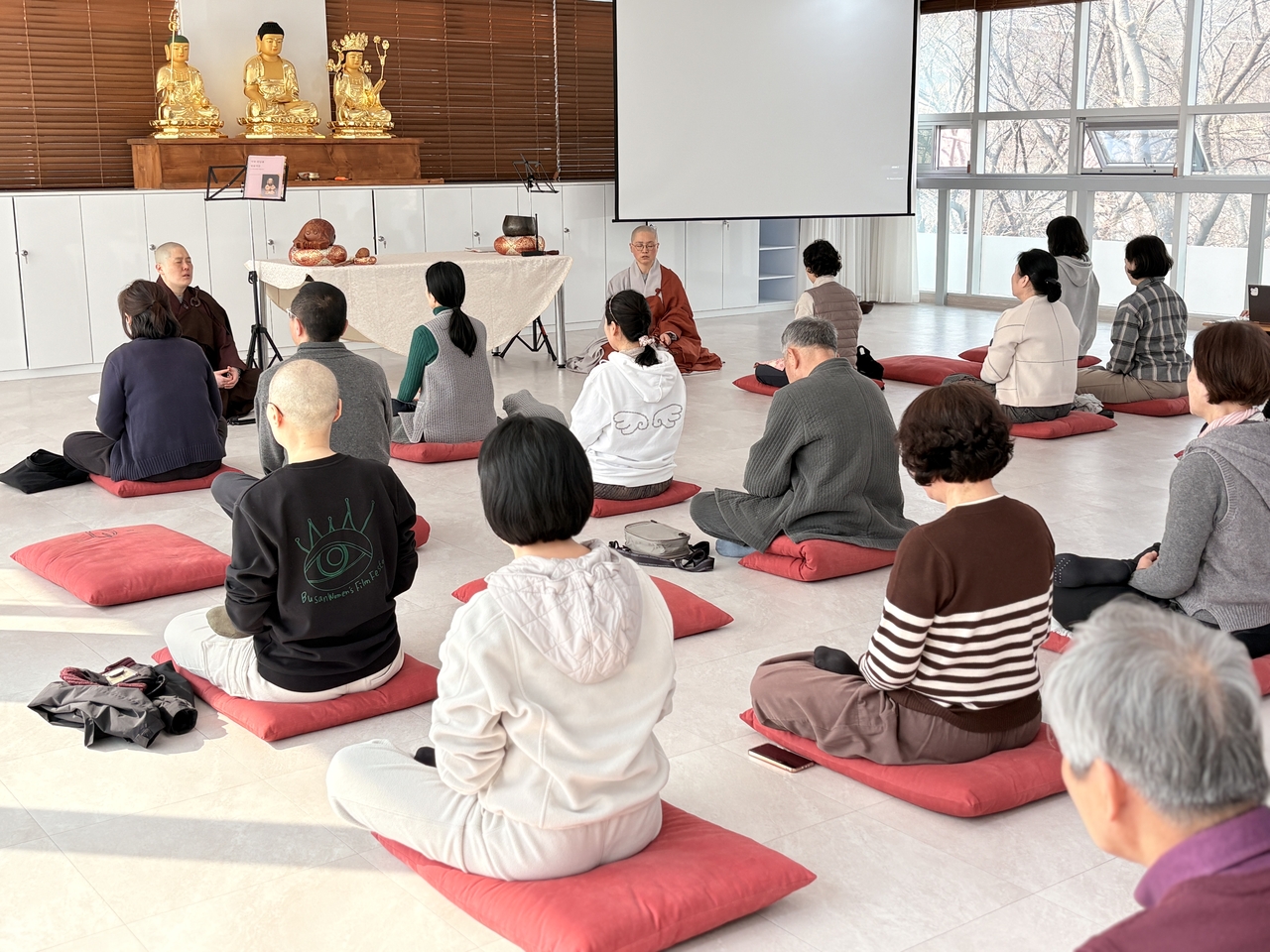 The Ven. XianAn, also known as Hyun-an in Korea, leads a meditation session on March 19 at Hongbeopsa, a temple in Busan. (JF Seon Center)
Every subsequent summer and winter, she would disappear to a monastery for at least a month at a time.
“When I was inside, I’d forget everything. Exploring that inner world was just so enjoyable,” she said.
The pull between the boardroom and the meditation cushion became a yearslong back-and-forth she couldn’t resolve.
Meanwhile, her business grew tenfold within three years. A chance feature in an online publication sent one product viral before “going viral” was a common phrase. She was, by any measure, succeeding.
The pattern, oddly, was spotted by her Catholic employee: Every time she came back from the temple, orders came in.
“Boss,” her employee said, “you should go more often.”
Then, in 2015, she brought the Ven. Yongwha to Korea for the first time. The trip left a quiet mark on him. Back in California, over lunch, he mentioned that Korea seemed full of people with real potential for practice. XianAn agreed and casually suggested a Korean teacher would probably be needed. His response floored her.
“He looked at me and said, ‘You could do it.'”
She put down her chopsticks. She didn’t sleep for three days.
“I thought: I’ve already enjoyed the good life. But having a great teacher right in front of you — that’s rarer.”
Within months, she had been ordained, packed up her business and moved back to Korea. She describes those early years as humbling. She arrived with little training, no institutional backing, and, as she puts it, “nobody thought I looked like a monk.”
Nearly a decade on, the Ven. has carved out an unexpected niche. The Guiyang order she represents under the Ven. Yongwha now counts around 30 monastics worldwide, with roughly two-thirds of them Korean. In Korea, XianAn operates out of three locations — including sites in Cheongju, North Chungcheong Province, and Bundang, Gyeonggi Province — and has published serially in outlets ranging from Buddhist media to a major daily newspaper. Young Koreans, she says, keep finding their way to her door, though she admits the reason remains something of a mystery to her.
Her approach to teaching is deliberately pragmatic. Before anything else, she asks why someone came and what they want. The answer, she says, almost never begins with enlightenment.
“If someone comes and their relationship with their family gets worse, or their work gets harder — that practice isn’t useful.” In her view, Buddhism earns trust the same way anything else does: by working.
She is candid about her own entry point: “I went to the temple, and my sales went up fifteenfold. I thought: Okay, this is credible. I can keep coming back.”
The laugh that follows is genuine.
“We’re all worldly. You can’t deny that.”
What she pushes back on is the idea that spiritual practice and everyday ambition are incompatible. The goal, she says, is to start where people actually are — their insomnia, their difficult colleague, their stalled career — and work from there toward something quieter.
Six years into her ordination, XianAn admits — with some self-deprecation — that she still carries parts of her old self.
“I’ve improved, but old habits don’t just vanish,” sh said, crediting Korean teachers for guiding her without judgment. “They didn’t say ‘you’re wrong.’ They just showed me how it’s done.”
Her teacher now visits Korea twice a year -— and this next visit is in April — growing more attuned to its rhythms and the pressures facing young people.
“I want to become that, eventually,” she said. “Someone who can really read a person.”
For now, she translates, teaches and shares tea with those who come and go — pushing those who stay. The sports car is someone else’s concern. Now, a 20-pyeong hall, it turns out, is enough.
gypark@heraldcorp.com