
A San Rafael home in 2017. About 1 in 4 Marin County homes that changed hands in 2025 went to an heir, one of the highest rates in California, according to property data firm Cotality.
Michael Macor/The Chronicle
For some who can’t afford a home in California, all they have to do is wait.
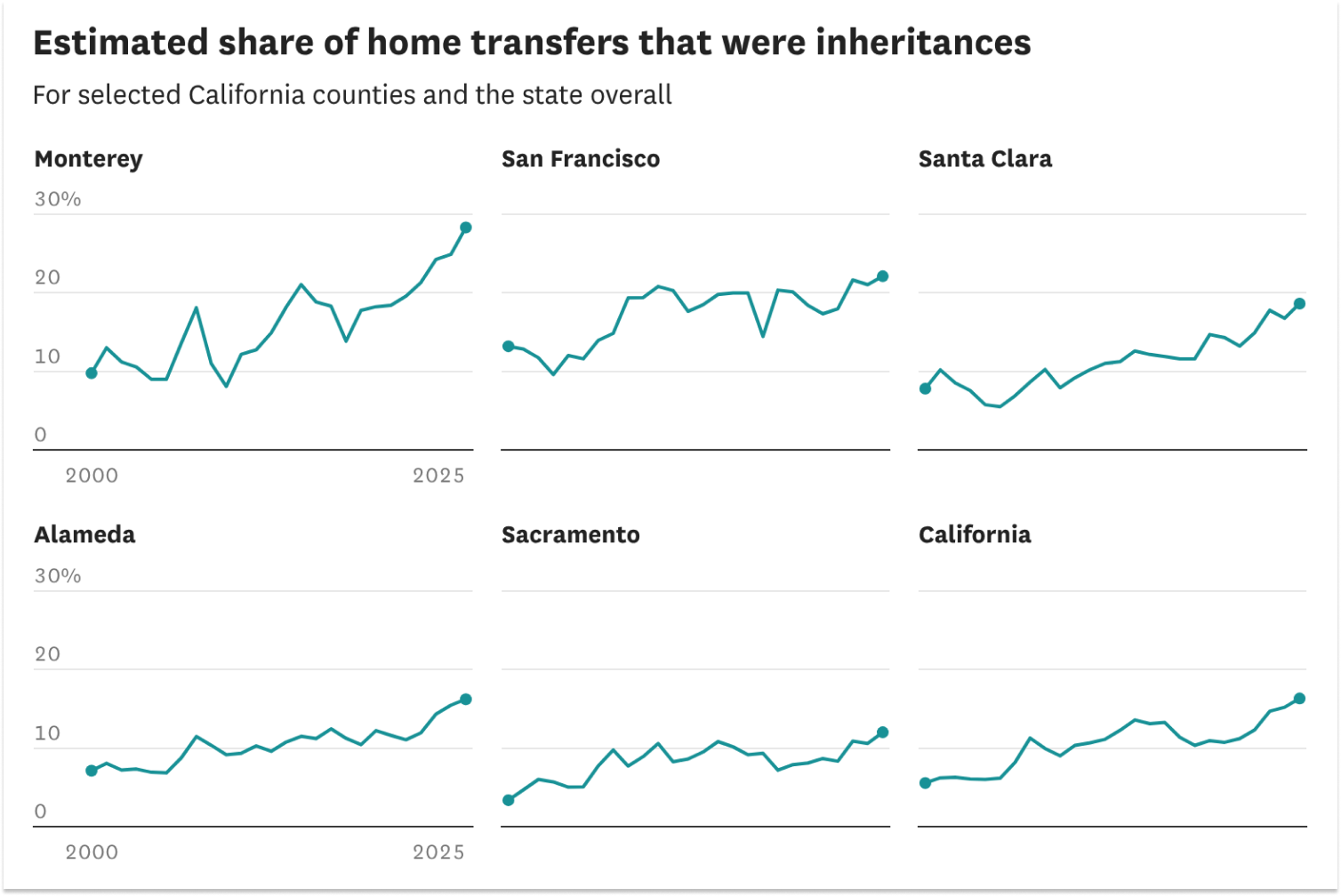
In Monterey, Santa Cruz, Napa and Marin counties, more than 1 in 4 homes that changed hands in 2025 were inherited, not purchased. That was far higher than the statewide rate of 16%, which itself was double the national figure.
Homes in other wealthy coastal counties are similarly likely to transfer via inheritance. About 22% of San Francisco homes that changed ownership in 2025 were passed on to an heir, according to an analysis of property records data by Cotality, which was first reported by the Wall Street Journal.
Article continues below this ad
Inherited properties were less common in California’s more affordable counties. But even in Yuba County, where such transfers made up the smallest share of any California county, the inheritance rate only got as low as 8%, which is the rate across the U.S.
California’s notoriously high prices and tight supply, as well as laws that incentivize homeowners to stay put rather than sell, mean a big chunk of homes stay within families, experts say. And the data points to the stark wealth inequality between families that own homes and those that don’t.
San Francisco Chronicle Logo
Make us a Preferred Source to get more of our news when you search.
Add Preferred Source
“When most people struggle to afford homeownership, but some people get to inherit homes without really trying, we don’t have a housing market — we have a caste system defined by family wealth,” Daryl Fairweather, chief economist at real estate brokerage Redfin, said in a recent YouTube video.
Article continues below this ad
Cotality’s data, based on county deed records, covers single-family houses and condominium units, though its analysis excludes properties whose use couldn’t be determined.
It’s become more common for Californians to get a home from a benefactor, Cotality’s data shows. In 2000, just 6% of transferred homes went to heirs, about a third of the 2025 rate.
But Matt Delventhal, an economist at Cotality, believes the upward trend is driven less by the number of actual inheritances than it is by the overall housing market. For example, the share of inheritances likely rose following the 2008 recession and the 2022 interest rate spike because sales of existing and new homes — the main way property is transferred — dropped.
The inverse also seems to apply: Building more homes brings down the inheritance rate. That helps explain why counties that have seen more housing growth in recent years see relatively fewer inheritance transfers.
Article continues below this ad
Those higher-growth counties also tend to have lower home prices where young families have a better chance at becoming homeowners the usual way, said Issi Romem, an economist at research organization MetroSight.
But in counties like Monterey or Santa Cruz, it can take decades for a middle-class household to save up enough money for a down payment. That means when someone does get a home, there’s a higher chance it’s because they were “grandfathered in,” Romem said.
“People know that unless they give their home to their kids, their kids have no shot at staying in California as homeowners,” he added.
Tax rules also incentivize keeping homes in the family. When a homeowner sells their property, they have to pay capital gains tax on the amount the home grew in value since they bought it. While married couples can exclude up to $500,000 from the taxable amount, that doesn’t go very far in counties where homes fetch seven figures.
Article continues below this ad
But if they pass on the home after they die, that tax bill goes away, effectively giving homeowners a reason to remain in place when their home no longer meets their needs.
Housing experts have lobbed similar criticisms against California Proposition 13. Approved by voters in the 1970s, the law caps how much property taxes can grow under the same owner. Then, another 1986 proposition allowed owners to pass those artificially low tax bases to their heirs. Together, those laws meant that staying in the same house for decades and then passing it could result in big, multigenerational tax breaks.
That changed partly in 2021, when Prop 19 required heirs to make an inherited home their primary residence and limited how much of a tax break they could get.
Still, Prop 19 doesn’t appear to have opened up as much housing supply as proponents said it would, said Delventhal, the Cotality economist. That’s probably because most heirs do in fact live in their inherited home, rather than renting it out or using it as a vacation home, he added.
Article continues below this ad
The state could change tax law to further incentivize inheritors to sell their homes to increase the supply of housing — but Fairweather, the Redfin economist, noted that California would still need to address the “root problem” of supply.
“Building more dense housing in the places people most want to live would alleviate housing scarcity,” she said in an email, which would “allow more young people to achieve homeownership without an inheritance.”