
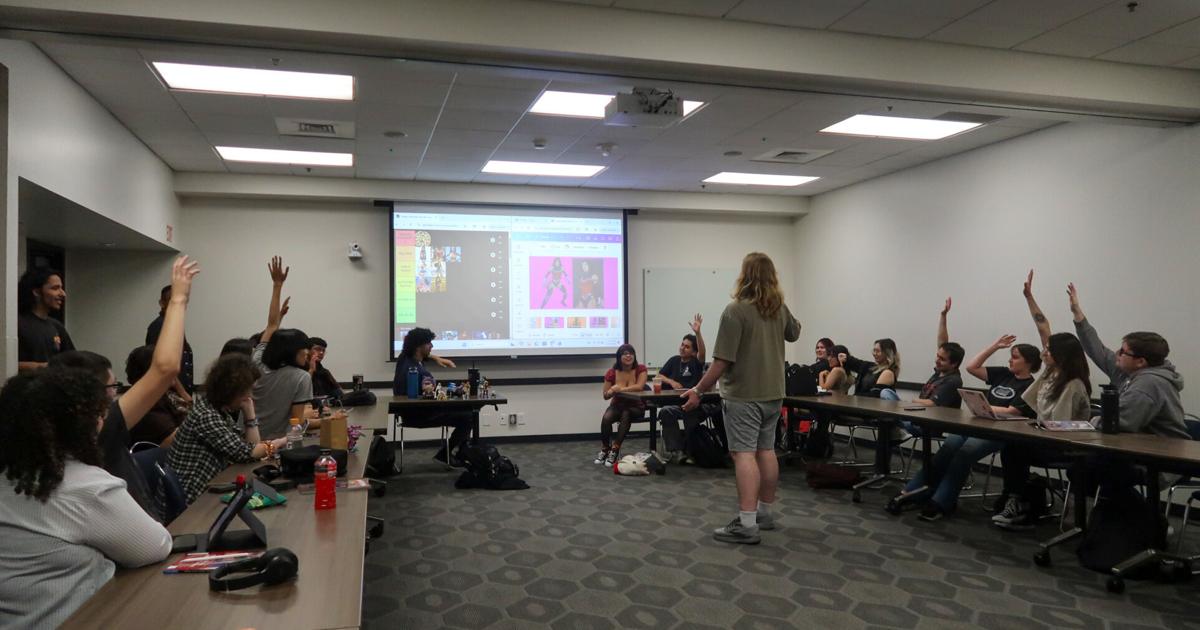
The communal clicking of Nintendo Switch controllers tick as the routine countdown to 2:30 p.m. each Thursday.
As the clock strikes two past noon, in unison, the group begins its migration from the basement of the Titan Student Union to the conference rooms above, swapping consoles for comics, commencing the headline event: Comics at Cal State Fullerton’s weekly meeting.
What began in off-campus coffee shops and self-promotion on CSUF social media, blossomed into a vibrant campus community. Started by a transfer student who perceived an “antisocial” campus climate, the club now houses 400 Discord members and a regularly full TSU meeting room.
Evan Gordon, a fifth-year communications major and the club’s president, unofficially founded the club in fall 2023 as a personal pursuit of friendship, running it as an off-the-books CSUF book club solely for comics.
Eventually, he was persuaded by member Miguel Fuentes, who graduated in 2025, to register Comics at CSUF as an official university club.
At the heart of Comics at CSUF, Gordon emphasizes inviting radical acceptance of one another to combat the poor reputation for inclusivity often surrounding “nerd media,” like the pretentious concept of “insider/outsider” often associated with pop culture fandoms.
“I really try to make a point of, ‘You don’t need to have ever read a comic before,’” Gordon said. “‘Prove you’re a fan?’ That’s so toxic. I would much rather have someone just show up and introduce them to something I like.”
Paired with the intentionally “low bar for entry” set by Gordon, he announces one mandatory obligation as a member on the first day of every semester: “You can believe what you want, but in here, you will not disrespect the personhood of those around you.”
Gordon attributes this explicit commitment to respect as the primary deterrent to the toxicity that can usually manifest within the mainstream comic community.
Bianca Sosa, president-in-training and a third-year political science major, reflected on how this toxicity can often have gendered consequences in male-dominated hobbies, such as comics.
“I stopped reading comics for a long time because I wasn’t comfortable allowing myself to feel that way about having male hobbies,” Sosa said. “All of a sudden, I was introduced to this club, and I felt more happy, I felt more able to be myself. And I think I feel like a lot of people also have that feeling.”
Reflecting its commitment to inclusivity, Comics at CSUF themed last Thursday’s club meeting as “Wonder Women Week.” They dedicated the second half of the meeting to a presentation highlighting women in the comics industry in celebration of Women’s History Month.
Izabelle McTigue, a second-year studio art major and vice president-in-training, created her presentation with data illustrating how severe the gender discrepancy exists in the industry; making it about authors, artists or the female characters themselves.
McTigue assures the themed weeks are intentionally interwoven within the fabric of the club’s mission statement, rather than a singled-out, surface-level festivity.
“Sometimes it can be a little difficult to want to do a specific, labeled week, because it feels like we can’t have them in other places,” McTigue said. “We should make an effort to include women authors and creators in every single week.”
The recognition of marginalized communities and underrepresented topics, like mental health, are a core priority of Comics at CSUF. This is also showcased when the organization often engages in and encourages lively discussion and healthy debate.
“I think it’s (Comics at CSUF) meant to show that fandom is meant to accept a wide variety of people who can interpret characters and in a way that means something to them,” said Nathan Dam, club member and fourth-year cinema and television arts major.
It is important to note that comics hold a history of being politically charged and arguably progressive. The club honors this quality of the industry itself.
In times of political turmoil, literacy crisis and a loneliness epidemic, Comics at CSUF offers a place to learn, think critically, share art and most importantly, belong.
“Comics have always been woke, even going as back as the 1940s and ’30s,” Gordon said. “They have always been used to tackle social issues of the time. And while there are definitely plenty of them that have been on the wrong side of history, there are significantly more that are always pushing the envelope and trying to challenge the way that we view things.”