
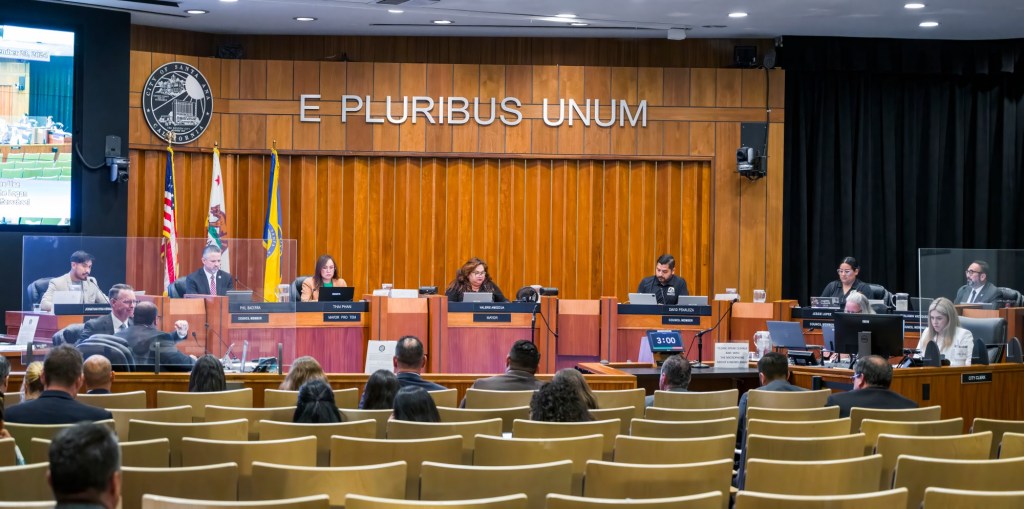
Santa Ana staffers will put together wording for a ballot measure that would keep the local sales tax collected in the city, as well as information to be shared with the community, for the City Council to consider in June.
After taking a look last week at the results of a December poll judging support for the potential ballot measure, council members agreed to have staff prepare its wording and public information materials. The measure would be aimed at the November ballot and ask voters to approve eliminating the reduction scheduled in 2029 and complete sunsetting in 2039 that are currently written into the law that created the 1.5 percentage points in sales tax that is collected solely for city coffers. Instead, voters would be asked to maintain the tax without a set sunset date.
Measure X was approved by voters in 2018 and went into effect in April 2019, adding the city’s 1.5 percentage point tax on top of the 7.25% tax collected statewide and the half-cent sales tax collected in Orange County to fund transportation needs. Since the adoption of Measure X, 9.25% as been collected in sales tax on purchases in Santa Ana.
The first phase-down of the tax in 2029 would eliminate up to $30 million that has been coming into city coffers annually and that officials are arguing that it would be hard to live without now. The new ballot measure that is being proposed would not change how much is collected, just eliminate the sunset dates that were included in Measure X. The council will still have to approve the final language and whether to go ahead with placing the ballot measure.
The survey conducted for the city by research company True North used email, text and the telephone to reach people in English, Spanish and Vietnamese. It was conducted Dec. 10-16 and got responses from 623 voters, according to a report on the results given to the council.
The survey results indicate voters “value the services they receive from the city, but also see opportunities to improve the quality of life in Santa Ana by addressing homelessness, improving public safety and improving the maintenance of city streets and infrastructure. Together, these sentiments translate into strong natural support (64%) for renewing the Measure X sales tax at the current 1.5-cent rate” to keep addressing those areas of service.
The True North folks also told the council that “the survey results indicate that voters are primarily interested in using the proceeds to fund public works and public safety” and that “one of the keys to building and sustaining support for the measure will be the presence of an effective, well-organized public outreach effort, as well as an independent campaign that focuses on the need for the measure as well as the many benefits that it will bring.”
Once a council puts such a measure on the ballot, it is prohibited from using public resources to campaign for its passage, and City Attorney Sonia R. Carvalho emphasized the city wouldn’t want to come even close to that line. But before that time, council members were eager to inform residents of all the things that are funded with Measure X sales tax revenue.
“I would like for the community to see what our budget looks like,” said Councilmember Jessie Lopez, who suggested a special meeting to present to the community a model budget without the revenue from Measure X. “If the city is prepared to lose $30 million, what is not going to be included in the budget? What is it that you are willing to walk away from in terms of improving your quality of life?”
While the council didn’t go with a scheduled meeting specifically on Measure X, it did expect information on its benefits and what it pays for to be part of upcoming discussions for the next fiscal year budget.
“We are going to be barebones here,” Mayor Valerie Amezcua said about having $30 million and ultimately $95 million removed from the city’s budget.
She added that she is glad the city is being proactive in addressing the upcoming changes to Measure X and not waiting until 2029.
Assistant City Manager Kathryn “Kat” Downs said the extended time frame would allow the city, if the measure isn’t approved, to “begin to whittle down those programs, almost like a ramp, over the next three years, rather than waiting for the last minute and doing a very abrupt stoppage of services.”
“Undoubtedly, some of these services are tied to staffing,” she said, adding that some of those losses could be absorbed by natural attrition with the additional time. “We could come up with a lot of different ideas to make it more palatable for our employee groups. But the loss of services, I don’t think that can be made palatable for our community.”
A ballot measure to make the Measure X sales tax permanent would require a simple majority of voters.