
California’s state government is running deeply in the red. CalMatters‘ Dan Walters reports:
California legislators are facing a fifth straight budget where spending would outstrip its revenues, amid warnings of multibillion-dollar deficits stretching well into the future unless they either reduce outlays or increase income.
Legislative analyst Gabe Petek, in his overview of Gov. Gavin Newsom’s proposed $349 billion 2026-27 budget, says the deficits totaled $125 billion over the last four years and “have persisted even as the state’s economy and revenues have grown, underscoring that the problem is structural rather than cyclical. Taken together, these trends raise serious concerns about the state’s fiscal sustainability.”
The proposed budget projects $227 billion in general fund revenues and $248 billion in general fund spending. Newsom has promised that when the budget — his last as governor — is revised in May, it will close not only its deficit but address the ongoing deficits. Petek and Newsom’s Department of Finance project them in the range of $20 billion to $35 billion a year.
This situation has not happened by accident. Since 2017, California has sharply increased its spending per resident faster than the rate of inflation. The state’s government spending has also increased faster than the rate of growth of the median household income of California’s residents.
The state’s spending depends on high-income taxes being imposed on California’s top income earners. Walters describes how the state government’s fiscal health has been put at risk by California politicians’ strategy to sustain excessive spending by targeting high-income earners with ever-higher tax burdens.
California’s budgets became dependent on a relatively few high-income taxpayers over the last four decades, as income taxes surpassed sales taxes to become the most important revenue source.
Income taxes exceeded sales taxes for the first time in 1983. The gap has steadily increased since then, as a detailed chart in the budget’s addendum reveals. The progressive structure of the income tax system ensures that high-income taxpayers supply most of its revenue.
This strategy is doomed to fail because high-income taxpayers’ incomes are especially volatile, making the state’s tax collections equally volatile.
Picturing the Problem
The chart below shows the state government’s spending per resident continually ratchets up while its average tax collections per resident swing wildly from year to year. That revenue collapsed in both 2019 and 2022, both of which were bad years for the state’s millionaires and billionaires.
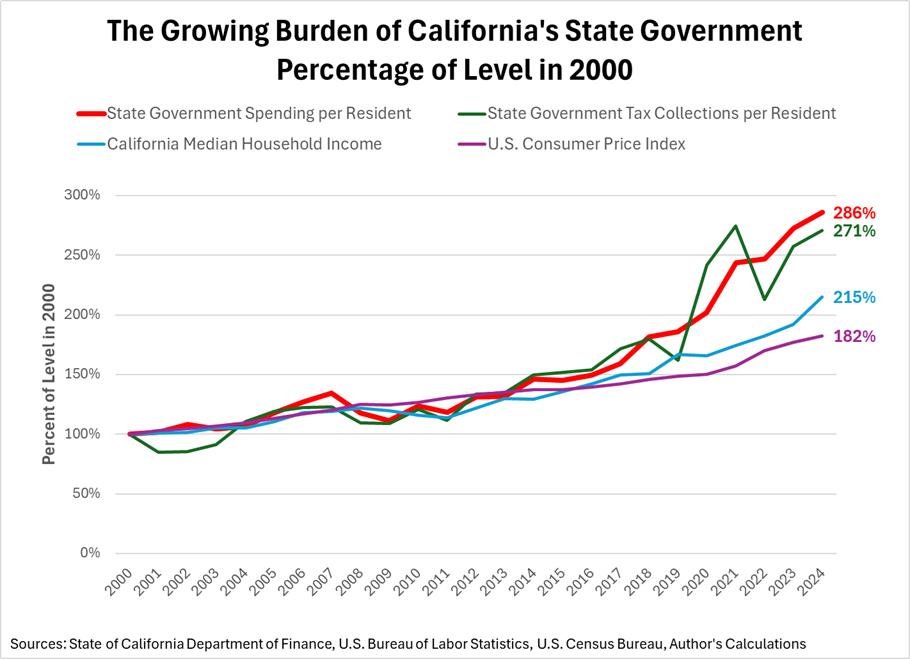
Since 2022, the state’s tax collections have lagged behind California’s spending, or rather, the portion of the state government’s spending that isn’t funded by the U.S. federal government.
Rather than dial back their spending to an affordable level, California’s legislators and governor seek to hike taxes even higher on the state’s highest income earners to fund even more spending. They also want to impose what they claim would be a one-time tax on their wealth, which has already driven out several of the state’s wealthiest residents. Their departure means California’s state government won’t be collecting the income taxes they count on from them going forward.
California’s politicians have only themselves and their greed to blame for this outcome. It’s not like they weren’t told their schemes to fund their excessive spending with taxes targeting the incomes and wealth of the state’s most successful residents is a bad idea.