
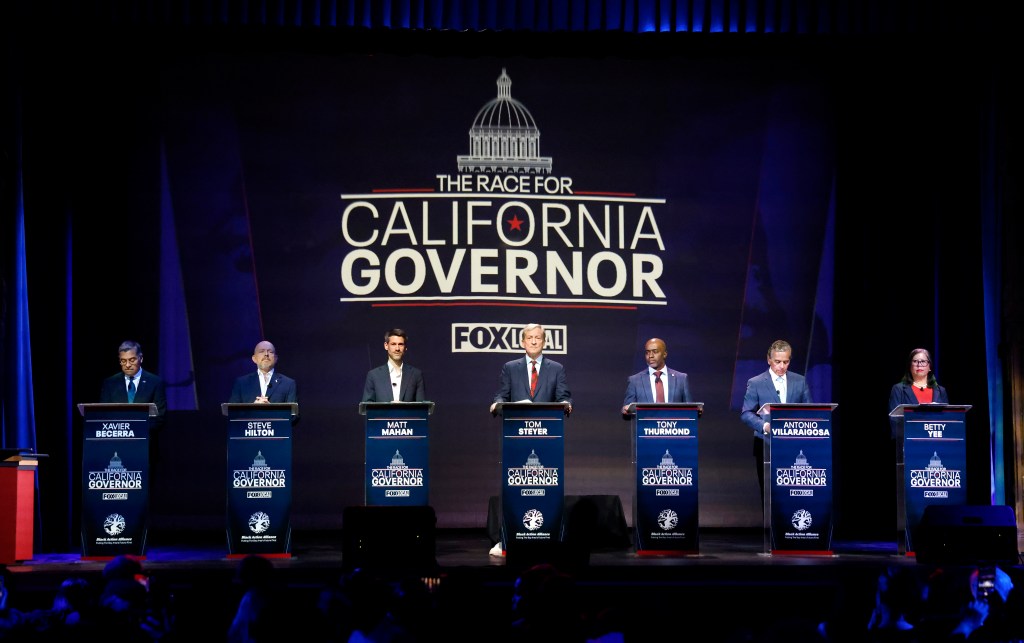
Only six of the ten leading candidates for California governor will take the stage Tuesday night for the next televised debate, prompting backlash from the excluded candidates — all of whom are major former officeholders — who are accusing organizers of using biased criteria that let in San Jose Mayor Matt Mahan despite similar polling numbers.
How did that happen? Here’s what you need to know:
Who’s in the debate?
Chad Bianco, Riverside County Sheriff (R)
Steve Hilton, former Fox News host (R)
Matt Mahan, San Jose mayor (D)
Katie Porter, former U.S. Representative (D)
Tom Steyer, billionaire philanthropist (D)
Eric Swalwell, U.S. Representative (D)
Who’s not in the debate?
Xavier Becerra, former U.S. health secretary, state attorney general (D)
Antonio Villaraigosa, former Los Angeles mayor (D)
Betty Yee, former state controller (D)
Tony Thurmond, state superintendent of public instruction (D)
Why are some candidates not included?
The six candidates participating in the debate were invited based on “independent and objective criteria” developed by University of Southern California Professor Christian Grose and the USC Democracy and Fair Elections Lab. Candidates were assessed using two metrics: polling data from the most recent Public Policy Institute of California poll and fundraising, which was calculated by dividing the total amount raised by the number of days since the candidate entered the race. The formula weighed polling more heavily than fundraising.
USC said the formula produced a viability score where there was a “clear separation” between the top six candidates and the rest of the field.
What does polling and fundraising look like?
Recent independent polling has showed that a large swath of voters are still undecided or “disengaged” in the race to succeed Gov. Gavin Newsom.
The most recent poll from the Institute of Government Studies at UC Berkeley, which was conducted March 9-15, placed Hilton in the lead with 17% support followed by Bianco at 16%. Swalwell and Porter tied at 13%, followed by Steyer at 10%, Becerra at 5%, Villaraigosa and Mahan at 4% and Yee and Thurmond at 1%.
The poll surveyed 5,019 registered voters — 3,889 of whom are considered likely to vote in the June 2 primary.
The PPIC poll that USC used for its criteria was conducted Feb. 3-11and found that the top five candidates — Hilton, Porter, Bianco, Swalwell and Steyer — are in a “statistical dead heat.”
Steyer has overwhelmingly led the fundraising race, dumping nearly $29 million into his campaign in 2025, though that number has exceeded $80 million to date. The second biggest fundraiser of last year was Porter, who raised $6 million, followed by Hilton with $5.7 million, Becerra with $5.2 million, Bianco with $3.72 million, Villaraigosa with $3.1 million and Swalwell with $3.1 million. Yee and Thurmond raised less than $1 million combined in 2025.
Mahan, who jumped into the race earlier this year, quickly amassed more than $7 million in political donations his first week on the campaign trail — largely from the tech sector.
The next round of fundraising reports will be released next month.
What have the excluded candidates been saying?
Becerra, Villaraigosa, Yee and Thurmond held a virtual news conference on Friday afternoon where they accused debate organizers of using a “biased” methodology that led to the inclusion of Mahan, a late entrant into the race whose polling numbers have been in line with Becerra and Villaraigosa’s.
The candidates accused organizers of using a subjective criteria that ultimately excluded all four candidates of color from the debate. They also called on the participants to withdraw from the debate.
“Under what objective standard is including a low performing candidate over higher performing candidates fair?” Becerra said. “None of us are asking that we be automatically included. We are asking for a fair process, not a predetermined process.”
Mahan responded to the criticism in a statement by calling on USC to include the four “highly qualified candidates,” though he did not signal that he would step down from the debate.
“Debates are a great equalizer, and at this stage of the race, entry should not be gated before candidates have a chance to be heard,” he said. “Each of these candidates has served California faithfully, won major elections, and most importantly each has much to contribute to a vigorous debate about the future of California.”
Porter also put out a statement saying that she was “disappointed” in USC’s handling of the process.
“Debates are at the heart of our democracy, giving voters the opportunity to hear candidates discuss and contrast our visions for California,” she said in a social media post.
What’s the debate host’s response?
The USC Dornsife Center for the Political Future put out a news release on Friday in which they “categorically, unequivocally deny any allegations that the debate criteria was in any way biased in favor or against any candidate.” The center said that the methodology was based on “well-established metrics consistent with formulas widely used to set debate participation nationwide” and said that no one at USC or the television networks influenced the process in any way.
“We have had in-depth discussions about expanding the debate’s format,” the center said in the news release. “However, there is a significant gap between the top six candidates and the seventh, eighth and ninth placed candidates. It simply would not be fair or feasible to invite every candidate in such a crowded field.”
Becerra, Villaraigosa, Yee and Thurmond, though, have rejected the argument.
When is the debate?
The debate, which is titled “Your Voice, Your Vote: Race for Governor 2026,” starts at 5 p.m. on Tuesday, March 24.
How do I watch the debate?
The debate will be broadcast on ABC7/KGO-TV San Francisco in the Bay Area or can be streamed on the ABC7 app.
Who’s hosting the debate?
The debate is being hosted by ABC7/KABC-TV Los Angeles and the University of Southern California Dornsife Center for the Political Future. The debate will be moderated by ABC7 Los Angeles Eyewitness News anchor Marc Brown, and ABC7 San Francisco reporter Monica Madden, ABC30 Fresno Action News Live anchor Warren Armstrong and Noticiero N+ Univision 34 Los Angeles anchor Gabriela Teissier will also ask questions.
When is the election?
The primary election is June 2. The top two candidates, regardless of political party, will move on to the general election, which is on Nov. 3. Early voting will begin in May when ballots are sent to voters.
Are there any other debates?
The next televised debate will be hosted by Nexstar Media Group on April 22 at 7 p.m. It will air on KRON4 in San Francisco and will include Swalwell, Hilton, Bianco, Steyer and Porter. Organizers used a 5% polling threshold as part of the criteria.