
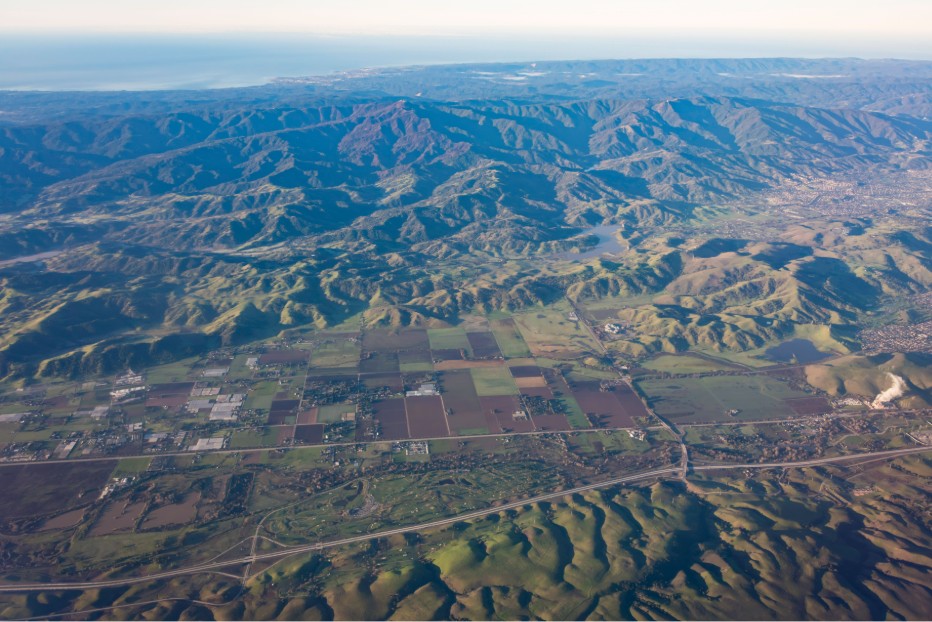
After more than a year of negotiations, Pacific Gas and Electric Co. has agreed to allow construction of new electrical facilities to upgrade the South Bay’s power grid on land adjacent to its existing Metcalf Substation on San Jose’s southern edges, negating a plan to bulldoze an orchard instead in nearby Coyote Valley.
The issue had become a priority for environmentalists and open space advocates, who said the project, proposed by New York company LS Power, threatened the rural character of Coyote Valley. Over the past decade, public agencies and environmental groups have spent more than $120 million to preserve Coyote Valley as a key wildlife corridor, farming region and natural buffer between San Jose and Morgan Hill.
After news stories surfaced in late 2024 about the project, several state senators and members of the Newsom administration joined leaders of the Santa Clara Valley Open Space Authority to raise concerns. They urged PG&E officials to allow LS Power to build its facilities on a 6-acre maintenance yard adjacent to PG&E’s Metcalf Substation, saying the impacts on wildlife and the bucolic Coyote Valley would be much less harmful to the environment if the construction were there instead of on a 14-acre apple and peach orchard 1 mile south that was LS Power’s fallback location.
PG&E agreed after LS Power said it would purchase the maintenance yard from PG&E and buy land somewhere else in the South Bay for an alternative location for the PG&E trucks, power poles and other equipment the utility stores there. On Thursday, the California Public Utilities Commission gave final approval to the project.
“We listened,” said Craig Degenfelder, PG&E’s vice president of major projects. “We evaluated a lot of options, and we found a solution that allows the critical transmission project to move forward while protecting Coyote Valley.”
Environmental groups said they are pleased with the outcome.
“We’re thrilled. It seemed like the obvious solution from the beginning,” said Alice Kaufman, policy and advocacy director for Green Foothills, a Palo Alto nonprofit that has worked since 1962 to preserve the open space in Coyote Valley and other parts of Santa Clara and San Mateo counties.
“There’s a reason why we don’t want to have industrial development in our open space,” she added. “It compromises it. You lose open space that can be used by wildlife, and you bring in noise, lights at night, buildings, and disturbance. All of these things add up and impact the ability of wildlife to survive.”
“I think PG&E realized pretty much everybody was demanding this. They heard from a whole lot of different voices. Give them credit. They put in the effort and did the right thing.”
The project is a major upgrade to the electricity supply in San Jose.
In 2023, state officials gave LS Power approval to build a 13-mile-long high-voltage transmission line from San Jose to Coyote Valley. The project, according to officials at the California Independent System Operator, the agency that runs most of California’s power grid and chose LS Power over four other competitors for the project, is needed to expand the amount of electricity that can flow in and out of Silicon Valley to handle a big jump in demand in the coming years from more electric cars, the expansion of artificial intelligence and population growth.
Construction is expected to start next month and finish in 2028, said Jacob Diermann, the project manager for LS Power.
The project will bring in an additional 1,000 megawatts of power to San Jose from sources around the state, enough to power roughly 750,000 homes.
“The project is all about reliable electric service,” said Casey Carroll, senior vice president of energy infrastructure development for LS Power. “We’re investing $1 billion to make sure that Silicon Valley can keep driving innovation forward.”
The electricity will be brought into the area through the Metcalf Substation, which is located on the west side of Highway 101 at Metcalf Road. Its wires will be buried underground. The controversy was over where to put their endpoint.
For the northern part of the project, LS Power paid $56 million in 2023 to buy 10 acres near downtown San Jose next to an existing PG&E substation at the corner of Coleman Avenue and Santa Teresa Street, just west of Highway 87. The company had planned to build the southern endpoint of the project adjacent the Metcalf substation, but PG&E said no, citing the need for the land for its maintenance yard and for security of the Metcalf Substation.
Using the orchard site instead would have increased costs for the project, LS Power said, because of the need to dig trenches for an extra mile to the south, disrupting sensitive areas around Coyote Creek. The orchard area is also adjacent to land the Open Space Authority, Caltrans and other agencies are studying for a wildlife overcrossing to allow mountain lions, deer, bobcats and other wildlife to migrate from the Diablo Range over Monterey Road to Coyote Valley and the Santa Cruz Mountains.
State Sens. Dave Cortese, John Laird and Josh Becker advocated for a compromise, as did Wade Crowfoot, Newsom’s secretary of natural resources.
“This was a major win,” said Andrea Mackenzie, general manager of the Santa Clara Valley Open Space Authority. “It shows California doesn’t have to choose between protecting iconic landscapes and delivering clean energy infrastructure. We can have both.”