
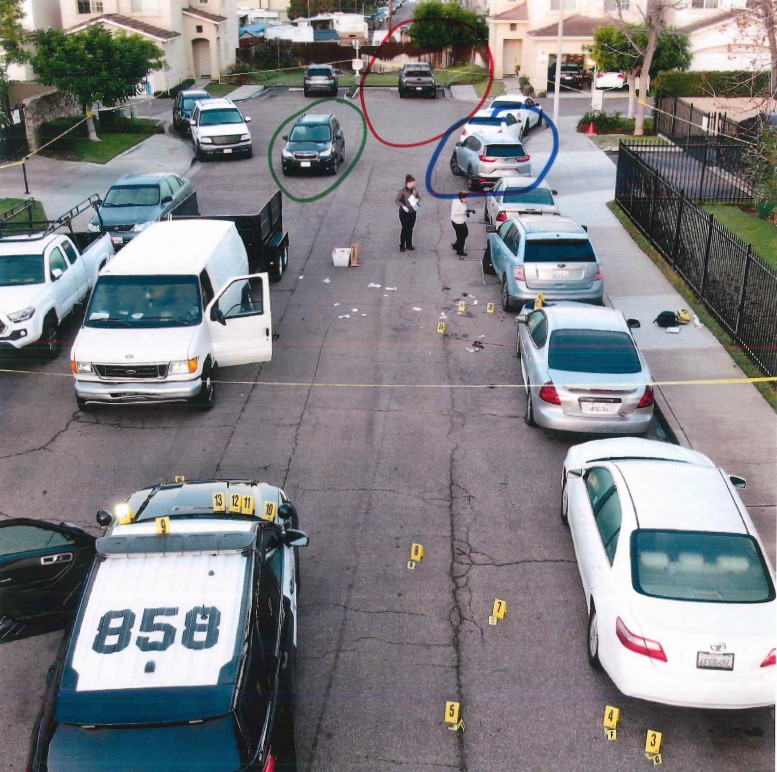
A federal judge has dismissed a lawsuit filed against San Diego County by a National City police detective who was struck by friendly fire from two sheriff’s deputies in 2022, ruling the deputies did not violate the detective’s constitutional rights when they fired at a vehicle-theft suspect while the detective was downrange.
U.S. District Judge Todd Robinson ruled that Rowdy Pauu, the detective who has since been promoted to corporal, can’t go to trial against the county and Deputies David Lovejoy and Jonathon Young because Pauu “failed to produce evidence that (the deputies) had a purpose to harm” either him or the vehicle-theft suspect.
Instead, in dismissing the case by granting a summary judgment motion made by the county and the deputies, Robinson ruled there was “no evidence of improper motive” by Lovejoy and Young when they fired at Erik Talavera, the theft suspect.
The county and the Sheriff’s Office declined to comment on the legal victory Monday.
An attorney for Pauu said his legal team is in the process of considering its next steps.
“We are deeply disappointed in the decision to deny Officer Pauu a trial,” Eugene Iredale said Monday. “This is a case in which we feel the conduct of the (deputies) in unleashing a barrage of bullets in a residential neighborhood — which resulted in the shooting of Mr. Talavera with approximately 16 gunshot wounds, and the striking and shooting of Officer Pauu — was entirely unwarranted.”
Talavera has also sued the county; his lawsuit remains pending.
Both lawsuits stem from a shooting that occurred late at night on Feb. 16, 2022, during an operation in East County involving Pauu and his colleagues on the San Diego County Regional Auto Theft Task Force, known as RATT.
Late that night, Pauu and other RATT detectives in plainclothes and unmarked vehicles began tracking the movements of a GPS device installed in a “bait trailer” they had set up as a trap to catch would-be thieves, according to the lawsuits and previous details provided by authorities. As they tracked its movement, they requested that uniformed sheriff’s deputies pull over the driver of the van towing the stolen trailer.
Deputies eventually stopped the van’s driver in a cul-de-sac at Ballard and Decker streets, just south of Main Street in El Cajon, where Talavera allegedly exited the van armed with a knife and began acting erratically.
Attorneys for Pauu and the county disagreed on whether Lovejoy and Young saw the knife before firing at Talavera. Robinson ruled in favor of the county and the deputies, ruling that “there is not a genuine dispute of material fact as to whether Defendants perceived a knife in Talavera’s hands before the first volley of shots.”
Footage of the shooting from the deputies’ body-worn cameras showed Talavera was about three car lengths away from Lovejoy and Young and moving toward the ground, which he’d been ordered to do, when both deputies opened fire. Robinson acknowledged in his ruling that Talavera began “moving sideways towards the ground” one second before the first volley of shots, but ruled this did not give them enough time to deliberate.
After dropping to the ground wounded, the footage showed Talavera pushing his upper body slightly off the ground and grabbing the knife. Lovejoy then fired two more shots.
The county District Attorney’s Office reviewed the shooting and cleared Lovejoy and Young of criminal liability. Investigators determined Lovejoy fired 12 rounds and Young fired five; Talavera was shot 16 times and survived, while one shot struck Pauu in his lower left leg.
Pauu’s attorneys argued that Lovejoy and Young violated Pauu’s 14th Amendment substantive due process rights under a legal standard known as “purpose to harm,” and that their actions “shocked the conscience,” another legal threshold. They argued that both deputies saw plainclothes officers downrange from Talavera but recklessly fired at him anyway.
Iredale told the judge during a February hearing that the deputies shot at Talavera as he was obeying their commands and moving toward the ground with his back to them, all while they fired 17 shots toward fellow officers and nearby residences in a densely populated cul-de-sac.
“That is shocking to the conscience,” Iredale argued during the hearing.
But Robinson disagreed, ruling Pauu did not present proof the deputies meant to harm Talavera, much less Pauu, their fellow law enforcement officer.
“There is no evidence that Defendants fired on Talavera for any purpose other than self-defense,” Robinson wrote. “Because Defendants did not act with the purpose to harm Talavera the Court grants Defendants’ motion for summary judgment.”
The county had also argued that Lovejoy and Young were entitled to qualified immunity, which protects law enforcement officers and other government officials from civil liability for their official actions unless those actions violate “clearly established” statutory or constitutional rights.
Robinson wrote in his order that there was no need to determine if qualified immunity applied in the case since he found there were no underlying constitutional violations.