
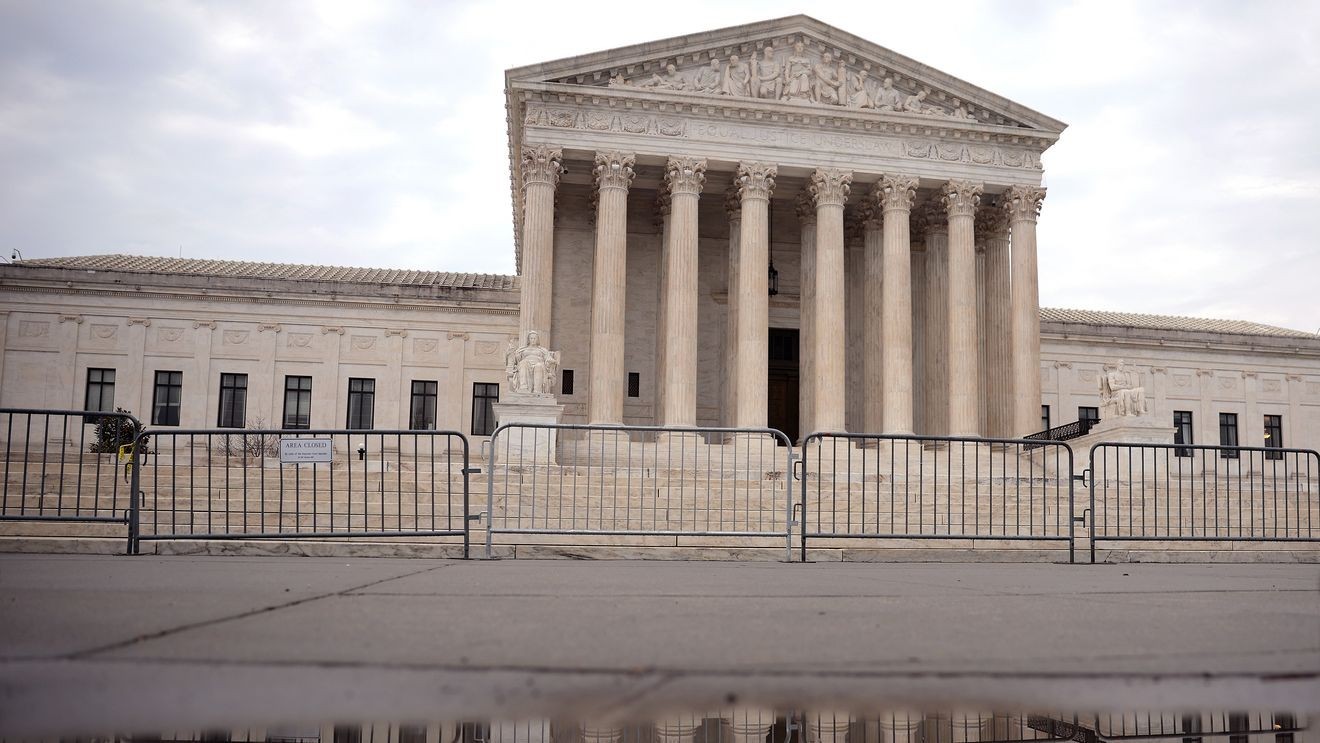
WASHINGTON (TNND) — The Supreme Court on Monday heard oral arguments in a case centered on an issue near and dear to President Donald Trump’s heart: mail-in ballots and when they can and cannot be counted.
Just before heading to Memphis, Trump told reporters, “ Mail-in ballots. They’re so corrupt.” (TNND)
Just before heading to Memphis, Trump told reporters, “ Mail-in ballots. They’re so corrupt.”
For years, he railed against the notion of not finding out the outcome of an election on Election night.
“We should know the result of the election on November 3rd,” Trump said at a rally in Dubuque, Iowa, on November 1, 2020.
Two days later, he said it again.
We should be entitled to know who won on November 3rd.
That year, 2020, as the country was in the midst of the COVID-19 pandemic, the election was not declared until four days after election day.
The central question before justices now: should ballots that arrive after election day be allowed to be counted, even if they’re postmarked by election day?
Mississippi’s Solicitor General, defending his state’s law, said yes.
“States have allowed that for over a century. Congress has respected it. No one challenged it until now. The question is whether Congress in 1845 blocked the practice. The answer is no,” Scott Stewart said during his opening statement.
14 states plus Washington D.C., as well as the territories of Guam, Puerto Rico and the U.S. Virgin Islands *accept* late arriving ballots, according to the National Conference of State Legislatures.
It’s a practice lawyers for the Republican National Committee and the federal government argued should be banned.
“I would say the day of the election is the day, the last day, in which all the ballots are cast and they are received into official custody,” said Paul Clement, Attorney for the Republican National Committee
Of the six conservative justices, all of them seemed skeptical of the grace period currently allowed.
“Some of the briefs have argued that confidence and election outcomes can be seriously undermined if the apparent outcome of the election on the day after the polls close is radically flipped by the acceptance later of a big stash of ballots that flipped the election,” said Justice Samuel Alito.
The three liberal justices raised concerns about ballots received from those serving in the U.S. military, and also cited the long history of counting them after election day and the lack of federal laws prohibiting the practice.
“Congress just said whatever the state has decided about ballot received deadlines is going to apply here, correct? ” asked Justice Ketanji Brown Jackson
“And that’s been the case for 180 years your honor,” Stewart responded.
Justice Sonia Sotomayor said,
“We have the military acts that, since World War II at least and the civil war should go back that far, have permitted absentee ballots to be received long past election day, correct?
” We have a very long history of that,” Stewart responded.
A decision on this case is expected sometime in June or July, with some already raising concerns outcome could be disruptive, less than six months before the midterm elections