
The San Diego Seniors Community Foundation is set to hold its first-ever “State of Seniors” address Tuesday, observing that a rapidly growing population of older Americans will further strain already-stressed health care systems as the local population age 60 and older moves from 730,000 today to 1 million by 2040.
It is not all difficult tidings. The address includes a new $2 million effort aimed at increasing longevity in seniors by better matching outreach to seniors’ needs.
Economic insecurity is cited as the largest threat currently impacting older residents. In its latest “State of Seniors Report,” the authors observed a 15% increase in the number of housing cost-burdened residents in 2025 as compared to 2024.
“A single older adult in San Diego now requires more than twice the average Social Security benefit of $2,071 per month to meet basic needs,” the report states.
The San Diego Seniors Community Foundation is a nonprofit dedicated to increasing “awareness and action toward issues impacting seniors,” with initiatives that address issues from elder fraud to senior loneliness.
Homelessness among residents age 55 and older is also on the rise. Researchers estimate that the number of unhoused seniors increased 5% from 2024 to 2025.
Food insecurity, the rising cost of health care and long-term care are also called out as major factors affecting San Diego County residents as they arrive at retirement age less and less able to actually retire.
Paul Downey, the foundation’s chief advocacy officer, said that more effectively serving people as they age comes down to better coordination between the myriad organizations that each have a piece of the larger problem.
“The State of California has a master plan on aging, which has some excellent recommendations and suggestions; the county is doing planning, most of the cities in our county also have plans, but there is not a unifying coordination and sort of common sense of purpose of what we’re going to do that also includes nonprofits and philanthropy,” Downey said.
Just 2% of foundations nationally are dedicated to seniors, he noted.
Tuesday’s state of seniors address, scheduled for 11 a.m. at the Grossmont Healthcare District Health and Wellness Library, is also a launch party.
The foundation will announce a $2 million “Longevity Fund” that aims to make services for those age 60 and older more relevant to a generation that is increasingly active in retirement and turned off by anyone calling them old.
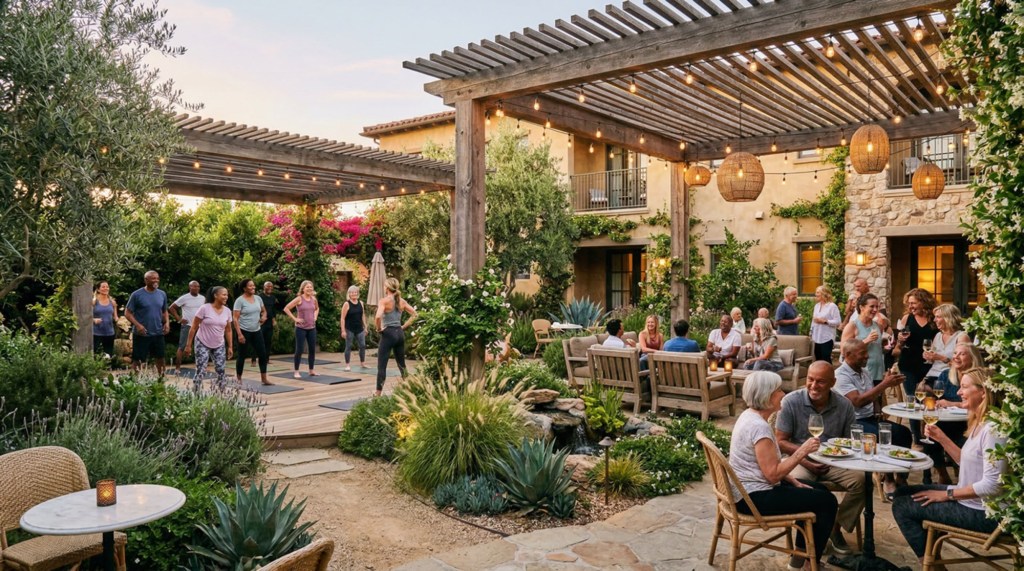
The longevity fund, with about $500,000 in baseline contributions from the Grossmont Healthcare District, Sahm Family Foundation and West Health, proposes building a “Longevity Club” in East County that it describes as “not your traditional senior center.” Artists’ renderings have restaurant-like finishes, picturing people engaging in exercise and activities designed around the idea of helping people avoid getting old as they age.
The fund would also work toward helping existing senior centers in San Diego County update their programming to better appeal to well-experienced residents.
For decades, “senior center” has been the traditional name for government-run locations that cater to people at or approaching retirement age.
But that’s not a name that gets much traction. The foundation’s own senior center assessment report, published in 2019, observed that the 28 centers studied across the region served “less than 8% of the total senior population.”
The word longevity, Downey said, aligns more directly with what people really want as they age: A chance at making every year count and maintaining quality of life as long as possible.
“The idea is to create a center that is focused around fitness, designed for older adults, classes that are of interest, whether it’s cooking, financial literacy or avoiding elder scams,” Downey said.
Tailoring activities and capabilities more precisely can increase participation, helping to decrease the amount of social isolation that people experience. Social activity and regular exercise are the biggest factors in maintaining health.
Dr. Ted Chan, chair of the Department of Emergency Medicine at UC San Diego Health and chair of the foundation’s board, is involved in the initiative and said that one in four of the health system’s emergency patients is already in the older demographic. And that ratio will only increase as the population ages.
UCSD Jacobs Medical Center in La Jolla was the first in the region, and among the first in the nation, to create a special emergency department unit specifically for its older patients.
As we age, Chan noted, the risk of falls, infections and cognitive impairment increases, but getting people engaged in the sorts of activities and resources that centers offer is good medicine.
“We’ve definitely seen, particularly our geriatric nurses who follow up regularly with their patients, we’ve seen success in reducing their returns to our emergency department,” Chan said.