
A century ago in 1926, it was front-page news in the Berkeley Daily Gazette when one of Berkeley’s wealthy prominent, residents, George Shima, died at age 61.
Shima, an immigrant from Japan to San Francisco in 1889, worked first as a household servant, then a farm laborer, then as an agent recruiting Japanese workers for Sacramento-San Joaquin River Delta farms. He was later able to acquire Delta land, drain it, and begin farming on his own, growing beans, then potatoes.
By the early 1910s he had potato fields on tens of thousands of acres of land, had become rich, and was popularly known as California’s “Potato King.” Shima bought a Berkeley home at 2601 College Ave. on the corner where the Mark Twain Condominiums stand today.
He owned a three-story mansion there, living “in regal fashion, emptying a retinue of servants and embellishing the rooms with elegant furniture; and also purchased the adjoining lot and converted it to a garden adorned with rare shrubs and flowers imported from Europe and Asia,” (according to a May 8, 1913, article in The Independent magazine).
Shima was the target of racist attacks in the newspapers when he moved to an East Berkeley neighborhood, but he persevered and remained in the home. Active in the greater Berkeley community and the state’s Japanese American community, he unsuccessfully fought California’s racist Alien Land Law in 1913.
When he died on March 27, 1926, of complications from a stroke, he was in Southern California, headed with his wife for Japan, where he had reportedly planned to stay for a long visit. His funeral was held in Berkeley. He left his wife and three children, one of them a student at Berkeley High and another a Stanford student.
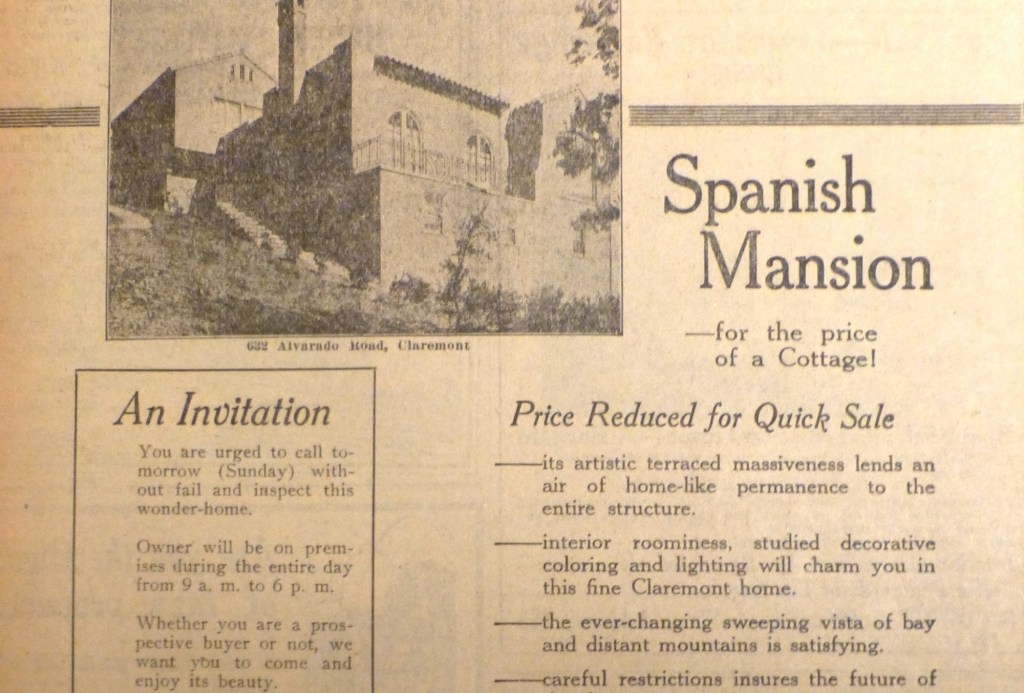
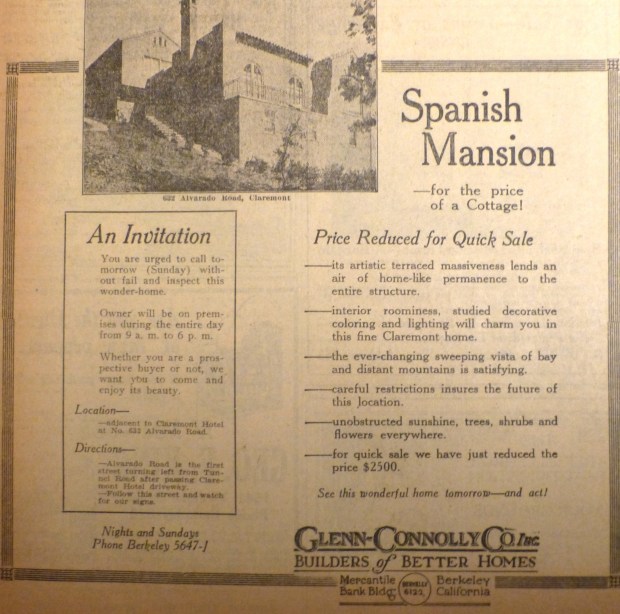 Among the city’s many alluring real estate offerings advertised in the Berkeley Daily Gazette a century ago was this stately Spanish Revival home above the Claremont Hotel on Alvarado Road that still stands today. (photo courtesy of the Berkeley History Society and Museum)

Real estate: A century ago, the Gazette was full of real estate ads featuring picturesque homes for sale, including a “Spanish Mansion” at 632 Alvarado Road. The real estate agency advertised It as available “for the price of a cottage!” after the asking price had been reduced by $2,500. The house appears to still stand, above the Claremont Hotel.
Last week I wrote about the pending sale in 1926 of the Martin Kellogg estate north of the UC Berkeley campus. That subdivision and sale marked an end to the large properties that once adjoined the campus site. I came across another Gazette article from March 20, 1926, that gave more details about the history of the property.
“In 1860, Henry Durant, the first president of the University of California, purchased 160 acres directly north of the campus,” according to the article. “In 1864, Martin Kellogg purchased from Durant a parcel of 22 acres which became the Kellogg estate.
“In 1869, after the (relocation) of the university to Berkeley, Kellogg built the home which still stands on one of the lots facing west on Spruce Street. Cedar Street, where it passes through the original Kellogg estate, was donated to public use by Martin Kellogg.”
Weather: Last week, we had a remarkable and record-breaking heat wave in the Bay Area, with Berkeley temperatures going above 80 degrees. A century ago on March 22, 1926, the Gazette noted something a bit similar.
“Spring blew in yesterday — it came over the hills coaxed along by a warm north wind that forced the thermometer up to 78 degrees and thoughts of glorious summertime … Blue sky without a cloud, a distinctively clear San Francisco Bay where a great ball all turned from gold to red and dropped beneath the horizon … all this came with the official arrival of spring. And the same weather was here again today.”
Bay Area native and Berkeley community historian Steven Finacom holds this column’s copyright.