

Here Lies Love at the Mark Taper Forum is a party, a night out, and a glittering journey through the seductions of Imelda Marcos, but what lingers after the beat drops is not just the shimmer of disco. It is the queasier question underneath it all. In this new Los Angeles staging, directed by Snehal Desai for Center Theatre Group, the audience is no longer plunged directly into Imelda’s dance floor the way Broadway audiences were. Here, the Los Angeles crowd is treated more like the studio audience of a Filipino noontime variety show, watching power sell itself through spectacle, applause, pageantry, and charm. That shift changes the mechanics of the experience, but not the central provocation.
Here Lies Love remains, at its core, a disco social commentary on the complicit nature of the masses when blinded by the fragmented reflections of Imelda Marcos’ disco ball of beauty, glitz, and glamour. The question it keeps tossing back at us is the one that matters most, then and now: Are you joining the party, or are you joining the revolution?
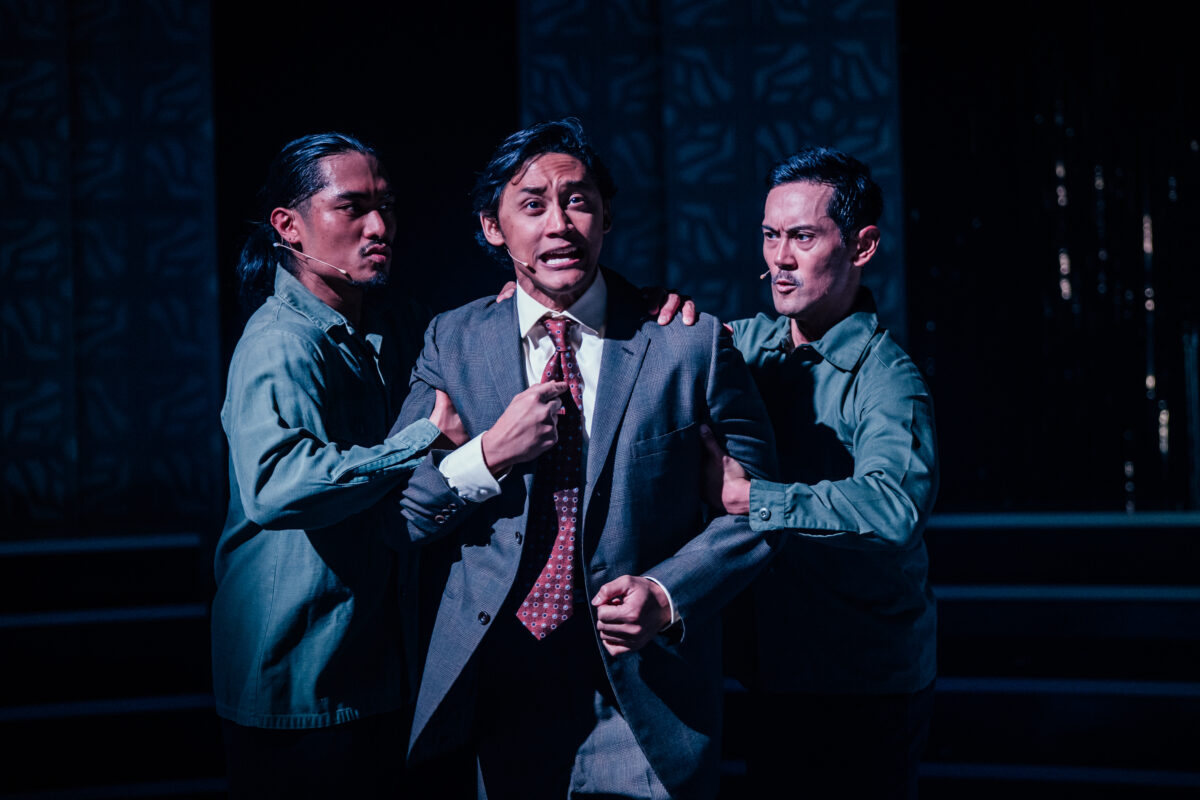 L—R: Jeff Lorenz Garrido, Joshua Dela Cruz, and Garrick Goce Macatangay in HERE LIES LOVE at the Mark Taper ForumCredit: Photo by Jeff Lorch
That question becomes even sharper in this Los Angeles staging because of one key addition: Imeldific, the new host figure played by RuPaul’s Drag Race alum Aura Mayari. She did not exist in past productions, and her presence gives the Taper version one of its smartest and most legible new ideas. In my interview with Mayari, she described Imeldific as someone who “starts out as someone who fantasizes about Imelda,” then moves “from celebratory to denial and then suddenly to awakening.” That arc matters. Imeldific is not just an emcee, not just comic relief, not just camp sparkle. She becomes the conscience arc of the play, the audience’s seduced-then-shaken surrogate. Through her, the show finds a more human pathway into its political teeth.
That makes Mayari a particularly inspired choice. As a drag performer, she already understands how image, illusion, myth, seduction, and public speech can all exist in the same body at once. Her performance helps the production talk about beauty as a political tool. “She really represents the glitz and glamor that the Marcoses had presented themselves as back then to sell themselves to the people,” Mayari told me, and that may be the cleanest way to describe what this production is after. The show wants to dazzle you first. Then it wants you to notice what, and who, the dazzle is distracting you from.
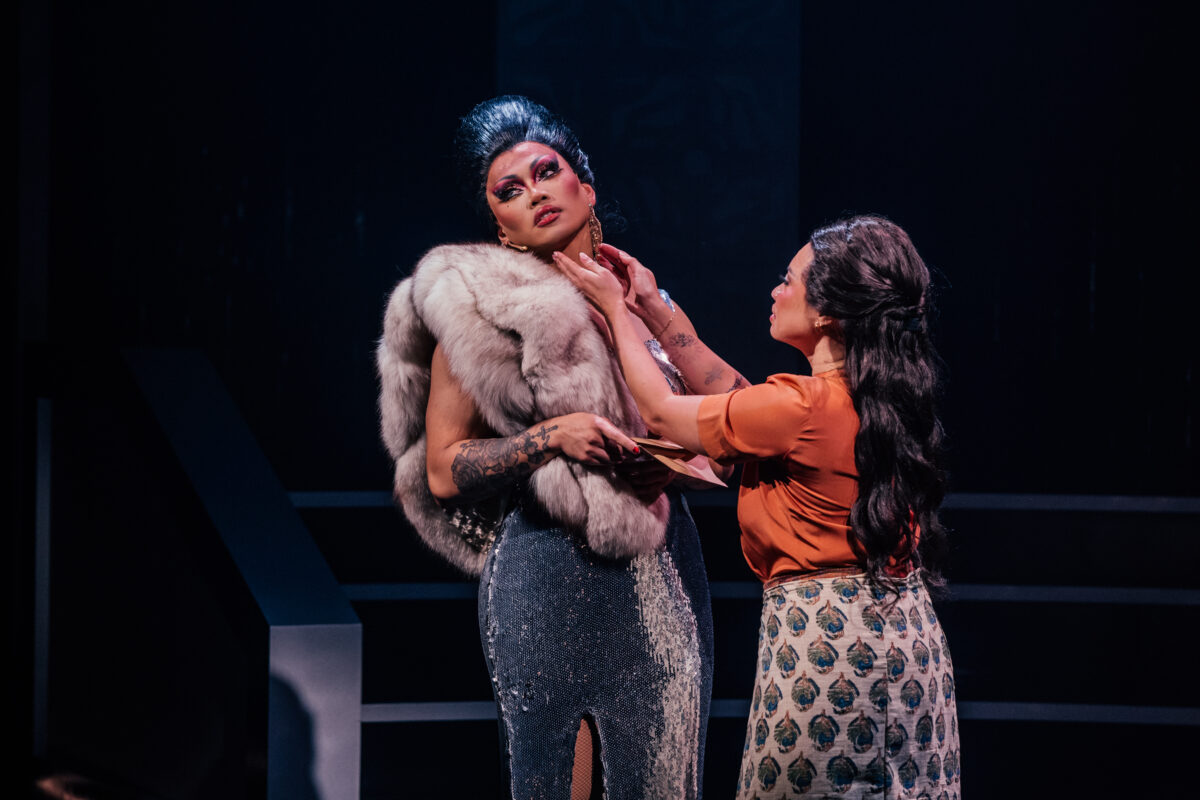 Aura Mayari and Carol Angeli in HERE LIES LOVE at the Mark Taper Forum.Credit: Photo by Jeff Lorch
That tension is where Here Lies Love is most interesting. It knows the danger of turning dictatorship into entertainment, and instead of denying that danger, it stages it. Mayari put it bluntly when she said, “When we focus on the topic of complacency, I think that is what our show is really telling people.” She is right. The production’s real subject is not simply Imelda Marcos. It is the ease with which public adoration can become passive consent. It is the way an image can anesthetize outrage. It is how people can convince themselves that being present is the same as being aware. In one of the interview’s sharpest lines, Mayari describes the audience cheering for Imelda and then stopping to ask, “Wait, why? Why am I cheering? And why am I clapping for her right now?” That question is the trapdoor under the whole musical.
The production is undeniably good at building that trap. The cast performs on top of its game. The vocals are strong, the acting committed, and the drama is delivered with conviction. Reanne Acasio’s Imelda knows how to weaponize charm. Joshua Dela Cruz brings grace and ache to Ninoy Aquino. Chris Renfro gives Ferdinand Marcos a polished chill. Visually, the show is creative, ambitious, and alive. It incorporates technology with real intelligence, and the presentation makes strong use of projections, lighting, and audience participation. One of the evening’s most effective images comes when thin beams of light become prison bars around Ninoy Aquino, a simple but striking theatrical gesture that cuts through the glitter with force. Even when the songs are not all outright bangers, the production itself keeps moving with energy and invention.
Scroll to continue reading
And yet, for all its style, skill, and imagination, Here Lies Love still lacks a final punch. That is the challenge. There is only so much a stage musical can do to accurately represent a large, broken, fragmented piece of another country’s traumatic history. The LCD text and contextual clues help, but only to an extent. If you are not paying enough attention to everything happening around you, you can miss a lot. You can miss context clues, you can miss historical weight, and you can miss the larger architecture of what the show is actually trying to say. As someone with prior knowledge of Philippine history, someone who learned it in school and then learned more through people who actually lived through it, I could feel both the message and the gaps. I understood the warning because I arrived with it already inside me. I am less certain the same will be true for every audience member walking in blind.
That does not make the production ineffective. It just makes it incomplete in a very specific way. I was entertained, definitely. I admired the cast, the presentation, the innovation, the art direction, the fashion (barongs and ternos from Noble Creation) the stage design, and the use of technology. Everyone delivered.
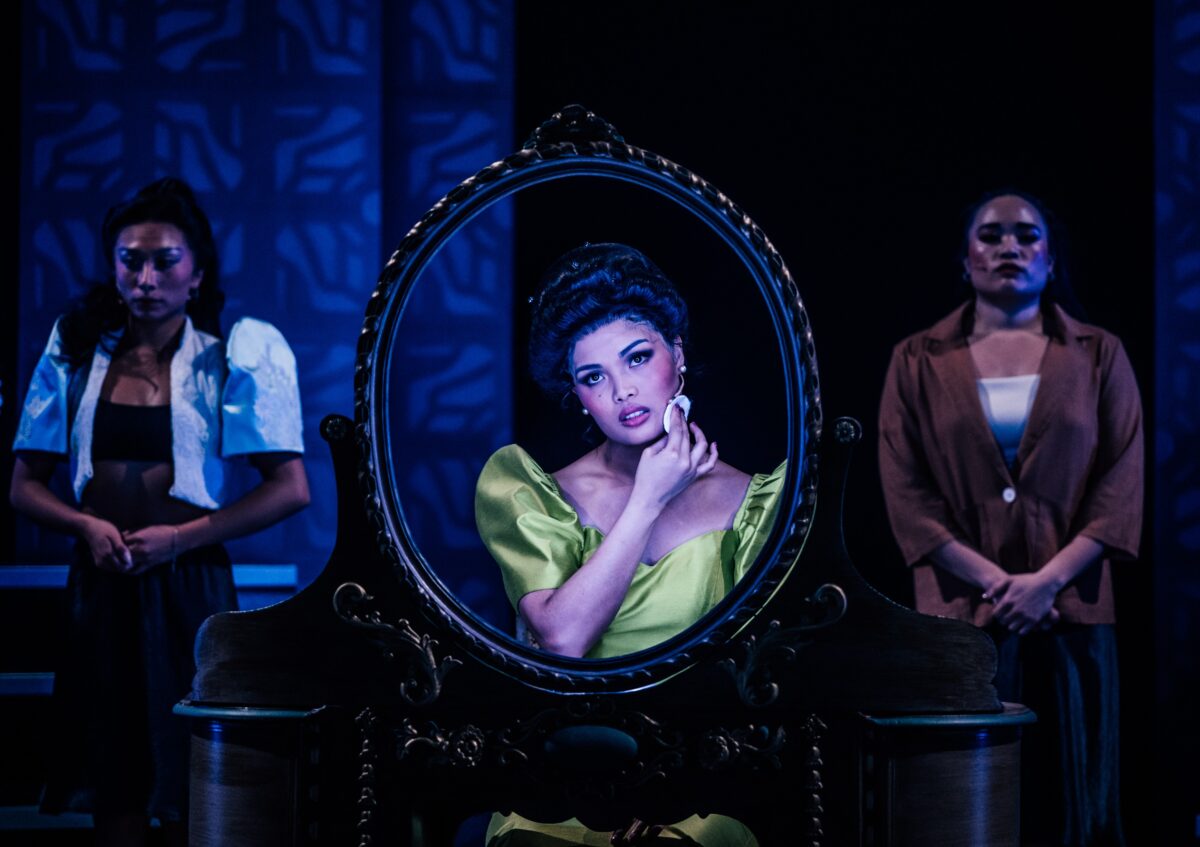 Kayla Amistad, Reanne Acasio, and Danielle Louise Mendoza in HERE LIES LOVE at the Mark Taper Forum. Credit: Photo by Jeff Lorch
I also admired how Imeldific gives this version a more legible emotional spine. But the Taper production threads a fine line between hard facts and fictional license, and sometimes the history feels more like it is being evoked than fully confronted. Somehow, the show humanizes Imelda without fully absolving her, and that balancing act is both one of its strengths and one of its slipperiest risks.
That tension becomes even more complicated when you remember where Here Lies Love began. It started as a concept album by David Byrne and Fatboy Slim, a project by white creators who turned the story of Imelda Marcos into a pop work fueled by rhythm, irony, and allure. That complicated origin never fully disappears, even in a production as thoughtful and Filipino-centered as this one. Representation matters. Filipino visibility matters. Seeing an all-Filipino cast command this material on a major Los Angeles stage matters deeply. But authorship matters too, especially when Filipino trauma is being staged inside a pop form that can soften, stylize, or aestheticize brutality. The production is at its most compelling when it does not try to solve that contradiction, only expose it.
That is also why the show feels so timely. It is not just about the Marcos’ past. It is about the recurring patterns that keep resurfacing across nations and eras: propaganda, revisionism, beauty as a smokescreen, public silence, and democratic erosion dressed up as spectacle.
Mayari recalled one of the show’s eeriest sequences, in which atrocities are discussed while the stage remains alive with distraction and performance, and she said, simply, “They did try to mask it with beauty.” That line lands with force because it is not only about the past. It is about now. It is about every moment in which style, celebrity, and pageantry are used to draw the eye away from violence, corruption, and loss.
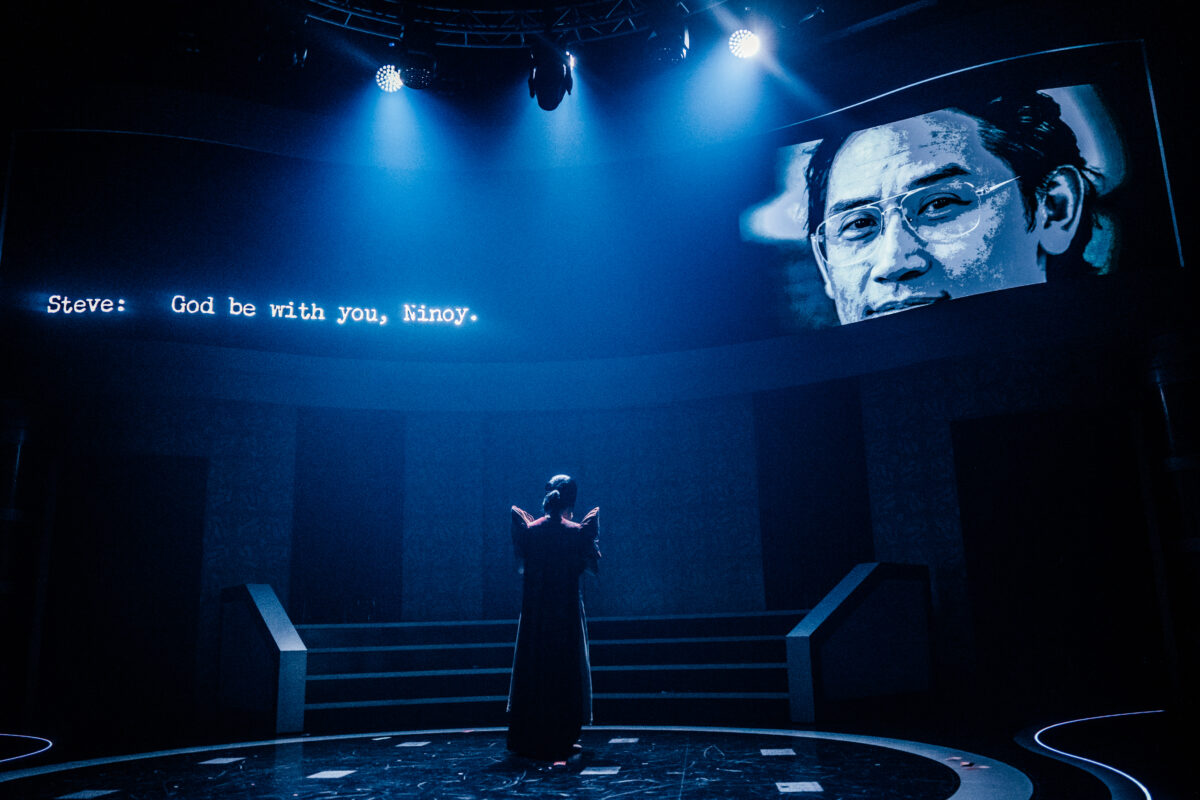 Aura Mayari in HERE LIES LOVE at the Mark Taper Forum.Credit: Photo by Jeff Lorch
Mayari also adds another layer of resonance to the production when she discusses the responsibility of telling this story as a Filipino artist. “We are telling real stories, and the history that the administration from the past tried to erase,” she said. That perspective matters, especially in Los Angeles, where Filipino and Filipino American audiences may be watching not just a historical musical, but an act of recovery. In that sense, Here Lies Love is not only staging Philippine history. It is also staging what it means for Filipino Americans to reclaim stories they were not always fully given.
So yes, I liked it. I would recommend it. I admired its ambition, its intelligence, and its craft. I just wanted it to hit harder in the gut than it ultimately does. Even so, Here Lies Love at the Taper is worth seeing, especially for the questions it leaves ringing after the final number. The biggest one is also the simplest. Which side are you on: the party, or the revolution?