
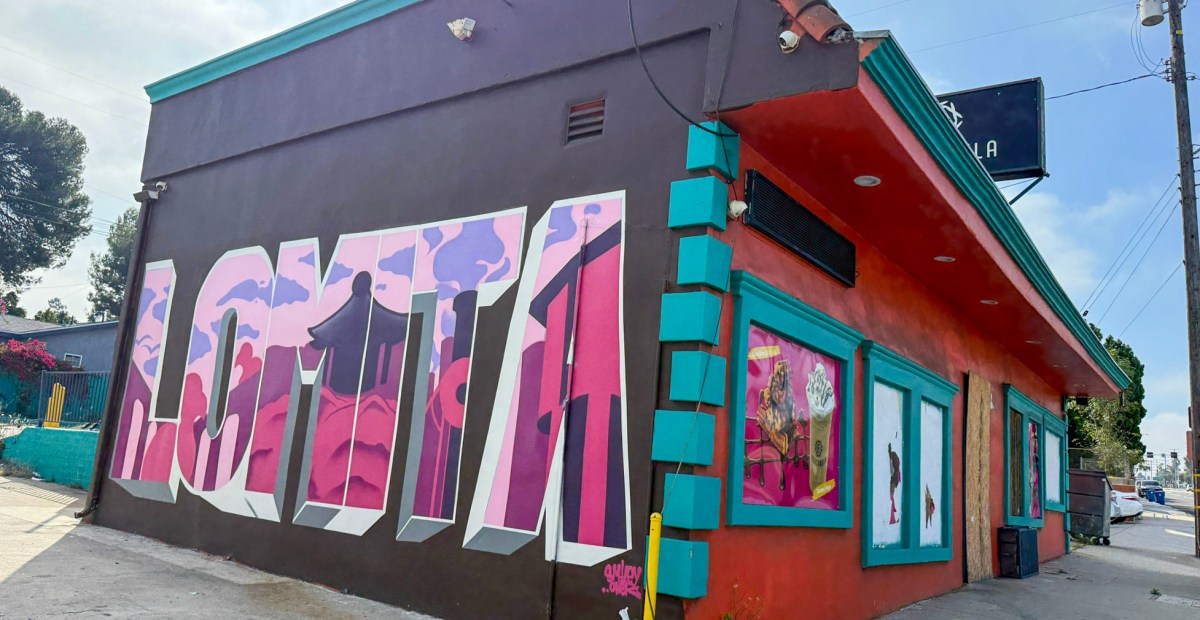
Located on a quieter stretch of Western Avenue at the site of a former churro shop, Lomi Lomi spans just over 1,000 square feet and will be open for lunch and dinner when it debuts. “I’m excited to be in the South Bay and in an area less scene-y than Los Angeles,” says Naran. (The restaurant’s name is a nod to the city in which it resides and not the Hawaiian salmon dish by the same name.)
Taking a page from his Gujarati upbringing (“Real estate’s in our bones; we were taught ever since we were young about loans, refinancing, and shit like that,” Naran says) and fast-food legend Ray Kroc’s playbook (“I love The Founder, it’s one of my favorite films,” he adds), Naran purchased Lomi Lomi’s building at 26344 Western Avenue along with his sister and brother-in-law. “LA is so hard to operate in unless you have some control over labor, the space itself, or have an infrastructure that’s Mike Glick big,” he says. “I think you need to own land to really do well in the restaurant space.”
Lomi Lomi will seat approximately 60 diners across its main room and an outdoor patio. Preen Inc.’s Alexis Readinger will lead the restaurant’s design, drawing inspiration from “the haze of India,” says Naran. (“I think that’s her euphemism for pollution, so it’s gonna be amber inside,” he jokes.) Early design treatments depict minimalist warm wood furnishings and an L-shaped terrazzo bar bathed in a golden glow.
Before landing on the idea for Lomi Lomi, Naran planned to open an Indian seafood restaurant modeled after Trishna in Mumbai called Little Spear. But the space’s size ultimately called for something more casual, like a temaki bar; he points to New York’s Nami Nori as inspiration. “I’ve been obsessed with temaki for a year,” says Naran. “I don’t know how to make it or anything. I’ll figure it out. We’ll find somebody.”
Lomi Lomi’s menu will include over a dozen hand rolls that take South Asian flavor influences (think masala-cured salmon and peppery crab Chettinad), a selection of snackable plates (like fried pakoras), and a few desserts (“I might throw a churro on the menu because this was a churro space before,” he says). The cocktail menu will exclusively focus on sochu highballs, a favorite style of Naran’s and a practical call for Lomi Lomi’s beer-and-wine-only licence. Lunch is estimated to run around $30 per person, while dinner rings in at $50 per person.
While some diners and food journalists may be quick to label Lomi Lomi as an Indian Japanese fusion restaurant, Naran doesn’t see the need to place the restaurant so neatly in a box. Though he acknowledges that some chefs, like his culinary inspiration Eddie Huang, “want to tell an ethnic story,” Naran’s approach isn’t rooted in a desire to share a specific cultural heritage.
“I’m not saying it’s Indian straight out, I’m just doing what I want. I don’t like the conversations surrounding ethnicity. Why is food boiled down to your ethnic makeup?” says Naran. “Just shut up and eat food.”