
Alameda’s status as home to a nonprofit institute devoted to maintaining a Costa Rican cloud forest just may be the Island’s best kept secret.
Cloud forests are very moist and unlike their lower-altitude cousins, rain forests, are generally found from 3,000 to 8,000 feet above sea level (britannica.com/science/cloud-forest-ecology). Making up just 1% of tropical forests worldwide, the condensation in cloud forests is great for growing all kinds of plants that don’t grow anywhere else.
Alameda’s David and Evelyne Lennette are the very devoted stewards of one such cloud forest in Costa Rica that is home to an organization they’re involved with, the Nectandra Institute. The institute consists of two gardens, the Nectandra and Persea, as well as an outreach program to help their Costa Rican neighbors secure water sources.
Located near the country’s town of San Ramon in its north-central province of Alajuela, both gardens are about 50 miles northwest of Costa Rica’s capital and largest city, San Jose. The larger Nectandra garden consists of 321 acres of cloud forest complete with orchids, ferns and other plants. The Persea garden is just less than 20 acres and sits on a former ornamental plantation. It’s trees and plants provide shade and wind protection for hardwoods.
The cloud forest is also home to lots of insects — so many, in fact, that cataloging them all is a major undertaking. Just ask a team of Texas A&M entomologists who spent several days collecting wasps, flies and other insects at Nectandra. The group expected to find hundreds of species but instead found thousands.
“If you go out and collect a couple of thousand bugs and you go back home and you look them up and 1,800 of them are things you can identify and 200 are not, well, you can imagine it’ll give some people some work in the future. But what happens if you collect 5,000 of them and 4,000 are new species nobody’s ever seen before?” asks David Lennette. “That’s what happened.”
The Lennettes decided to take on the responsibility of preserving a cloud forest because they “are rare and their area has been decreasing for decades, mostly due to cutting for conversion to other uses like cattle ranching,” says Lennette.
Another reason is that cloud forests are not just biodiverse but rather are hyper-diverse, hosting many more species than all other categories of forest, Lennette says. Also, if protected against human encroachment, cloud forests are resilient and can regrow rapidly.
“We have seen substantial changes and growth during the last 25 years of our work in Costa Rica,” he says.
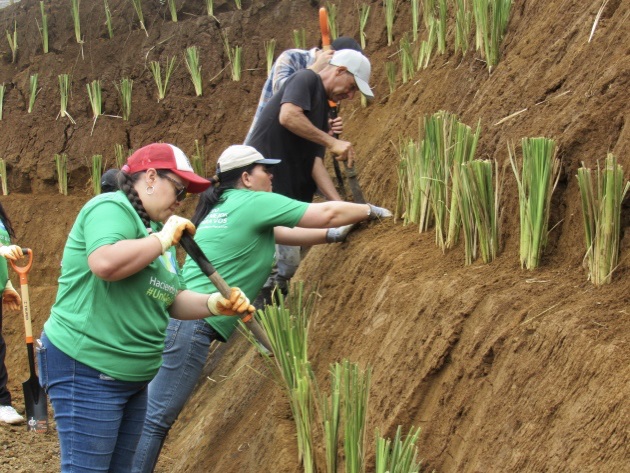
In addition to operating the gardens, the Nectandra Institute also loans funds at no interest to local communities through its Eco Loan Fund so they can buy land with water resources and create water storage facilities. The loans are paid off in the work or “sweat equity” of the recipients needed to convert the sites.
Lennette says he spends about a third of the year at the preserve while his wife puts in two-thirds of her time there annually. The couple, who met as UC Berkeley undergrads in 1966 and then both went on to obtain doctorates in molecular biology from Washington University in St. Louis, Missouri, in the mid-1970s opened Virolab, a Berkeley virus diagnostic lab.
Always interested in horticulture, especially growing irises, the pair bought a vacant lot off North Berkeley’s 10th Street to pursue their hobby as part of a flower club known as the Sydney B. Mitchell Iris Society. Before a Nature Conservancy trip to Costa Rica in the late 1990s they became aware of the country’s efforts to protect 25% of its land by two biologists, Alvaro Ugalde and Mario Boza.
As fate would have it, their tour guide, Arturo Jarquin, knew Ugalde and arranged for the Lennettes to meet him. Shortly thereafter the idea for the Nectandra Institute germinated (Nectandra is a local tree species bearing fruits that are the size of olives and related to the avocado).
The Lennettes sold their iris patch and with the $300,000 in proceeds purchased land for the Nectandra Institute. Ugalde, who passed away in 2015 and is considered the father of Costa Rica’s national park system, started Nectandra in 2000 along with the Lennettes and Jarquin, their former tour guide.
In the end, the idea of Nectandra stems from the Lennettes wanting to do something more hands-on than just sending “a check to an organization,” he says.
“We had the interest and the opportunity to do things our way. With our biology background, we felt it was up to us to make it work.”
For more information on the Nectandra Institute, visit Nectandra.org.
Paul Kilduff is a San Francisco-based writer who also draws cartoons. He can be reached at pkilduff350@gmail.com.