
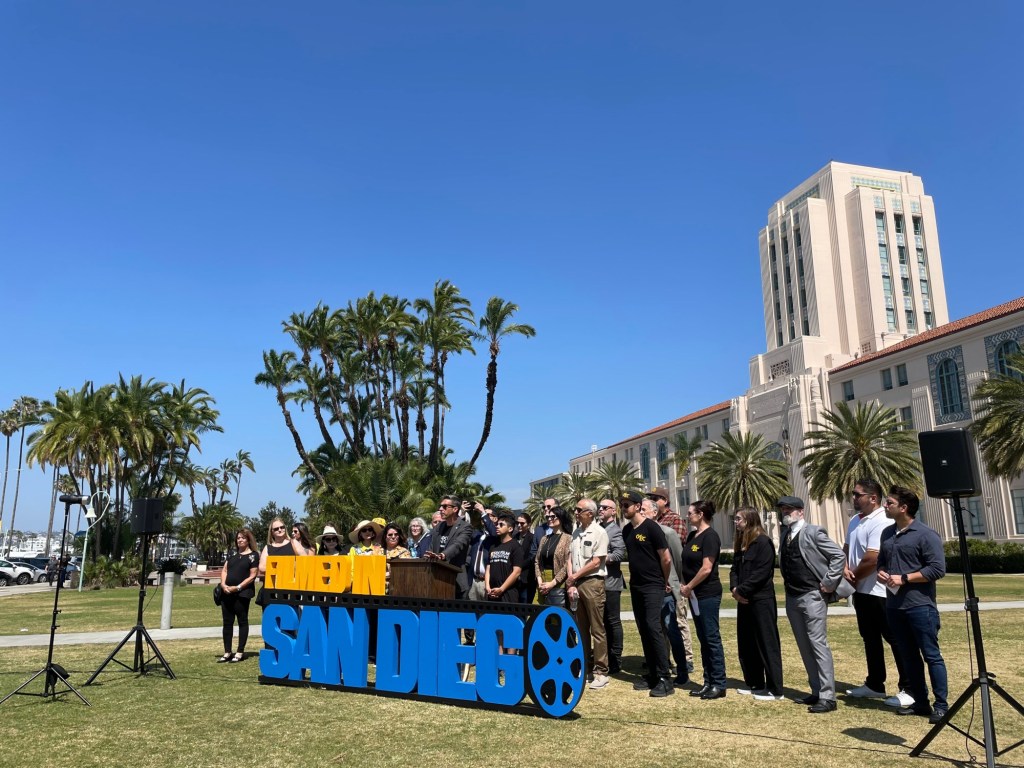
On a sunny Tuesday afternoon outside the San Diego County Administration Building, a coalition of union workers, producers and filmmakers made their case for what they say is a long-overdue investment in the region’s film and television industry.
The group held a press conference on the building’s front lawn before heading inside to comment during a Board of Supervisors budget hearing for the upcoming fiscal year. They are calling for three things: a county film commission, a film office and a competitive tax incentive program.
“San Diego is ready,” said Greg Sowizdrzal, president of IATSE Local 122 and vice president of the San Diego Film Commission Foundation. “What has been missing is not talent. What has been missing is not proof. What has been missing is the structure to turn that capacity into a real, lasting, competitive advantage.”
Speakers pointed to a recent production that filmed six weeks in the region, generating nearly $6.8 million in local economic impact and employing 250 cast and crew members, as evidence that San Diego can support large-scale production. They argued the region lacks the public infrastructure to replicate that success consistently.
“Talent alone does not build an industry,” Sowizdrzal said. “Infrastructure does.”
Lou Slocum, a national board member representing SAG-AFTRA’s San Diego local, noted that California recently expanded its state film tax credit program from $300 million to $750 million. He said the coalition wants San Diego to secure a share of those funds, and that a local rebate of up to 35% for productions using local crews, actors and veterans could further strengthen the region’s position.
“There are many signs pointing toward better days ahead,” he said. “But the best way to do it here in San Diego is to make sure that my brothers and sisters … can make a fair living wage doing what we love.”
A tax credit is a dollar-for-dollar reduction in income tax owed, directly decreasing tax liability rather than simply reducing taxable income. Under the updated state program, the base credit increased from 20% to 35%, with additional uplifts for filming outside the Los Angeles zone, meaning San Diego County productions can qualify for 40% to 45% in total credits.
Sarah Sweeney, deputy director of the county’s Communications Office, said in an email the county’s Office of Economic Development and Government Affairs currently works with external partners and internal departments to facilitate permitting and site selection for films, TV shows, commercials and print media. Should the Board of Supervisors provide direction to move forward with a tax credit program or a film commission, Sweeney said the county will take the appropriate steps to carry out that direction.
“The San Diego region continues to show tremendous promise as a destination for film — reflected most recently in the success of this year’s Oscar winner “One Battle After Another,” which filmed here,” Sweeney said.
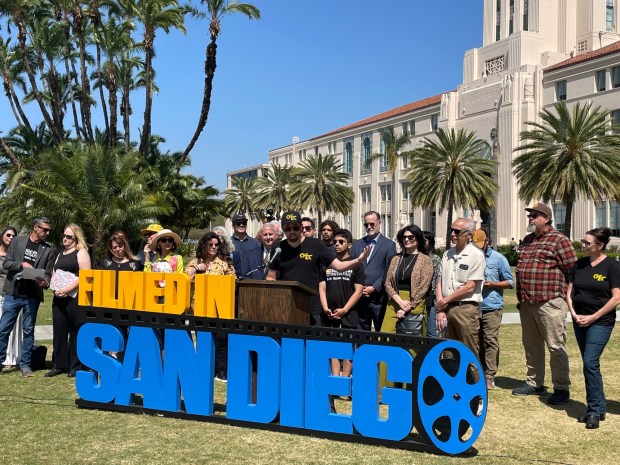 Arron Roberts, founder and CEO of the Chula Vista Entertainment Company, addresses the media Tuesday outside the San Diego County Administration Building during a press conference calling for expanded film production infrastructure in San Diego County. (Walker Armstrong / The San Diego Union-Tribune)
Supervisor Paloma Aguirre said she supported the effort.
“South County deserves good-paying jobs and real opportunity, and a Film Commission is how we deliver both,” she said. “It means jobs for local workers, support for small businesses, and new investment in our communities. Our team is currently in the planning phase, working directly with community partners and County staff to bring a proposal before the Board soon.”
Aaron Roberts, founder and CEO of the Chula Vista Entertainment Company — which is developing the Chula Vista Entertainment Complex in the top two floors of the Millenia Library building in the city’s Otay Ranch area — said the region’s film economy generated more than $100 million annually in economic impact in 2005, when stronger studio and government infrastructure was in place.
“San Diego has always had the raw ingredients to be a major player in film and television,” Roberts said. “Now is the time for San Diego to establish itself as our region’s next creative hub.”