
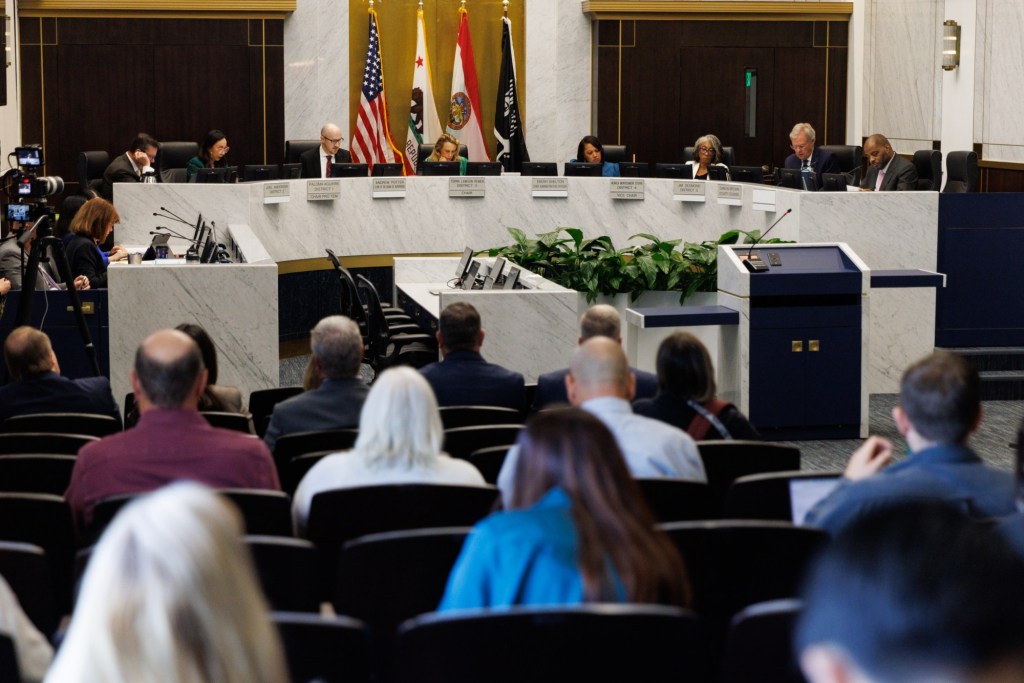
San Diego County supervisors approved an overhaul of jail medical services on Tuesday, but they balked at providing millions of dollars to cover cost overruns by healthcare contractor NaphCare.
In a split vote, the board approved a plan by Sheriff Kelly Martinez to shift key medical billing and administrative functions to a new provider, AmeriChoice, but declined to approve $13.8 million to cover medical costs that have exceeded the cap in NaphCare’s contract.
Supervisors made clear they wanted more accountability before approving the additional money.
“I don’t believe that we should normalize a pattern where we continually have to backfill shortfalls,” Supervisor Paloma Aguirre said.
The proposal marks the latest development in the county’s troubled relationship with NaphCare, the Alabama-based correctional health care company hired by the Sheriff’s Office in 2022 to consolidate more than 20 jail medical contracts into one provider.
At the time, officials said the deal would streamline services and reduce costs while improving care for people in custody. Instead, off-site medical costs — particularly from hospital visits — have surged.
Sheriff’s officials now estimate the county will spend roughly $26.9 million this year on off-site care alone, far exceeding a $20.6 million annual cap. Under a 2024 contract amendment, NaphCare agreed to take on greater liability risk in exchange for the Sheriff’s Office covering any costs above the cap.
Officials said Tuesday that the department is already facing about $17.6 million in excess costs from the past two years.
The sheriff’s plan aims to rein in those costs by shifting administrative services, like hospital billing and cost management, to AmeriChoice, a subsidiary of UnitedHealthcare that already works with other county departments.
Officials say the company is better positioned to negotiate lower rates with hospitals and to secure reimbursements through CalAIM, a state Medi-Cal initiative that allows counties to recoup some medical costs for incarcerated people in the 90 days before their release.
“NaphCare has been unable to perform billing functions that are imperative for the Sheriff’s Office to comply with the state-mandated CalAIM program,” sheriff’s spokesperson Lt. David Collins said earlier this month.
But the proposal — which includes a no-bid contract with AmeriChoice of up to $25 million annually — raised concerns among Supervisors Monica Montgomery Steppe, Terra Lawson-Remer and Paloma Aguirre, who questioned whether the new contract would save money and said they hadn’t seen enough detail.
Montgomery Steppe said she could not support the proposal without better data.
“I don’t have enough in front of me to get there for this ask — that I think is a really big ask, a really big switch, about a year out from when the (NaphCare) contract would actually end,” she said.
Aguirre proposed allowing the sheriff to move forward with the AmeriChoice contract while withholding the $13.8 million and adding new oversight requirements, including regular cost reporting and tracking CalAIM reimbursements.
In a statement issued after the vote, she said the money would have come from an account earmarked for reentry services and crime prevention programs.
“While I recognize the complex challenges facing the sheriff’s medical services, I cannot support the use of restricted community funds to paper over a departmental shortfall,” she said.
The board ultimately approved the contract changes — with Montgomery Steppe voting no — along with new oversight requirements.
The board’s three Democrats — Montgomery Steppe, Aguirre and Lawson-Remer — rejected the funding request in a separate vote. Both Aguirre and Lawson-Remer said they were open to revisiting the funding if a different source was identified.
The debate comes amid longstanding issues with NaphCare.
Roughly a year into its contract, county officials accused the company of failing to meet its contract obligations, including leaving shifts unfilled, relying on unlicensed staff and failing to pay outside hospitals and providers.
“As of April 17, 2023, there are $9.3 million of unpaid bills due to hospitals,” a county compliance report found. “Due to a lack of payment, some community providers do not want to see or accept our patients.”
Last year, the county took the unusual step of suing NaphCare over its alleged role in the death of 24-year-old Brandon Yates, who was killed by his cellmate after mental health staff failed to intervene. Yates’ family had already sued the county over his death.
Sheriff’s officials have said the switch to AmeriChoice is driven by administrative and financial challenges, not concerns about quality of care.
“We don’t like having to come before the board for cost overruns, but we also want to take care of the people in our custody and make sure they’re getting the best treatment,” Martinez said.
Officials said the costs tied to the NaphCare contract will keep adding up — about $2.5 million per month — as the county transitions to the new AmeriChoice contract.
Lawson-Remer said she supported the shift to AmeriChoice, but the county’s experience with NaphCare underscored the need for stronger safeguards.
“We got so burned last time,” she said. “NaphCare made a good deal in that trade.”